मराठी

A Toy is in the Form of a Cone Surmounted on a Hemisphere. the Diameter of the Base and the Height of Cone Are 6cm and 4cm. Determine Surface Area of Toy? - Mathematics

Advertisements
Advertisements

प्रश्न

A toy is in the form of a cone surmounted on a hemisphere. The diameter of the base and the height of cone are 6cm and 4cm. determine surface area of toy?

थोडक्यात उत्तर
Advertisements

उत्तर

Given height of cone (h) = 4cm

Diameter of cone (d) = 6cm

∴Radius (r) =`6/2 =3 cm`
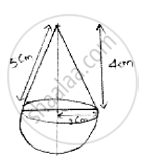
Let ‘l’ be slant height of cone

`l=sqrt(r^2+h^2)`

`=sqrt(3^2+4^2) =5cm`

l = 5cm

∴ Slant height of cone (l) = 5cm.

Curved surface area of cone (S1) = πrl

S1 = π(3)(5) = 47.1cm2

Curved surface area of hemisphere (S2) = 2πr2

`S_2=2pi(3)^2=56.52cm^2`

∴Total surface area(S) = S1 + S2

= 47.1 + 56.52

= 103.62cm2

∴ Curved surface area of toy = 103.62cm2

shaalaa.com
  या प्रश्नात किंवा उत्तरात काही त्रुटी आहे का?
पाठ 14: Surface Areas and Volumes - Exercise 14.2 [पृष्ठ ६०]

APPEARS IN

आरडी शर्मा Mathematics [English] Class 10
पाठ 14 Surface Areas and Volumes
Exercise 14.2 | Q 4 | पृष्ठ ६०
आरडी शर्मा Mathematics [English] Class 10
पाठ 14 Surface Areas and Volumes
Exercise 14.3 | Q 54 | पृष्ठ ८४

व्हिडिओ ट्यूटोरियलVIEW ALL [3]

संबंधित प्रश्‍न

Due to sudden floods, some welfare associations jointly requested the government to get 100 tents fixed immediately and offered to contribute 50% of the cost. If the lower part of each tent is of the form of a cylinder of diameter 4.2 m and height 4 m with the conical upper part of same diameter but of height 2.8 m, and the canvas to be used costs Rs. 100 per sq. m, find the amount, the associations will have to pay. What values are shown by these associations? [Use π=22/7]


504 cones, each of diameter 3.5 cm and height 3 cm, are melted and recast into a metallic sphere. Find the diameter of the sphere and hence find its surface area.
[Use π=22/7]


The number of solid spheres, each of diameter 6 cm that can be made by melting a solid metal cylinder of height 45 cm and diameter 4 cm, is:


In Fig. 4, from the top of a solid cone of height 12 cm and base radius 6 cm, a cone of height 4 cm is removed by a plane parallel to the base. Find the total surface area of the remaining solid. (Use `pi=22/7` and `sqrt5=2.236`)


A cubical block of side 7 cm is surmounted by a hemisphere. What is the greatest diameter the hemisphere can have? Find the surface area of the solid. [Use `pi = 22/7`]


From a solid cylinder whose height is 2.4 cm and diameter 1.4 cm, a conical cavity of the same height and same diameter is hollowed out. Find the total surface area of the remaining solid to the nearest cm

[use `pi = 22/7`]


Find the area of the shaded region in Fig. 3, where arcs drawn with centres A, B, C and D intersect in pairs at mid-points P, Q, R and S of the sides AB, BC, CD and DA respectively of a square ABCD of side 12 cm. [Use π = 3.14]


If the radii of circular ends of a bucket 24cm high are 5cm and 15cm. find surface area of
bucket?


The radii of the circular bases of a frustum of a right circular cone are 12 cm and 3 cm and the height is 12 cm. Find the total surface area and the volume of the frustum.


A milk container is made of metal sheet in the shape of frustum of a cone whose volume is 10459 `3/7` cm3. The radii of its lower and upper circular ends are 8cm and 20cm. find the cost of metal sheet used in making container at rate of  Rs 1.4  per cm2?


A metallic cylinder has radius 3 cm and height 5 cm. To reduce its weight, a conical hole is drilled in the cylinder. The conical hole has a radius of `3/2` cm and its depth is `8/9 `cm. Calculate the ratio of the volume of metal left in the cylinder to the volume of metal taken out in conical shape.


Two solid cones and B are placed in a cylindrical tube as shown in fig .16.76. The ratio of their capacities are 2: 1 . Find the heights and capacities of the cones . Also, find the volume of the remaining portion of the cylinder.


A circus tent is cylindrical to a height of 4 m and conical above it. If its diameter is 105 m and its slant height is 40 m, the total area of the canvas required in m2 is


The volume of a hemisphere is 2425 `1/2` cm. Find its curved surface area.


From a solid cylinder of height 2.8 cm and diameter 4.2 cm, a conical cavity of the same height and same diameter is hollowed out. Find the total surface area of the remaining solid.


The volume of a hemisphere is 19404 cm3. The total surface area of the hemisphere is


If the surface areas of two spheres are in ratio 16 : 9, then their volumes will be in the ratio ______.


If two solid hemispheres of same base radius r are joined together along their bases, then curved surface area of this new solid is ______.


Khurja is a city in the Indian state of Uttar Pradesh famous for the pottery. Khurja pottery is traditional Indian pottery work which has attracted Indians as well as foreigners with a variety of tea sets, crockery and ceramic tile works. A huge portion of the ceramics used in the country is supplied by Khurja and is also referred as "The Ceramic Town".

One of the private schools of Bulandshahr organised an Educational Tour for class 10 students to Khurja. Students were very excited about the trip. Following are the few pottery objects of Khurja.

Students found the shapes of the objects very interesting and they could easily relate them with mathematical shapes viz sphere, hemisphere, cylinder etc.

Maths teacher who was accompanying the students asked the following questions:

  1. The internal radius of hemispherical bowl (filled completely with water) in I is 9 cm and the radius and height of the cylindrical jar in II are 1.5 cm and 4 cm respectively. If the hemispherical bowl is to be emptied in cylindrical jars, then how many cylindrical jars are required?
  2. If in the cylindrical jar full of water, a conical funnel of the same height and same diameter is immersed, then how much water will flow out of the jar?

Tamper-proof tetra-packed milk guarantees both freshness and security. This milk ensures uncompromised quality, preserving the nutritional values within and making it a reliable choice for health-conscious individuals.

500 ml milk is packed in a cuboidal container of dimensions 15 cm × 8 cm × 5 cm. These milk packets are then packed in cuboidal cartons of dimensions 30 cm × 32 cm × 15 cm.

Based on the above-given information, answer the following questions:

i. Find the volume of the cuboidal carton. (1)

ii. a. Find the total surface area of the milk packet. (2)

OR

b. How many milk packets can be filled in a carton? (2)

iii. How much milk can the cup (as shown in the figure) hold? (1)


Share
Notifications

Englishहिंदीमराठी


      Forgot password?
Use app×