Advertisements
Advertisements
प्रश्न
A particle of mass 100 g moving at an initial speed u collides with another particle of same mass kept initially at rest. If the total kinetic energy becomes 0.2 J after the collision, what could be the minimum and the maximum value of u.
Advertisements
उत्तर
It is given that:
Mass of particles = 100 g
Initial speed of the first particle = u
Final K.E. of the system after collision = 0.2J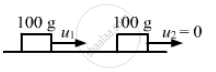
Initial K.E. of the system, before collision = \[\frac{1}{2}m u^2 + 0 \]
i.e. Initial K.E. = \[\frac{1}{2} \times 0 . 1 \times u^2 = 0 . 05 u^2\]
Let v1 and v2 be the final velocities of the first and second block respectively.
Let v1 and v2 be the final velocities of the first and second block respectively.
By law of conservation of momentum, we know:
\[m v_1 + m v_2 = mu\]
\[\Rightarrow v_1 + v_2 = u . . . (1)\]
\[( v_1 - v_2 ) + e( u_1 - u_2 ) = 0\]
\[ \Rightarrow eu = v_2 - v_1 . . . (2) [\text{ Putting } u_2 = 0, u_1 = u]\]
\[\text{ Adding the equations (1) and (2), we get:}\]
\[ 2 v_2 = (1 + e)u\]
\[ \Rightarrow v_2 = \left( \frac{u}{2} \right)(1 + e)\]
\[ \therefore v_1 = u - \frac{u}{2}(1 + e)\]
\[ v_1 = \frac{u}{2}(1 - e)\]
\[\text{ According to given condition, }\]
\[\frac{1}{2}m v_1^2 + \frac{1}{2}m v_2^2 = 0 . 2\]
\[ \Rightarrow v_1^2 + v_2^2 = 4\]
\[ \Rightarrow \frac{u^2}{2}\left( 1 + e^2 \right) = 4\]
\[ \Rightarrow u^2 = \frac{8}{1 + e^2}\]
For maximum value of u, denominator should be minimum in the above equation.
i.e. e = 0
⇒ u2 = 8
\[\Rightarrow u = 2\sqrt{2} \text{ m/s}\]
For minimum value of u, denominator should have maximum value.
i.e. e = 1
⇒ u2 = 4
⇒ u = 2 m/s .
