Advertisements
Advertisements
प्रश्न
A large He balloon of volume 1425 m3 is used to lift a payload of 400 kg. Assume that the balloon maintains constant radius as it rises. How high does it rise? [Take y0= 8000 m and `rho_"He"`= 0.18 kg m–3].
Advertisements
उत्तर १
`Density rho = "Mass"/"volume"`
`= "Mass of the payload + Mass of helium"/"Volume"`
`= (m+Vrho_"He")/V`
`= (400 + 1425 xx 0.18)/1425`
`= 0.46 "kg/m"^3`
From equaiton ii and iii we can obtain y as
`rho = rho_0^(e^(-y/y_0))`
`log_e = rho/rho_0 = -y/y_0`
`:. y = -8000xx log_e 0.46/1.25`
`= -8000xx -1`
= 8000 m = 8 km
Hence, the balloon will rise to a height of 8 km.
उत्तर २
Here volume of He balloon,V= `1425 m^3`, mass of payload, m = 400 kg
y_0 = 8000 m, density of He `rho_He` = `0.18 kg^(-3)`
Mean density of ballon, `rho = "Total mass of ballon"/"Volume" = (m + V.rho_"He")/V Pa`
= `(400 + 1425 xx 0.18)/1425 = 0.4608 = 0.46 kgm^(-3)`
As density of air at sea level `rho_0 = 1.25 kg m^(-3)`. The balloon will rise up to a height y = where density of air = density of ballon `rho = 0.46 kgm^(-3)`
As `rho = rho_0^(e^(-y/y_0))` or `rho_0/rho = e^(y_0/y)`
`:. log_e (rho_0/rho) = y_0/y or y = y_0/log_e(rho_0/rho) = 8000/log_e(1.25/0.46)`
= 8002 m or 8.0 km
APPEARS IN
संबंधित प्रश्न
Explain why The blood pressure in humans is greater at the feet than at the brain
A 50 kg girl wearing high heel shoes balances on a single heel. The heel is circular with a diameter 1.0 cm. What is the pressure exerted by the heel on the horizontal floor?
Two vessels have the same base area but different shapes. The first vessel takes twice the volume of water that the second vessel requires to fill up to a particular common height. Is the force exerted by the water on the base of the vessel the same in the two cases? If so, why do the vessels filled with water to that same height give different readings on a weighing scale?
A plane is in level flight at a constant speed and each of its two wings has an area of 25 m2. If the speed of the air is 180 km/h over the lower wing and 234 km/h over the upper wing surface, determine the plane’s mass. (Take air density to be 1 kg m–3).
Water in a lake exerts pressure only at its bottom.
Pressure is reduced if .................... increases.
Define the term ‘pressure’ and state its unit.
Why is the bottom part of the foundation of a building made wider?
It is easier to cut with a sharp knife than with a blunt one. Explain.
Find the area of a body which experiences a pressure of 50000 Pa by a thrust of 100 N?
Calculate the pressure exerted on a surface of 0.5 m2 by a thrust of 100 kgf.
The figure shows a brick of weight 2 kgf and dimensions 20 cm × 10 cm × 5 cm placed in three different positions on the ground. Find the pressure exerted by the brick in each case.
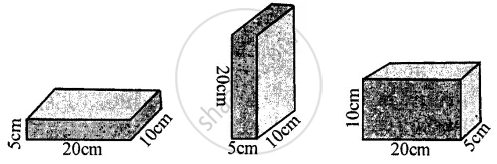
Find the pressure 200m below the surface of the ocean if pressure on the free surface of liquid is one atmosphere. (Density of seawater = 1060 kg/m3)
In a hydraulic lift, the input piston had surface area 30 cm2 and the output piston has surface area of 1500 cm2. If a force of 25 N is applied to the input piston, calculate weight/force on output piston.
Consider the statement given below and choose the correct option.
Assertion: Sharp knives are used to cut the vegetables.
Reason: Sharp edges exert more pressure.
Consider the statement given below and choose the correct option.
Assertion: Broad straps are used in bags.
Reason: Broad straps last for long.
Explain why the cutting instruments are sharpened.
The pressure in mines is ______ than the sea level.
The force exerted by liquid perpendicular to the surface of the body is equal to the product of ______ at that point.
A vessel filled with water is kept on a weighing pan and the scale adjusted to zero. A block of mass M and density ρ is suspended by a massless spring of spring constant k. This block is submerged inside into the water in the vessel. What is the reading of the scale?
