Advertisements
Advertisements
प्रश्न
A large He balloon of volume 1425 m3 is used to lift a payload of 400 kg. Assume that the balloon maintains constant radius as it rises. How high does it rise? [Take y0= 8000 m and `rho_"He"`= 0.18 kg m–3].
Advertisements
उत्तर १
`Density rho = "Mass"/"volume"`
`= "Mass of the payload + Mass of helium"/"Volume"`
`= (m+Vrho_"He")/V`
`= (400 + 1425 xx 0.18)/1425`
`= 0.46 "kg/m"^3`
From equaiton ii and iii we can obtain y as
`rho = rho_0^(e^(-y/y_0))`
`log_e = rho/rho_0 = -y/y_0`
`:. y = -8000xx log_e 0.46/1.25`
`= -8000xx -1`
= 8000 m = 8 km
Hence, the balloon will rise to a height of 8 km.
उत्तर २
Here volume of He balloon,V= `1425 m^3`, mass of payload, m = 400 kg
y_0 = 8000 m, density of He `rho_He` = `0.18 kg^(-3)`
Mean density of ballon, `rho = "Total mass of ballon"/"Volume" = (m + V.rho_"He")/V Pa`
= `(400 + 1425 xx 0.18)/1425 = 0.4608 = 0.46 kgm^(-3)`
As density of air at sea level `rho_0 = 1.25 kg m^(-3)`. The balloon will rise up to a height y = where density of air = density of ballon `rho = 0.46 kgm^(-3)`
As `rho = rho_0^(e^(-y/y_0))` or `rho_0/rho = e^(y_0/y)`
`:. log_e (rho_0/rho) = y_0/y or y = y_0/log_e(rho_0/rho) = 8000/log_e(1.25/0.46)`
= 8002 m or 8.0 km
APPEARS IN
संबंधित प्रश्न
Toricelli’s barometer used mercury. Pascal duplicated it using French wine of density 984 kg m–3. Determine the height of the wine column for normal atmospheric pressure.
It is easier to hammer a blunt nail into a piece of wood than a sharply pointed nail.
The S.I. unit of pressure is pascal.
Pressure is reduced if .................... increases.
The unit of thrust is
State the unit of thrust
It is easier to cut with a sharp knife than with a blunt one. Explain.
If someone presses a pointed needle against your skin, you are hurt. But if someone presses a rod against your skin with the same force, you easily tolerate. Explain.
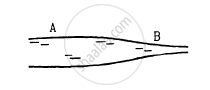
Water flows through a horizontal tube of variable cross section. The area of cross section at A and B are 4 mm2 and 2 mm2 respectively. If 1 cc of water enters per second through A, find (a) the speed of water at A, (b) the speed of water at B and (c) the pressure difference PA − PB.
In a hydraulic lift, the input piston had surface area 30 cm2 and the output piston has surface area of 1500 cm2. If a force of 25 N is applied to the input piston, calculate weight/force on output piston.
In a pressure cooker, the food is cooked faster because ______.
An empty plastic bottle closed with an airtight stopper is pushed down into a bucket filled with water. As the bottle is pushed down, there is an increasing force on the bottom. This is because
A drinking straw works on the existence of ______.
If the same force is made to act on a larger area, the pressure ______.
Explain the variation of the pressure exerted by liquid with respect to the following factors.
- Amount of liquid
- Depth
- Shape and size of the container
Scuba divers wear special suits to withstand ______.
All flowing substances, both liquids, and gases are called ______.
Assertion (A): Wide wooden sleepers are kept below railway lines to reduce pressure on the railway tracks and prevent them from sinking into the ground.
Reason (R): Pressure is directly proportional to the area in which it is acting.
Define thrust.
The force exerted by liquid perpendicular to the surface of the body is equal to the product of ______ at that point.
