Advertisements
Advertisements
प्रश्न
a) Identify the figure given below
b) Redraw the structure as a replicating fork and label the parts
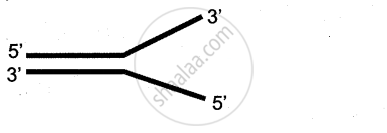
c) Write the source of energy for this replication and name the enzyme involved in this process.
d) Mention the differences in the synthesis of protein, based on the polarity of the two template strands.
Advertisements
उत्तर
a) Replication fork
b)

c) Deoxy nucleotide, triphosphate acts as a energy source for replication. DNA polymerase is used for replication.
d) mRNA contacting information for protein synthesis will developed from DNA strand having polariy 5 ’ → 3 ’
संबंधित प्रश्न
A DNA segment has 75 cytosine and 40 thymine nucleotides. What shall be the total number of phosphates in the DNA segment?
What are Okazaki fragments?
Complementary strands of DNA molecule are (i) and bound by (ii).
E. coli, in which both the strands of DNA are labeled with 15N is transferred to 14N medium and allowed to replicate for three generations. What would be the number of hybrid DNA molecules in the third generation?
When DNA directs the synthesis of chemical molecules other than itself, then such functions of DNA are known as ______.
Identify the CORRECT combination of statements with respect to DNA synthesis.
I. Always the direction of DNA polymerization 5' → 3' when referring to the polarity of strand being synthesized.
II. DNA ligase forms hydrogen bonds between two newly synthesized DNA strands.
III. DNA polymerases on their own cannot initiate the process of replication.
IV. DNA polymerase can catalyse polymerization in both 5'→ 3' and 3'→ 5' direction.
Read the following statements and select the correct option.
Statement I: DNA replication is continuous on leading strand while on the lagging strand it is discontinuous.
Statement II: DNA polymerase cannot initialize polymerization without a primer.
During the replication of DNA, the separated strands are prevented from recoiling by using ______.
Characteristics unique to DNA are ______.
Draw a suitable diagram of replication of eukaryotic DNA and label any three parts.
