Advertisements
Advertisements
प्रश्न
A hole is drilled in a copper sheet. The diameter of the hole is 4.24 cm at 27.0 °C. What is the change in the diameter of the hole when the sheet is heated to 227 °C? Coefficient of linear expansion of copper = 1.70 × 10⁻⁵ K–1.
Advertisements
उत्तर १
Initial temperature, T1 = 27.0°C
Diameter of the hole at T1, d1 = 4.24 cm
Final temperature, T2 = 227°C
Diameter of the hole at T2 = d2
Co-efficient of linear expansion of copper, αCu= 1.70 × 10⁻⁵ K–1
For co-efficient of superficial expansion β,and change in temperature ΔT, we have the relation:
`"Change in area(ΔA)"/"Original area(A)" = betaΔT`
`(((pi (d_2^2))/4 - pi (d_1^2)/4))/((pi d_1^2/4)) = (triangleA)/A`
`:.(triangleA)/A = (d_2^2 - d_1^2)/d_1^2`
But `beta = 2 alpha`
`:.(d_2^2-d_1^2)/d_1^2 = 2alpha triangleT`
`d_2^2/d_1^2 - 1= 2alpha (T_2 - T_1)`
`d_2^2/(4.24)^2 = 2xx 1.7 xx10^(-5)(227- 27) + 1`
`d_2^2 = 17.98 xx 1.0068 = 18.1`
`:. d_2 = 4.2544 cm`
Change in diameter = d2 – d1 = 4.2544 – 4.24 = 0.0144 cm
Hence, the diameter increases by 1.44 × 10⁻² cm.
उत्तर २
In this superficial expansion of copper sheet will be involved on heating
Here, area of hole at `27^@, A_1 = piD_1^2/4 = pi/4 xx(4.24)^2 cm^2`
if `D_2` cm is the diameter of the hole at `227^@C` then area of the hole at `227^@C`
`A_2 = (piD_2^2)/4 cm^2`
Coefficient of superficial expansion of copper is
`beta = 2 alpha = 2xx1.70 xx 10^(-5) = 3.4 xx 10^(-5)"'^@C^(-1)`
Increase in area = `A_2 - A_1 = betaA_1triangleT or A_2 = A_1 +betaA_1 triangle T = A_1(1 + beta triangleT)`
`(piD_2^2)/4 = pi/4(4.24)^2 [1+3.4xx10^(-5)(228 - 27)]`
`=> D_2^2 = (4.24)^2xx 1.0068` or
`D_2 = 4.2544 cm`
Change4 in diameter = `D_2 - D_1 = 4.2544 - 4.24 = 0.0114 cm`
APPEARS IN
संबंधित प्रश्न
If two bodies are in thermal equilibrium in one frame, will they be in thermal equilibrium in all frames?
Show that the moment of inertia of a solid body of any shape changes with temperature as I = I0 (1 + 2αθ), where I0 is the moment of inertia at 0°C and α is the coefficient of linear expansion of the solid.
Answer the following question.
Derive the relation between three coefficients of thermal expansion.
A clock pendulum having coefficient of linear expansion. α = 9 × 10⁻⁷/°C-1 has a period of 0.5 s at 20°C. If the clock is used in a climate, where the temperature is 30°C, how much time does the clock lose in each oscillation? (g = constant)
An iron plate has a circular hole of a diameter 11 cm. Find the diameter of the hole when the plate is uniformly heated from 10° C to 90° C.`[alpha = 12 xx 10^-6//°"C"]`
A metal rod is heated to t°C. A metal rod has length, area of cross-section, Young's modulus and coefficient of linear expansion as 'L', 'A', 'Y' and 'a' respectively. When the rod is heated, the work performed is ______.
A bimetallic strip is made of aluminium and steel (αAl > αsteel) . On heating, the strip will ______.
A uniform metallic rod rotates about its perpendicular bisector with constant angular speed. If it is heated uniformly to raise its temperature slightly ______.
An aluminium sphere is dipped into water. Which of the following is true?
The radius of a metal sphere at room temperature T is R, and the coefficient of linear expansion of the metal is α. The sphere is heated a little by a temperature ∆T so that its new temperature is T + ∆T. The increase in the volume of the sphere is approximately ______.
A student records the initial length l, change in temperature ∆T and change in length ∆l of a rod as follows:
| S.No. | l(m) | ∆T (C) | ∆l (m) |
| 1. | 2 | 10 | `4 xx 10^-4` |
| 2. | 1 | 10 | `4 xx 10^-4` |
| 3. | 2 | 20 | `2 xx 10^-4` |
| 4. | 3 | 10 | `6 xx 10^-4` |
If the first observation is correct, what can you say about observations 2, 3 and 4.
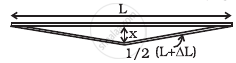
A rail track made of steel having length 10 m is clamped on a raillway line at its two ends (figure). On a summer day due to rise in temperature by 20° C, it is deformed as shown in figure. Find x (displacement of the centre) if αsteel = 1.2 × 10⁻⁵/°C.
If the length of a cylinder on heating increases by 2%, the area of its base will increase by ______.
A disc is rotating freely about its axis. The percentage change in angular velocity of a disc if temperature decreases by 20°C is ______.
(coefficient of linear expansion of material of disc is 5 × 10⁻⁴/°C)
If the temperature of the sun were to increase from T to 2T and its radius from R to 2R, then the ratio of the radiant energy received on earth to what it was previously will be ______.
A solid metallic cube having a total surface area of 24 m2 is uniformly heated. If its temperature is increased by 10°C, calculate the increase in the volume of the cube.
(Given: α = 5.0 × 10⁻⁴°C−1)
A clock with an iron pendulum keeps the correct time at 15°C. If the room temperature is 20°C, the error in seconds per day will be near ______.
(coefficient of linear expansion of iron is 1.2 × 10⁻⁵/°C)
A metallic bar of Young’s modulus, 0.5 × 10¹¹ N m−2 and coefficient of linear thermal expansion 10−5°C−1, length 1 m and area of cross-section 10−3 m2 is heated from 0°C to 100°C without expansion of bending. The compressive force developed in it is ______.
The volume of a block of metal at 30°C changes by 0.12% when its temperature is increased to 70°C. The coefficient of linear expansion of the metal is ______.
