Advertisements
Advertisements
प्रश्न
A force always produces both the linear and turning motions.
पर्याय
True
False
Advertisements
उत्तर
The given statement is False.
Explanation:
Turning motion depend on applied force and the perpendicular distance of force from axis o rotation, so if the distance is zero, there is no turning motion.
APPEARS IN
संबंधित प्रश्न
The S.I. unit of force is kgf. (kilogram-force)
How does the effect of force differ when it is applied on a rigid body?
The hand flour grinder is provided with a handle near the rim.
Calculate the acceleration produced in a body of mass 50 g when acted upon by a force of 20 N.
Is moment of force a scalar or a vector?
A, B and C are the three forces each of magnitude 4 N acting in the plane of the paper as shown in Figure. The point O lies in the same plane.
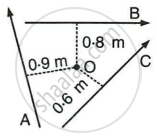
- Which force has the least moment about O? Give a reason.
- Which force has the greatest moment about O? Give a reason.
- Name the forces producing
(a) Clockwise
(b) anticlockwise moments. - What is the resultant torque about the point O?
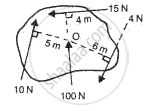
Calculate the resultant moment of forces about O and state its direction in fig.
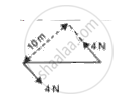
(i) What do you understand by the term couple of forces?
(ii) Calculate the moment of a couple shown in fig.
Write the expression for the moment of force about a given axis.
Calculate the length of arm of couple, if a force of 13 N produces a moment of couple of 14.3 Nm.
