Advertisements
Advertisements
प्रश्न
A current carrying solenoid when freely suspended, it always rests in ______ direction.
Advertisements
उत्तर
A current carrying solenoid when freely suspended, it always rests in north-south direction.
APPEARS IN
संबंधित प्रश्न
How does a solenoid behave like a magnet? Can you determine the north and south poles of a current-carrying solenoid with the help of a bar magnet? Explain.
State two ways by which the magnetic field due to a current carrying solenoid can be made stronger.
How is the magnetic field due to a solenoid carrying current affected if a soft iron bar is introduced inside the solenoid?
What is a solenoid?
For a current in a long straight solenoid, N-pole and S-pole are created at the two ends. Among the following statements, the incorrect statement is ____________.
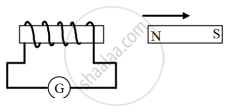
The diagram below shows a magnet moved near a coil along its axis. Which of the diagram shows correct flow of current during this motion?
Under what conditions permanent electromagnet is obtained if a current carrying solenoid is used? Support your answer with the help of a labelled circuit diagram.
Ansari Sir was demonstrating an experiment in his class with the setup as shown in the figure below.

A magnet is attached to a spring. The magnet can go in and out of the stationary coil. He lifted the Magnet and released it to make it oscillate through the coil.
Based on your understanding of the phenomenon, answer the following question.
Is there any difference in the observations in the galvanometer when the Magnet swings in and then out of the stationary coil? Justify your answer.
When does a solenoid behave as a magnet? Draw the pattern of the magnetic field produced inside it showing the directions of the magnetic field lines.
Refer to the image below and state how the magnetic field pattern indicates regions where the magnetic field is stronger outside the magnet. What happens to the magnetic field when the current in the circuit is reversed?

