Advertisements
Advertisements
प्रश्न
A crowbar of length 100 cm is used to lift a load of 5 kgf. It has its fulcrum at a distance of 20 cm from the load. Calculate:
(i) the mechanical advantage of a crowbar and,
(ii) the effort applied at the other end.
Advertisements
उत्तर
Given: L = 5 kgf, Load arm = 20 cm, Effort arm = 100 – 20 = 80 cm.
(Since the crowbar is the lever of first order with the fulcrum in between the load and the effort).
(i) Mechanical advantage =`("Effort arm")/("Load arm")=80/20=4`
(ii) M.A. =`"Load(L)"/"Effort(E)"`
∴ Effort =`"Load(L)"/"M.A."=5/4`
= 1.25 kgf.
संबंधित प्रश्न
What is a lever?
State the principle of a lever?
Fig 3.17 below shows a lever in use.
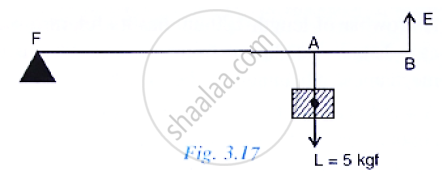
(a) To which class of lever does it belong?
(b) If FA = 80 cm, AB = 20 cm, find its mechanical advantage.
(c) Calculate the value of E.
The following belong to which class of lever?
The Physical balance
The following belong to which class of lever?
An oar of a boat
The following belong to which class of lever?
Human-arm
The following belong to which class of lever?
A pair of scissors
The following belong to which class of lever?
Nutcracker
The following belong to which class of lever?
Knife
The following belong to which class of lever?
Fore-arm
