Advertisements
Advertisements
प्रश्न
A coaxial cable consists of a central conducting core wire of radius ‘a’ and a coaxial cylindrical outer conductor of radius ‘b’. The two conductors carry equal current in opposite directions, in and out of the plane of the paper. What will be the magnitude of magnetic induction B for
- a < r < b and
- b < r?
What will be its direction?
Where ‘r’ is the radius of the Ampere’s circular loop.
Advertisements
उत्तर
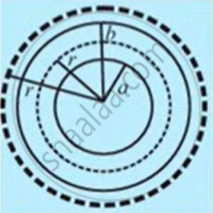
By symmetry, B will be tangent to any circle centred on the central conductor.
i. In order to apply Ampere’s law, consider a circle of radius r such that a < r < b.
∴ `oint vec B * vec(dL)` = μ0I
∴ B.2π r = μ0I
∴ B = `(mu_0 I)/(2 pi r)`, a < r < b
ii. For b < r,
∴ `oint vec B * vec(dL)` = μ0 (I − I) = 0 ...[∵ The two currents are equal and opposite.]
∴ B.2π r = 0, b < r
The magnetic field around the coaxial cable forms concentric circular lines centered on the axis of the cable. The direction of the magnetic field is given by the right-hand thumb rule, and at every point, the field acts tangentially to these circular field lines.
