Advertisements
Advertisements
प्रश्न
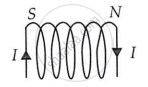
A closely wound solenoid of 800 turns and area of cross-section 2.5 × 10⁻⁴ m2 carries a current of 3.0 A. Explain the sense in which the solenoid acts like a bar magnet. What is its associated magnetic moment?
Advertisements
उत्तर

Number of turns in the solenoid, n = 800
Area of cross-section, A = 2.5 × 10⁻⁴ m2
Current in the solenoid, I = 3.0 A
A current-carrying solenoid behaves like a bar magnet because a magnetic field develops along its axis, i.e., along its length.
The magnetic moment associated with the given current-carrying solenoid is calculated as:
M = n I A
= 800 × 3 × 2.5 × 10−4
= 0.6 J T−1
APPEARS IN
संबंधित प्रश्न
Write any three properties of magnetic lines of force.
Predict the polarity of the capacitor in the situation described below :

Solve the following problem.
Two small and similar bar magnets have a magnetic dipole moment of 1.0 Am2 each. They are kept in a plane in such a way that their axes are perpendicular to each other. A line drawn through the axis of one magnet passes through the center of other magnet. If the distance between their centers is 2 m, find the magnitude of the magnetic field at the midpoint of the line joining their centers.
Answer the following question in detail.
Two bar magnets are placed on a horizontal surface. Draw magnetic lines around them. Mark the position of any neutral points (points where there is no resultant magnetic field) on your diagram.
A short bar magnet placed with its axis at 30° with a uniform external magnetic field of 0.25 T experiences a torque of magnitude equal to 4.5 × 10⁻² J. What is the magnitude of magnetic moment of the magnet?
A closely wound solenoid of 2000 turns and area of cross-section 1.6 × 10⁻⁴ m2, carrying a current of 4.0 A, is suspended through its centre allowing it to turn in a horizontal plane.
- What is the magnetic moment associated with the solenoid?
- What is the force and torque on the solenoid if a uniform horizontal magnetic field of 7.5 × 10⁻² T is set up at an angle of 30° with the axis of the solenoid?
A closely wound solenoid of 2000 turns and area of cross-section 1.6 × 10⁻⁴ m2 , carrying a current of 4.0 A, is suspended through its centre allowing it to turn in a horizontal plane.
What is the force and torque on the solenoid if a uniform horizontal magnetic field of 7.5 × 10⁻² T is set up at an angle of 30° with the axis of the solenoid?
If the bar magnet is turned around by 180°, where will the new null points be located?
Magnetic field at far axial point due to solenoid as well as bar magnet varies ______.
Four point masses, each of value m, are placed at the comers of a square ABCD of side L, the moment of inertia of this system about an axis through A and parallel to BD is ______.
When current is double deflection is also doubled in
A particle having charge 100 times that of an electron is revolving in a circular path by radius 0.8 with one rotation per second. The magnetic field produced at the centre is
A bar magnet of magnetic moment 3.0 Am is placed in a uniform magnetic field of 2 × 10⁻⁵T. If each pole of the magnet experience a force of 6 × 10⁻⁴ N, the length of the magnet is ______.
A toroid of n turns, mean radius R and cross-sectional radius a carries current I. It is placed on a horizontal table taken as x-y plane. Its magnetic moment m ______.
A proton has spin and magnetic moment just like an electron. Why then its effect is neglected in magnetism of materials?
Suppose we want to verify the analogy between electrostatic and magnetostatic by an explicit experiment. Consider the motion of (i) electric dipole p in an electrostatic field E and (ii) magnetic dipole m in a magnetic field B. Write down a set of conditions on E, B, p, m so that the two motions are verified to be identical. (Assume identical initial conditions.)
A long straight wire of circular cross section of radius 'a' carries a steady current I. The current is uniformly distributed across its cross section. The ratio of magnitudes of the magnetic field at a point `a/2` above the surface of wire to that of a point `a/2` below its surface is ______.