Advertisements
Advertisements
प्रश्न
A car moves with a speed of 54 km h−1 towards a cliff. The horn of the car emits sound of frequency 400 Hz at a speed of 335 m s−1. (a) Find the wavelength of the sound emitted by the horn in front of the car. (b) Find the wavelength of the wave reflected from the cliff. (c) What frequency does a person sitting in the car hear for the reflected sound wave? (d) How many beats does he hear in 10 seconds between the sound coming directly from the horn and that coming after the reflection?
Advertisements
उत्तर
Given:
Velocity of car \[v_{car}\] = 54 kmh−1 = \[54 \times \frac{5}{18} = 15 {\text { ms }}^{- 1}\]
Frequency of the car f = 400 Hz
Velocity of sound in air \[v_{air}\]= 335 ms−1
Wavelength in front of the car \[\lambda\]=?
(a) Net velocity in front of the car \[v\] =\[v_{car} - v_{air}\]= 335\[-\]15 = 320 m/s
\[\text { As } v = f\lambda, \]
\[ \therefore \lambda = \frac{v}{f}\]
\[ \Rightarrow \lambda = \frac{320}{400} = 80 \text { cm }\]
(b) The frequency \[\left( f_1 \right)\] heard near the cliff is given by :
\[f_1 = \frac{v_{air}}{v_{air} + v_{car}} \times f_0 \]
\[ \Rightarrow f_1 = \frac{335}{335 + 5} \times 400\]
\[ \Rightarrow f_1 = \frac{335 \times 400}{320} \text{ Hz }\]
\[ \Rightarrow f_1 = 418 . 75 \text { Hz }\]
As we know,
\[v = f\lambda\]
\[\text { Wavelength reflected from the cliff is } \] \[\lambda = \frac{v}{f_1} = \frac{335}{418 . 75} = 80 \text { cm }\]
(c) Here,
\[v_0\]= 15 `\text { ms}^\(- 1)`
Frequency of the reflected sound wave \[\left( f_2 \right)\]heard by the person sitting in the car :
\[f_2 = \frac{v + v_0}{v} \times f_1 \]
\[ \Rightarrow f_2 = \frac{335 + 15}{335} \times \frac{335}{320} \times 400\]
\[ \Rightarrow f_2 = 437 \text{ Hz }\]
(d) He will not hear any beat in 10 seconds because the difference of frequencies is greater than 10 (persistence of sound for the human ear is 1/10 of a second).
APPEARS IN
संबंधित प्रश्न
Explain what is Doppler effect in sound
If you are walking on the moon, can you hear the sound of stones cracking behind you? Can you hear the sound of your own footsteps?
Two loudspeakers are arranged facing each other at some distance. Will a person standing behind one of the loudspeakers clearly hear the sound of the other loudspeaker or the clarity will be seriously damaged because of the 'collision' of the two sounds in between?
Two tuning forks vibrate with the same amplitude but the frequency of the first is double the frequency of the second. Which fork produces more intense sound in air?
A tuning fork sends sound waves in air. If the temperature of the air increases, which of the following parameters will change?
An electrically maintained tuning fork vibrates with constant frequency and constant amplitude. If the temperature of the surrounding air increases but pressure remains constant, the produced will have
(a) larger wavelength
(b) larger frequency
(c) larger velocity
(d) larger time period.
A source of sound moves towards an observer.
A man stands before a large wall at a distance of 50.0 m and claps his hands at regular intervals. Initially, the interval is large. He gradually reduces the interval and fixes it at a value when the echo of a clap merges every 3 seconds, find the velocity of sound in air.
Two point sources of sound are kept at a separation of 10 cm. They vibrate in phase to produce waves of wavelength 5.0 cm. What would be the phase difference between the two waves arriving at a point 20 cm from one source (a) on the line joining the sources and (b) on the perpendicular bisector of the line joining the sources?
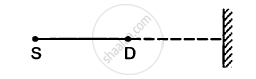
A source of sound S and detector D are placed at some distance from one another. a big cardboard is placed near hte detector and perpendicular to the line SD as shown in figure. It is gradually moved away and it is found that the intensity changes from a maximum to a minimum as the board is moved through a distance of 20 cm. Find the frequency of the sound emitted. Velocity of sound in air is 336 m s−1.
The two sources of sound, S1 and S2, emitting waves of equal wavelength 20.0 cm, are placed with a separation of 20.0 cm between them. A detector can be moved on a line parallel to S1 S2 and at a distance of 20.0 cm from it. Initially, the detector is equidistant from the two sources. Assuming that the waves emitted by the sources are in detector should be shifted to detect a minimum of sound.
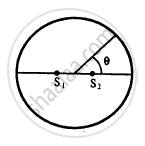
Figure shown two coherent sources S1 and S2 which emit sound of wavelength λ in phase. The separation between the sources is 3λ. A circular wire of large radius is placed in such way that S1,S2 is at the centre of the wire. Find the angular positions θ on the wire for which constructive interference takes place.
The fundamental frequency of a closed pipe is 293 Hz when the air in it is a temperature of 20°C. What will be its fundamental frequency when the temperature changes to 22°C?
A tuning fork produces 4 beats per second with another tuning fork of frequency 256 Hz. The first one is now loaded with a little wax and the beat frequency is found to increase to 6 per second. What was the original frequency of the tuning fork?
Show that if the room temperature changes by a small amount from T to T + ∆T, the fundamental frequency of an organ pipe changes from v to v + ∆v, where \[\frac{∆ v}{v} = \frac{1}{2}\frac{∆ T}{T} .\]
A sound source, fixed at the origin, is continuously emitting sound at a frequency of 660 Hz. The sound travels in air at a speed of 330 m s−1. A listener is moving along the lien x= 336 m at a constant speed of 26 m s−1. Find the frequency of the sound as observed by the listener when he is (a) at y = − 140 m, (b) at y = 0 and (c) at y = 140 m.
A source of sound emitting a 1200 Hz note travels along a straight line at a speed of 170 m s−1. A detector is placed at a distance 200 m from the line of motion of the source. (a) Find the frequency of sound receive by the detector at the instant when the source gets closest to it. (b) Find the distance between the source and the detector at the instant in detects the frequency 1200 Hz. Velocity of sound in air = 340 m s−1.
Equation of a plane progressive wave is given by `y = 0.6 sin 2π (t - x/2)`. On reflection from a denser medium its amplitude becomes 2/3 of the amplitude of the incident wave. The equation of the reflected wave is ______.
In an experiment to determine the velocity of sound in air at room temperature using a resonance tube, the first resonance is observed when the air column has a length of 20.0 cm for a tuning fork of frequency 400 Hz is used. The velocity of the sound at room temperature is 336 ms-1. The third resonance is observed when the air column has a length of ______ cm.
A transverse wave is represented by y = 2sin (ωt - kx) cm. The value of wavelength (in cm) for which the wave velocity becomes equal to the maximum particle velocity, will be ______.
