Advertisements
Advertisements
प्रश्न
`(5/7, (2sqrt(6))/7)` is a point on the terminal side of an angle θ in standard position. Determine the six trigonometric function values of angle θ
Advertisements
उत्तर
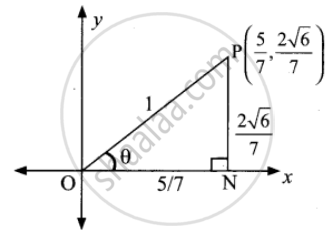
In the diagram ON = `5/7`
PN = `(2sqrt(6))/7`
ON2 + NP2 = OP2
(i.e) `25/49 + 24/49 = 49/49` = OP2
⇒ OP = 1
sin θ = `"PN"/"OP"`
= `(2sqrt(6)/7)/1`
= `(2sqrt(6))/7`
cos θ = `"ON"/"OP"`
= `(5/7)/1`
= `5/7`
tan θ = `"PN"/"ON"`
= `((2sqrt(6))/7)/(5/7)`
= `(2sqrt(6))/5`
cosec θ = `1/sintheta = 7/(2sqrt(6))`
sec θ = `1/costheta = 7/5`
cot θ = `1/tantheta = 5/(2sqrt(6))`
APPEARS IN
संबंधित प्रश्न
Find the values of `tan ((19pi)/3)`
Find the value of the trigonometric functions for the following:
tan θ = −2, θ lies in the II quadrant
Prove that `(cot(180^circ + theta) sin(90^circ - theta) cos(- theta))/(sin(270^circ + theta) tan(- theta) "cosec"(360^circ + theta))` = cos2θ cotθ
Find all the angles between 0° and 360° which satisfy the equation sin2θ = `3/4`
Find sin(x – y), given that sin x = `8/17` with 0 < x < `pi/2`, and cos y = `- 24/25`, x < y < `(3pi)/2`
Find the value of tan `(7pi)/12`
Prove that sin(30° + θ) + cos(60° + θ) = cos θ
Prove that sin 105° + cos 105° = cos 45°
Prove that cos(A + B) cos(A – B) = cos2A – sin2B = cos2B – sin2A
Show that cos2 A + cos2 B – 2 cos A cos B cos(A + B) = sin2(A + B)
If θ is an acute angle, then find `sin (pi/4 - theta/2)`, when sin θ = `1/25`
Express the following as a sum or difference
cos 5θ cos 2θ
Show that `cos pi/15 cos (2pi)/15 cos (3pi)/15 cos (4pi)/15 cos (5pi)/15 cos (6pi)/15 cos (7pi)/15 = 1/128`
Show that `(sin 8x cos x - sin 6x cos 3x)/(cos 2x cos x - sin 3x sin 4x)` = tan 2x
Show that `((cos theta -cos 3theta)(sin 8theta + sin 2theta))/((sin 5theta - sin theta) (cos 4theta - cos 6theta))` = 1
Prove that `(sin 4x + sin 2x)/(cos 4x + cos 2x)` = tan 3x
Choose the correct alternative:
`(sin("A" - "B"))/(cos"A" cos"B") + (sin("B" - "C"))/(cos"B" cos"C") + (sin("C" - "A"))/(cos"C" cos"A")` is
