Advertisements
Advertisements
प्रश्न
`(5/7, (2sqrt(6))/7)` is a point on the terminal side of an angle θ in standard position. Determine the six trigonometric function values of angle θ
Advertisements
उत्तर
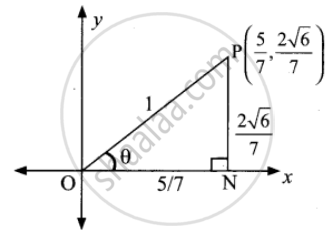
In the diagram ON = `5/7`
PN = `(2sqrt(6))/7`
ON2 + NP2 = OP2
(i.e) `25/49 + 24/49 = 49/49` = OP2
⇒ OP = 1
sin θ = `"PN"/"OP"`
= `(2sqrt(6)/7)/1`
= `(2sqrt(6))/7`
cos θ = `"ON"/"OP"`
= `(5/7)/1`
= `5/7`
tan θ = `"PN"/"ON"`
= `((2sqrt(6))/7)/(5/7)`
= `(2sqrt(6))/5`
cosec θ = `1/sintheta = 7/(2sqrt(6))`
sec θ = `1/costheta = 7/5`
cot θ = `1/tantheta = 5/(2sqrt(6))`
APPEARS IN
संबंधित प्रश्न
Find the values of cos(300°)
Find the values of cot(660°)
Find the values of `tan ((19pi)/3)`
Find the value of the trigonometric functions for the following:
cos θ = `- 1/2`, θ lies in the III quadrant
Prove that `(cot(180^circ + theta) sin(90^circ - theta) cos(- theta))/(sin(270^circ + theta) tan(- theta) "cosec"(360^circ + theta))` = cos2θ cotθ
If sin A = `3/5` and cos B = `9/41 0 < "A" < pi/2, 0 < "B" < pi/2`, find the value of sin(A + B)
If sin A = `3/5` and cos B = `9/41, 0 < "A" < pi/2, 0 < "B" < pi/2`, find the value of cos(A – B)
Prove that sin(n + 1) θ sin(n – 1) θ + cos(n + 1) θ cos(n – 1)θ = cos 2θ, n ∈ Z
If θ + Φ = α and tan θ = k tan Φ, then prove that sin(θ – Φ) = `("k" - 1)/("k" + 1)` sin α
Prove that `tan (pi/4 + theta) - tan(pi/4 - theta)` = 2 tan 2θ
Express the following as a sum or difference
sin 4x cos 2x
Show that `cos pi/15 cos (2pi)/15 cos (3pi)/15 cos (4pi)/15 cos (5pi)/15 cos (6pi)/15 cos (7pi)/15 = 1/128`
If A + B + C = 180°, prove that sin2A + sin2B − sin2C = 2 sin A sin B cos C
If A + B + C = 180°, prove that `tan "A"/2 tan "B"/2 + tan "B"/2 tan "C"/2 + tan "C"/2 tan "A"/2` = 1
If A + B + C = 2s, then prove that sin(s – A) sin(s – B)+ sin s sin(s – C) = sin A sin B
If ∆ABC is a right triangle and if ∠A = `pi/2` then prove that cos2 B + cos2 C = 1
Choose the correct alternative:
If cos 28° + sin 28° = k3, then cos 17° is equal to
Choose the correct alternative:
cos 1° + cos 2° + cos 3° + ... + cos 179° =
Choose the correct alternative:
Let fk(x) = `1/"k" [sin^"k" x + cos^"k" x]` where x ∈ R and k ≥ 1. Then f4(x) − f6(x) =
