Advertisements
Advertisements
प्रश्न
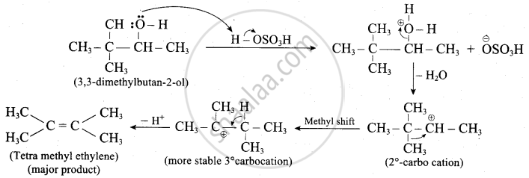
3, 3-dimethyl butane-2-ol on treatment with conc. H2SO4 to give tetramethyl ethylene as a major product. Suggest a suitable mechanism.
Advertisements
उत्तर

According to Saytzeff’s rule the dehydration of 3, 3-dimethyl butane-2-ol gives a mixture of alkenes. But the secondary carbocation formed in this reaction undergoes rearrangement to form a more stable tertiary carbocation which further, undergoes 13 elimination leads more stable product, that is 2, 3-dimethyl but-2-ene (more yield). According to Saytzeff’s rule, 2, 3-dimethyl pent-2-ene is the major product.
APPEARS IN
संबंधित प्रश्न
Which one of the following will react with phenol to give salicylaldehyde after hydrolysis.
The reaction can be classified as

Isopropyl benzene on air oxidation in the presence of dilute acid gives ___________.
Assertion: Phenol is more reactive than benzene towards electrophilic substitution reaction
Reason: In the case of phenol, the intermediate arenium ion is more stabilized by resonance.
Predict the major product, when 2-methyl-but-2-ene is converted into alcohol in the following method.
Hydroxylation using bayers reagent
Arrange the following in the increasing order of their boiling point and give a reason for your ordering.
Butan-2-ol, Butan-1-ol, 2-methyl propane-2-ol
Is it possible to oxidise t-butyl alcohol using acidified dichromate to form a carbonyl compound?
How is the conversion effected benzyl chloride to benzyl alcohol?
What will be the product (X and A) for the following reaction?
acetylchloride \[\ce{->[i) CH3MgBr][ii) H3O+] X ->[acid K2Cr2O7] A}\]
What will be the product (X and A) for the following reaction:
\[\ce{acetylchloride ->[i) CH3MgBr][ii) H3O+]X->[acid K2Cr2O7]A}\]