Advertisements
Chapters
![Selina solutions for Concise Chemistry [English] Class 7 ICSE chapter 2 - Physical and Chemical Changes - Shaalaa.com](/images/concise-chemistry-english-class-7-icse_6:c4b696cc57c1484eba21c5a1929ab504.jpg "Selina solutions for Concise Chemistry [English] Class 7 ICSE chapter 2 - Physical and Chemical Changes")
Advertisements
Solutions for Chapter 2: Physical and Chemical Changes
Below listed, you can find solutions for Chapter 2 of CISCE Selina for Concise Chemistry [English] Class 7 ICSE.
Selina solutions for Concise Chemistry [English] Class 7 ICSE 2 Physical and Chemical Changes Exercise
Define physical change. Give two examples for the above changes.
Define a chemical change. Give two examples of the above changes.
What are reversible and irreversible changes ? Give one example for each.
Mention a change which is always desirable.
Mention a change which is always undesirable.
Mention a change which is always periodic.
Is burning a physical change or a chemical change? Why?
A burning candle shows both physical and chemical changes. Explain ?
State three differences between evaporation and boiling
State four differences between physical and chemical changes.
What do you observe when :
water is boiled
What do you observe when :
a piece of paper is burnt
What do you observe when :
some ice cubes are kept in a glass tumbler
What do you observe when :
solid ammonium chloride is heated
What do you observe when :
an iron nail is kept in tap water for few days
What do you observe when :
a spoon of sugar is heated in a pan
What do you observe when :
lighted match stick is brought near the mouth of the test tube containing hydrogen gas.
What do you observe when :
ime is dissolved in water.
What do you observe when: little amount of curd is added to a bowl containing warm milk and kept for five hours.
Name a chemical change which takes place in presence of:
Selina solutions for Concise Chemistry [English] Class 7 ICSE 2 Physical and Chemical Changes Objective Type Questions
Fill in the blank
A new substance is always formed in a _______ change.
Fill in the blank.
Melting of ice is a _______ change.
Fill in the blank.
When a candle burns, wax melts. Melting of wax is a ________ change.
Fill in the blank
Chemical change occurs as a result of __________ between two substances.
Fill in the blank
Burning of fuel is a _______ change.
Fill in the blank
Revolution of the earth around the sun is a ________ change.
Fill in the blank.
Growing of a seedling into a plant is _______ change.
State whether the following is physical or chemical changes.
glowing of a bulb -
State whether the following is physical or chemical changes.
burning of sugar —
State whether the following is physical or chemical changes.
heating of water —
State whether the following is physical or chemical changes.
growing of a piglet into a pig —
State whether the following is physical or chemical changes.
burning of wood -
State whether the following is physical or chemical changes.
passing electric current through a heater rod —
State whether the following is physical or chemical changes.
water cycle in nature —
State whether the following is physical or chemical changes.
respiration in living beings —
State whether the following is physical or chemical changes.
shaping a piece of glass —
State whether the following is physical or chemical changes.
lightning —
State whether the following is physical or chemical changes.
(energy produced) dissolving sugar in water —
State whether the following is physical or chemical changes.
heating a mixture of iron filings and sulphur—
State whether the following is physical or chemical changes.
mixing oil with water —
State whether the following is physical or chemical changes.
cutting wood into small pieces —
State whether the following is physical or chemical changes.
photosynthesis —
State whether the following is physical or chemical change.
Digestion of food —
State whether the following is physical or chemical changes.
Melting of wax —
State whether the following is physical or chemical changes.
Boiling of an egg —
State whether the following is physical or chemical changes.
Slaking of lime —
Match the following:
| Column A | Column B |
| (a) Evaporation of water | (i) Non-periodic change |
| (b) Milk turning sour | (ii) Periodic change |
| (c) Earthquake | (iii) Chemical change |
| (d) Change of seasons | (iv) Physical change |
| (e) Glowing of bulb | (v) Reversible change |
Write true or false
Cutting of paper into pieces is a chemical change.
True
False
Write true or false
Rusting of iron is a chemical change.
True
False
Write true or false
Earthquake is a desirable change.
True
False
Write true or false
Melting of ice is a physical change.
True
False
Write true or false
Burning of sugar is a temporary change.
True
False
Selina solutions for Concise Chemistry [English] Class 7 ICSE 2 Physical and Chemical Changes Multiple Choice Questions
Tick (√) the correct alternative from the choice given for the following statement.
A substance which can not sublime is
iodine
camphor
sugar
dry ice
Tick (√) the correct alternative from the choice given for the following statement.
When you put some ice cubes in a glass, droplets of water are formed on the outer wall of the glass. This explains the phenomenon of
melting
freezing
condensation
evaporation
Tick (√) the correct alternative from the choice given for the following statement
Burning is a
slow process
fast process
natural process
none of the above
Tick (√) the correct alternative from the choice given for the following statement
Which one of the following is volatile in nature ?
common salt
petrol
water
milk
Tick (√) the correct alternative from the choice given for the following statement.
An example of both physical and chemical change is
burning of candle
melting of ice
cooking of food
blowing of bulb
Tick (√) the correct alternative from the choice given for the following statement.
The compound rust is a hydrated oxide of
copper
aluminium
iron
gold
Tick (√) the correct alternative from the choice given for the following statement
When sugar is heated, its colour changes into
red
brown
black
grey
Tick (√) the correct alternative from the choice given for the following statement
A pop sound is heard when a lighted match stick is brought near the mouth of a jar. This indicates the release of gas.
oxygen
hydrogen
nitrogen
water-vapour
Tick (√) the correct alternative from the choice given for the following statement.
When we add water to the following substances, which one will show a chemical change?
Salt
Sugar
oil
quick lime
Selina solutions for Concise Chemistry [English] Class 7 ICSE 2 Physical and Chemical Changes Additional questions 1
True or false
Is melting of ice a reversible change?
True
False
True or false
Change of seasons is a non-periodic change.
True
False
True or false
In a physical change no net energy change is involved.
True
False
True or false
New substances are formed in a chemical change.
True
False
True or false
Dissolving of a solid in liquid is a physical change.
True
False
True or false
Is the process of digestion a physical change?
True
False
True or false?
During a physical change energy is either given out or absorbed by the system.
True
False
True or false?
In a chemical change, rearrangement of molecules and atoms involves some energy changes.
True
False
Selina solutions for Concise Chemistry [English] Class 7 ICSE 2 Physical and Chemical Changes Additional questions 2
Tick the most appropriate answer.
Melting of ice is a
reversible change
irreversible change
chemical change
none of these
Tick the most appropriate answer.
Rising and setting of the sun at a given place is a
periodic change
undesirable change
physical change
reversible change
Tick the most appropriate answer.
Physical changes are
permanent
periodic
temporary
irreversible
Tick the most appropriate answer.
Chemical changes involve
change in shape
change in size
change in molecular composition
none of these
Tick the most appropriate answer.
Photosynthesis requires
heat energy
wind energy
sunlight
sound energy
Selina solutions for Concise Chemistry [English] Class 7 ICSE 2 Physical and Chemical Changes Additional questions 3
Fill in the blank
A change in which the substance can be brought back to its original state is called a _______ change.
Fill in the blank
Changes that occur in nature are called ______
Fill in the blank
An earthquake is a _______ change.
Fill in the blank
A new substance is formed in a _______ change.
Fill in the blank
Heat is ________ by a gas during the process of condensation.
Selina solutions for Concise Chemistry [English] Class 7 ICSE 2 Physical and Chemical Changes Additional questions 4
Match the columns.
| Column A | Column B |
| 1. a change which cannot be easily reversed | a. man-made change |
| 2 a change that repeats itself at regular intervals | b. chemical chang |
| 3. a change that is made by humans | c. physical change |
| 4. a change in which the original substance cannot be obtained | d. periodic change |
| 5. a change where no new substance is formed | e. irreversible change |
| f . slow change |
Selina solutions for Concise Chemistry [English] Class 7 ICSE 2 Physical and Chemical Changes Additional questions 5
Write true or false
Burning of paper and formation of curd are reversible changes.
True
False
Write true or false
A natural change can also be a desirable change.
True
False
Write true or false
Deforestation is a man-made change.
True
False
Write true or false
Decomposition of leaves is a fast change.
True
False
Write true or false
Dissolving of solute in a solvent and rusting of iron are both physical changes.
True
False
Selina solutions for Concise Chemistry [English] Class 7 ICSE 2 Physical and Chemical Changes Additional questions 6
Dissolving salt in water is a reversible change.
Ripening of fruits is a desirable change.
Melting of solid (wax) is a physical change.
Chemical changes are accompanied by changes in energy.
Photosynthesis cannot take place at night.
Selina solutions for Concise Chemistry [English] Class 7 ICSE 2 Physical and Chemical Changes Additional questions 7
Name two reversible changes.
Give two examples of periodic changes.
Give an example of desirable change which can also be undesirable.
What are man-made changes ?
Sublimation is classified as a physical change. Why ?
Selina solutions for Concise Chemistry [English] Class 7 ICSE 2 Physical and Chemical Changes Additional questions 8
Classify the following changes as physical or chemical.
A physical change is temporary. Explain.
State the Differences Between a Physical Change and a Chemical Change.
State the various conditions that favour the process of evaporation.
How do you say that the process of digestion is a chemical change ?
What role does energy play in initiating a chemical change ?
Selina solutions for Concise Chemistry [English] Class 7 ICSE 2 Physical and Chemical Changes Additional questions 9
Solve this crossword by using the clues that follow-
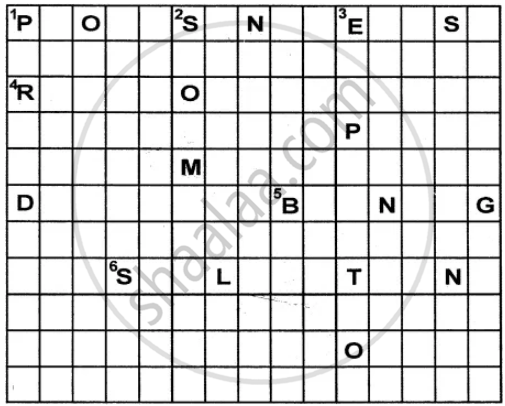
Across
1. Energy in the form of sunlight is absorbed by the green plants in this process.
4. The reddish-brown substance formed over iron in the presence of oxygen and moisture.
5. This change is permanent and irreversible.
6. The process in which a solid directly changes into gaseous state.
Down
1 . It is the change that takes place in case of swinging pendulum of a clock. –
2. Occurrence of this is a non-periodic change as well as a natural change.
3. It is a physical change.
Make a list of different types of changes with example.
Solutions for 2: Physical and Chemical Changes
Selina solutions for Concise Chemistry [English] Class 7 ICSE chapter 2 - Physical and Chemical Changes
Shaalaa.com has the CISCE Mathematics Concise Chemistry [English] Class 7 ICSE CISCE solutions in a manner that help students grasp basic concepts better and faster. The detailed, step-by-step solutions will help you understand the concepts better and clarify any confusion. Selina solutions for Mathematics Concise Chemistry [English] Class 7 ICSE CISCE 2 (Physical and Chemical Changes) include all questions with answers and detailed explanations. This will clear students' doubts about questions and improve their application skills while preparing for board exams.
Further, we at Shaalaa.com provide such solutions so students can prepare for written exams. Selina textbook solutions can be a core help for self-study and provide excellent self-help guidance for students.
Concepts covered in Concise Chemistry [English] Class 7 ICSE chapter 2 Physical and Chemical Changes are Changes-Physical and Chemical, Classification of Change: Slow and Fast Changes, Classification of Change: Natural and Man-made Changes, Classification of Change: Periodic and Non-periodic Changes, Classification of Change: Desirable and Undesirable Changes, Classification of Change: Reversible and Irreversible Changes, Classification of Change: Physical Changes, Change of State, Concept of Melting (Fusion), Vaporisation or Boiling, Concept of Freezing (Solidification), Concept of Condensation (Liquefaction), Concept of Evaporation, Chemical Reaction, Indicators of a Chemical Change (Chemical Reaction).
Using Selina Concise Chemistry [English] Class 7 ICSE solutions Physical and Chemical Changes exercise by students is an easy way to prepare for the exams, as they involve solutions arranged chapter-wise and also page-wise. The questions involved in Selina Solutions are essential questions that can be asked in the final exam. Maximum CISCE Concise Chemistry [English] Class 7 ICSE students prefer Selina Textbook Solutions to score more in exams.
Get the free view of Chapter 2, Physical and Chemical Changes Concise Chemistry [English] Class 7 ICSE additional questions for Mathematics Concise Chemistry [English] Class 7 ICSE CISCE, and you can use Shaalaa.com to keep it handy for your exam preparation.
