Advertisements
Online Mock Tests
Chapters
2: Contemporary Centres of Power
3: Contemporary South Asia
4: International Organisations
▶ 5: Security in the Contemporary World
6: Environment and Natural Resources
7: Globalisation
Advertisements
Solutions for Chapter 5: Security in the Contemporary World
Below listed, you can find solutions for Chapter 5 of CBSE NCERT for पोलिटिकल साइंस कॉनटेंपोरॅरी वर्ल्ड पॉलिटिक्स [अंग्रेजी] कक्षा १२.
NCERT solutions for पोलिटिकल साइंस कॉनटेंपोरॅरी वर्ल्ड पॉलिटिक्स [अंग्रेजी] कक्षा १२ 5 Security in the Contemporary World Intext Questions [Pages 64 - 78]
Who decides about my security? Some leaders and experts? Can’t I decide what is my security?
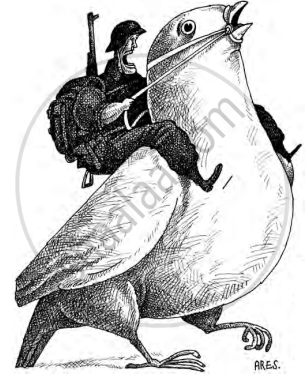
Taming Peace
Have you heard of ‘peacekeeping force’? Do you think this is paradoxical term?
War is all about insecurity, destruction and deaths. How can a war make anyone secure?
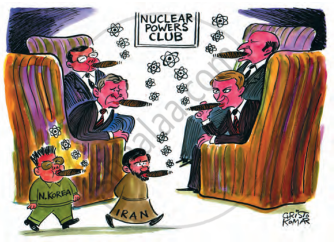
How do the big powers react when new countries claim nuclear status? On what basis can we say that some countries can be trusted with nuclear weapons while others can’t be?
LET'S DO IT
Browse through a week's newspaper and list all the external and internal conflicts that are taking place around the globe.
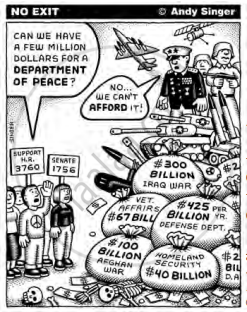
The cartoon comments on the massive expenditure on defence and lack of money for peace-related initiatives in the US. Is it any different in our country?
Why do we always look outside when talking about human rights violations? Don't we have examples from our own country?
LET'S DO IT
Take a map of Africa and plot various threats to the people’s security on that map.
How should the world address issues shown here?
LET'S DO IT
Compare the expenditure by the Indian government on traditional security with its expenditure on non-traditional security.
STEPS
- Narrate the following imaginary situation of four villages settled on the banks of a river.
Kotabagh, Gewali, Kandali and Goppa are villages adjoining each other beside a river. People in Kotabagh were the first settlers on the riverbank. They had an uninterrupted access to abundant natural resources available in the region. Gradually, people from different regions started coming to this region because of the abundant natural resources and water. Now there are four villages. With time the population of these villages expanded. But resources did not expand. Each village started making claims over natural resources including the boundary of their respective settlement. Inhabitants of Kotabagh argued for a greater share in natural resources, as they were the first settlers. Settlers of Kandali and Gewali said that as they have bigger populations than the others they both need a greater share. The people of Goppa said as they are used to an extravagant life they need a bigger share, though their population is smaller in size. All four villages disagreed with each other’s demands and continued to use the resources as they wished. This led to frequent clashes among the villagers. Gradually, everybody felt disgusted with the state of affairs and lost their peace of mind. Now they all wish to live the way they had lived earlier. But they do not know how to go back to that golden age. - Make a brief note describing the characteristics of each village - the description should reflect the actual nature of present-day nations.
- Divide the classroom into four groups. Each group is to represent a village. Hand over the village notes to the respective groups.
- The teacher is to allot a time (15 minutes) for group discussions on how to go back to the golden age. Each should develop its own strategy.
All groups are to negotiate freely among themselves as village representatives, to arrive at a solution (within 20 minutes). Each would put forth its arguments and counter arguments. The result could be: an amicable agreement accommodating the demands of all, which seldom happens; or, the entire negotiation/discussion ends without achieving the purpose.
Ideas for the Teacher
- Link the villages to nations and connect to the problems of security (threat to geographical territory/access to natural resources/insurgency, and so on).
- Talk about the observations made during the negotiation and explain how similarly the nations behave while negotiating on related issues.
- The activity could be concluded by making reference to some of the current security issues between and among nations.
NCERT solutions for पोलिटिकल साइंस कॉनटेंपोरॅरी वर्ल्ड पॉलिटिक्स [अंग्रेजी] कक्षा १२ 5 Security in the Contemporary World Exercises [Pages 79 - 80]
Match the terms with their meaning:
| i. Confidence Building Measures (CBMs) | a. Giving up certain types of weapons. |
| ii. Arms Control | b. A process of exchanging information on defence matters between nations on a regular basis. |
| iii. Alliance | c. A coalition of nations meant to deter or defend against military attacks. |
| iv. Disarmament | d. Regulates the acquisition of development of weapons. |
Which among the following would you consider as a traditional security concern/non-traditional/not a threat?
- The spread of chikungunya/dengue fever
- Inflow of workers from a neighbouring nation.
- Emergence of a group demanding nationhood for their region.
- Emergence of a group demanding autonomy for their region.
- A newspaper that is critical of the armed-forces in the country.
What is the difference between traditional and non-traditional security?Which category would the creation and sustenance of alliances belong to?
What are the differences in the threats that people in the third world face and those living in the First World face?
Is terrorism a traditional or non-traditional threat to security?
What are the choices available to a state when its security is threatened, according to the traditional security perspective?
What is ‘Balance of Power’? How could a state achieve this?
What are the objectives of military alliances? Give an example of a functioning military alliance with its specific objectives.
Rapid environmental degradation is causing a serious threat to security. Do you agree with the statement? Substantiate your arguments.
‘Nuclear weapons as deterrence or defense have limited usage against contemporary security threats to states.’ Explain the statement.
Looking at the Indian scenario, what type of security has been given priority in India, traditional or non-traditional? What examples could
you cite to substantiate the argument?
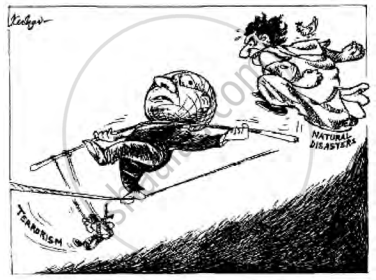
Read the cartoon below and write a short note in favour or against the connection between war and terrorism depicted in this cartoon.

Solutions for 5: Security in the Contemporary World
NCERT solutions for पोलिटिकल साइंस कॉनटेंपोरॅरी वर्ल्ड पॉलिटिक्स [अंग्रेजी] कक्षा १२ chapter 5 - Security in the Contemporary World
Shaalaa.com has the CBSE Mathematics पोलिटिकल साइंस कॉनटेंपोरॅरी वर्ल्ड पॉलिटिक्स [अंग्रेजी] कक्षा १२ CBSE solutions in a manner that help students grasp basic concepts better and faster. The detailed, step-by-step solutions will help you understand the concepts better and clarify any confusion. NCERT solutions for Mathematics पोलिटिकल साइंस कॉनटेंपोरॅरी वर्ल्ड पॉलिटिक्स [अंग्रेजी] कक्षा १२ CBSE 5 (Security in the Contemporary World) include all questions with answers and detailed explanations. This will clear students' doubts about questions and improve their application skills while preparing for board exams.
Further, we at Shaalaa.com provide such solutions so students can prepare for written exams. NCERT textbook solutions can be a core help for self-study and provide excellent self-help guidance for students.
Concepts covered in पोलिटिकल साइंस कॉनटेंपोरॅरी वर्ल्ड पॉलिटिक्स [अंग्रेजी] कक्षा १२ chapter 5 Security in the Contemporary World are Introduction to Security in the Contemporary World, What is Security?, Traditional Notions: External, Traditional Security and Cooperation, Non-traditional Notions, New Sources of Threats, Cooperative Security, India’s Security Strategy, Issues of Human Rights and Migration, Traditional Concerns of Security and Politics of Disarmament, Non-traditional Or Human Security - Global Poverty, Health and Education, Overview of Security in Contemporary World, Introduction to Security in the Contemporary World, What is Security?, Traditional Notions: External, Traditional Security and Cooperation, Non-traditional Notions, New Sources of Threats, Cooperative Security, India’s Security Strategy, Issues of Human Rights and Migration, Traditional Concerns of Security and Politics of Disarmament, Non-traditional Or Human Security - Global Poverty, Health and Education, Overview of Security in Contemporary World.
Using NCERT पोलिटिकल साइंस कॉनटेंपोरॅरी वर्ल्ड पॉलिटिक्स [अंग्रेजी] कक्षा १२ solutions Security in the Contemporary World exercise by students is an easy way to prepare for the exams, as they involve solutions arranged chapter-wise and also page-wise. The questions involved in NCERT Solutions are essential questions that can be asked in the final exam. Maximum CBSE पोलिटिकल साइंस कॉनटेंपोरॅरी वर्ल्ड पॉलिटिक्स [अंग्रेजी] कक्षा १२ students prefer NCERT Textbook Solutions to score more in exams.
Get the free view of Chapter 5, Security in the Contemporary World पोलिटिकल साइंस कॉनटेंपोरॅरी वर्ल्ड पॉलिटिक्स [अंग्रेजी] कक्षा १२ additional questions for Mathematics पोलिटिकल साइंस कॉनटेंपोरॅरी वर्ल्ड पॉलिटिक्स [अंग्रेजी] कक्षा १२ CBSE, and you can use Shaalaa.com to keep it handy for your exam preparation.
