NCERT solutions for फिज़िकल एजुकेशन एण्ड वेल-बीइंग खेल प्रवीण [अंग्रेजी] कक्षा ९ chapter 22 - Yogamaya Jīvana (Lifestyle for Holistic Health) [Latest edition]
Chapters
1: Physical Education and Well-being
2: History and Culture of Physical Education in India
3: Careers in Physical Education
4: Fitness and its Components
UNIT 2: Science and Sports
5: Understanding Our Body
6: Cardiorespiratory System
7: Growth, Development, and Maturation
8: First Aid
UNIT 3: Olympism
9: Olympic Values
10: The Ancient Olympic Games
11: The Modern Olympic Games
UNIT 4: Sports for All
12: Sports and Inclusivity
13: Sports and Disability
14: Disability Etiquettes: Respecting Everyone with Dignity
15: Young Athlete
16: Women in Sports
17: Age is Just a Number
UNIT 5: Sports
Chapter 18: Indigenious Martial Arts and Sport
Chapter 19: Combat Sports
Chapter 20: Outdoor Sports
UNIT 6: Yoga for Holistic Health and Personal Excellence
21: Samagra Svāsthya (Yoga for Holistic Health)
▶ 22: Yogamaya Jīvana (Lifestyle for Holistic Health)
23: Yoga for Personal Excellence
Advertisements
Advertisements
Solutions for Chapter 22: Yogamaya Jīvana (Lifestyle for Holistic Health)
Below listed, you can find solutions for Chapter 22 of CBSE NCERT for फिज़िकल एजुकेशन एण्ड वेल-बीइंग खेल प्रवीण [अंग्रेजी] कक्षा ९.
Advertisements
NCERT solutions for फिज़िकल एजुकेशन एण्ड वेल-बीइंग खेल प्रवीण [अंग्रेजी] कक्षा ९ 22 Yogamaya Jīvana (Lifestyle for Holistic Health) Intext Questions [Pages 166 - 182]
Activity
A weekend trip to your local market to discover seasonal and local foods
On a weekend, visit a local market with your family to explore the food native to your region. Observe the fresh seasonal fruits, vegetables, grains, and traditional snacks available there. Find out which fruits and vegetables are in season and note how they help the body stay healthy during the current weather (for example, cooling foods in summer or warming foods in winter).
If possible, talk to a farmer or vendor to learn when these foods are harvested and how they are grown. Also, ask them if they use any regional or traditional recipes using seasonal ingredients, to prepare the food.
After your visit, complete the following task:
- List 3–4 seasonal fruits or vegetables you found and write one health benefit for each of them.
Activity
Choosing Foods That Support Your Body Systems
Our body works best when we eat foods that support each of its systems. This chart is a simple way to understand what kinds of food help different parts of the body stay healthy. You can also fill in examples of local and seasonal foods that are easily found in your region. Eating fresh, home-cooked meals made from seasonal and local ingredients help the body stay active, energetic, and clear-headed throughout the day.
| Body Functions | Food that help us stay healthy | Local/Seasonal options |
| Healthy digestion | Warm, freshly cooked meals; such as soups, rice, dal, mildly spiced food, etc. | |
| Healthy breathing and optimal function | Fresh fruits, steamed vegetables, tulsi, ginger, warm water, etc. | |
| Body's resistance to illness | Amla, turmeric milk, leafy greens, and seasonal vegetables | |
| Healthy blood circulation | Whole grains, sprouts, lentils, and fibre-rich foods | |
| Muscle growth and strength | Dal, paneer, lentils, peanuts, and millets | |
| Strong bones and flexible joints | Ragi, sesame seeds, leafy greens, and sunlight exposure | |
| Memory and learning ability | Nuts, seeds, ghee, warm milk, Almonds, walnuts, fruits, and wholegrain porridge | |
| Sustained energy and stamina | Banana, jaggery, buttermilk, and traditional snacks (poha/upmā) | |
| Healthy Skin and Hair growth | Coconut, ghee, vegetables, and adequate water |
Activity
Healthy Plate Check
| Body Functions | What to Do | Your Response |
| 1. Before Eating | Ask yourself: Am I truly hungry? | |
| 2. During Eating | • Take small bites • Chew slowly • Avoid distractions (watching TV/mobile) |
How did you feel? |
| 3. After Eating | Feel your body and mood | Did you feel light/ heavy? |
| 4. Reflect | Did you stop eating when you felt comfortable enough? | |
| 5. Healthy Choice | Write one small change you will try this week. |
Sleep and energy check
- For the next two weeks, try this simple night routine.
Yogic Practices: Practice 5 minutes of deep breathing and prāṇāyāma before sleep.
Avoid using screens (mobile/TV) for at least 1 hour before bed. Avoid heavy meals at night and eat in moderation. - Each morning, reflect and write down the following:
The quality of your sleep (deep/disturbed/dreams)
Your energy level (fresh/tired/alert) - At the end of the week, think of the day when you slept less than usual.
- Did you find it harder to focus in class the next day?
- How was your mood throughout the next day?
- Did you notice any cravings for junk food or sugary snacks?
Write a few lines about what you experienced and whether the night-time routine made any difference to your sleep and energy. Share and discuss your answers with your classmates. Does the amount of sleep we get affect our focus, feelings, and food cravings?
LET US REFLECT
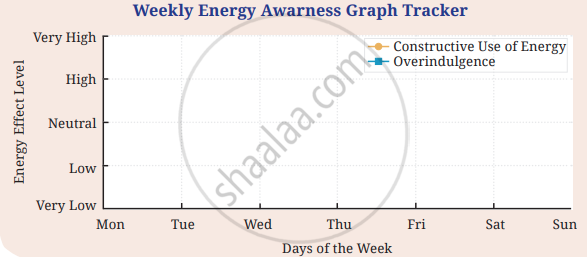
Weekly Energy Awareness Check (7-Day Reflection Chart)
Student Checklist – My energy level today is:
| Energy Level | Tick ✓ the statements that match how you feel |
| Very High Energy | ☐ I feel very active and fresh. |
| ☐ I am excited to do my work or play. | |
| ☐ My mind feels sharp and focused. | |
| ☐ I have a positive, enthusiastic mood. | |
| High Energy | ☐ I feel alert and ready for tasks. |
| ☐ I can concentrate well. | |
| ☐ I feel motivated to complete my work. | |
| Neutral Energy | ☐ I feel okay—not tired, not energetic. |
| ☐ I can do routine tasks without difficulty. | |
| ☐ My mind feels normal, neither fast nor slow. | |
| Low Energy | ☐ I feel tired or sleepy. |
| ☐ It is hard to focus for longer periods. | |
| ☐ I feel lazy or slow in starting tasks. | |
| Very Low Energy | ☐ I feel drained or exhausted. |
| ☐ I want to rest or lie down. | |
| ☐ Even simple work feels difficult. |
Use the checklist to note your energy levels each day for one week. As you observe, think not only about how much energy you have, but also how you use it. Continue this activity for the next two weeks and notice whether your energy is being directed towards meaningful goals like studies, sports, or creative work, or is it getting scattered in distractions such as indulging in excessive screen time or junk food. This activity helps you understand brahmacharya as the wise use of energy.
After completing the previous chart, answer the following questions.
- Which activities gave you the most positive energy this week?
- Which habits made you feel tired, low, or restless?
- What is one healthy change that you practised that you want to continue next week as well?
LET US REFLECT
What is one distraction you could avoid to better concentrate on your goals?
Activity
Value of association
| Question | Your Reflection |
| How do you feel after spending time with your friends/classmates? | |
| Has anyone inspired you to adopt a good habit? What habit was it? | |
| Is there a habit you picked up from peers that you want to change? |
Activity
Track how much time you spend on studying, phone, play, and sleep.
| Day | Study time | Play time | Sleep time | Screen time | Others | How I feel |
Activity
Expression scale for managing adolescent challenges
Read statement carefully. Be honest with yourself and tick the option that best matches how you usually feel or act. The following table will help you understand your emotions and habits so you can manage them.
Anger Management
| Statements | Always | Often | Sometimes | Rarely | Never |
| I lose my temper quickly when things do not go my way. | |||||
| I argue, shout, or fight when I feel angry or upset. | |||||
| I find it hard to calm down once I get angry. | |||||
| I try to relax by taking deep breaths or staying quiet when I'm angry. (positive check) |
Activity
Expression scale for managing adolescent challenges
Read statement carefully. Be honest with yourself and tick the option that best matches how you usually feel or act. The following table will help you understand your emotions and habits so you can manage them.
Emotional Balance and Stress
| Statements | Always | Often | Sometimes | Rarely | Never |
| I feel stressed or pressured because of exams, expectations, or studies. | |||||
| I find it difficult to relax, even during play or free time. | |||||
| I often feel sad, worried, or withdrawn when things go wrong. | |||||
| I practice yoga, breathing, or meditation to calm my mind. (positive check) |
Activity
Expression scale for managing adolescent challenges
Read statement carefully. Be honest with yourself and tick the option that best matches how you usually feel or act. The following table will help you understand your emotions and habits so you can manage them.
Peer Pressure and Substance Use
| Statements | Always | Often | Sometimes | Rarely | Never |
| I have been tempted or pressurised by friends to try harmful substances. | |||||
| I feel that it is difficult to say 'no' to peer pressure. | |||||
| I know that smoking, alcohol, or drugs can harm my health. | |||||
| I choose to stay away from harmful substances. (positive check) | |||||
| I choose to stay with friends who follow healthy habits. |
LET US REFLECT
What situations cause you to feel the most anger or stress?
What helps you calm down — talking, breathing, physical activity or something else?
Who can you talk to when you feel overwhelmed?
Activity
Discuss in your class, the common problems faced during adolescence and their possible solutions.
Maintain a diary to note down your emotions, stress levels, and how yoga helped regulate them.
Enact situations showing peer pressure, stress, or family conflict and present healthy ways to resolve them.
Activity
Track Your Yogic Lifestyle (Weekly Self-Check)
At the end of each week, rate yourself on a scale of 5–1, where 5 = ‘Very Good’, 4 = ‘Good’, 3 = ‘Average’, 2 = ‘Needs Improvement’, and 1 = ‘Needs a Lot of Improvement’.
| Area | Sentences to reflect on | Week 1 | Week 2 | Week 3 | Week 4 |
| Physical Health | I usually choose healthy, home-cooked food | ||||
| I get enough sleep and wake up fresh | |||||
| I practise yoga or physical activity daily | |||||
| Emotional Well-being | I stay calm most of the day | ||||
| I express my feelings instead of holding them in | |||||
| Social Behaviour | I use mobile phones and gadgets wisely | ||||
| I spend time with positive and supportive people | |||||
| I am able to concentrate better in class and studies | |||||
| For girls Only | I take care of my body and rest well during menstruation |
Activity
This activity will help you understand your natural energy pattern and see how sleep and screen time influence your mood and alertness. By observing these daily habits, you become more aware of your circadian rhythm and how it affects your body and mind. This awareness supports the practice of Brahmacharya, as it encourages the wise use of time and energy, and helps in forming healthy habits. Over time, it supports better daily planning, balance, and a more disciplined lifestyle. For the next two weeks, fill in this chart to observe your body rhythm.
| Day | Wakeup Time | Bed Time | Screen Use Before Sleep (Yes/No and Duration) | Time I Felt Most Active | Time I Felt Tired or Low | Mood on Waking Up |
| Day 1 | ||||||
| Day 2 | ||||||
| Day 3 | ||||||
| Day 4 | ||||||
| Day 5 | ||||||
| Day 6 | ||||||
| Day 7 |
NCERT solutions for फिज़िकल एजुकेशन एण्ड वेल-बीइंग खेल प्रवीण [अंग्रेजी] कक्षा ९ 22 Yogamaya Jīvana (Lifestyle for Holistic Health) Check Your Progress [Page 183]
Section A
Answer in one sentence.
What is Mitāhāra?
Answer in one sentence.
Name the three types of foods described in the Bhagavad-Gītā.
Answer in one sentence.
What is the body's natural 24-hour cycle called?
Answer in one sentence.
What does brahmacharya mean in daily life?
Answer in one sentence.
Write one benefit of regular sleep.
Section B
Answer in 2–3 sentences.
How does sleep affect your mood and concentration?
Answer in 2–3 sentences.
Why is it important to choose sāttvika food more often?
Answer in 2–3 sentences.
What changes can you make to reduce distractions in your daily routine?
Answer in 2–3 sentences.
How does practising yoga help during adolescence?
Answer in 2–3 sentences.
Why is good company important for a healthy lifestyle?
Section C
Answer in 3–4 sentences.
Look at your weekly habits. Identify one overindulgence (for example, screen time, junk food, gossip) and explain how you can bring moderation to it.
Answer in 3–4 sentences.
Explain how the circadian rhythm can guide healthy habits in sleep, study, and eating.
Solutions for 22: Yogamaya Jīvana (Lifestyle for Holistic Health)
NCERT solutions for फिज़िकल एजुकेशन एण्ड वेल-बीइंग खेल प्रवीण [अंग्रेजी] कक्षा ९ chapter 22 - Yogamaya Jīvana (Lifestyle for Holistic Health)
Shaalaa.com has the CBSE Mathematics फिज़िकल एजुकेशन एण्ड वेल-बीइंग खेल प्रवीण [अंग्रेजी] कक्षा ९ CBSE solutions in a manner that help students grasp basic concepts better and faster. The detailed, step-by-step solutions will help you understand the concepts better and clarify any confusion. NCERT solutions for Mathematics फिज़िकल एजुकेशन एण्ड वेल-बीइंग खेल प्रवीण [अंग्रेजी] कक्षा ९ CBSE 22 (Yogamaya Jīvana (Lifestyle for Holistic Health)) include all questions with answers and detailed explanations. This will clear students' doubts about questions and improve their application skills while preparing for board exams.
Further, we at Shaalaa.com provide such solutions so students can prepare for written exams. NCERT textbook solutions can be a core help for self-study and provide excellent self-help guidance for students.
Concepts covered in फिज़िकल एजुकेशन एण्ड वेल-बीइंग खेल प्रवीण [अंग्रेजी] कक्षा ९ chapter 22 Yogamaya Jīvana (Lifestyle for Holistic Health) are .
Using NCERT फिज़िकल एजुकेशन एण्ड वेल-बीइंग खेल प्रवीण [अंग्रेजी] कक्षा ९ solutions Yogamaya Jīvana (Lifestyle for Holistic Health) exercise by students is an easy way to prepare for the exams, as they involve solutions arranged chapter-wise and also page-wise. The questions involved in NCERT Solutions are essential questions that can be asked in the final exam. Maximum CBSE फिज़िकल एजुकेशन एण्ड वेल-बीइंग खेल प्रवीण [अंग्रेजी] कक्षा ९ students prefer NCERT Textbook Solutions to score more in exams.
Get the free view of Chapter 22, Yogamaya Jīvana (Lifestyle for Holistic Health) फिज़िकल एजुकेशन एण्ड वेल-बीइंग खेल प्रवीण [अंग्रेजी] कक्षा ९ additional questions for Mathematics फिज़िकल एजुकेशन एण्ड वेल-बीइंग खेल प्रवीण [अंग्रेजी] कक्षा ९ CBSE, and you can use Shaalaa.com to keep it handy for your exam preparation.
