Advertisements
Chapters
*: Bharat Our Land
▶ 2: The Pot Maker
*: Gifts of Grace: Honouring Our Vocations
3: Winds of Change
*: Canvas of Soil
4: Vitamin-M
*: I Cannot Remember My Mother
5: The World of Limitless Possibilities
*: Nine Gold Medals
6: Twin Melodies
*: A Friend Found in Music
7: Carrier of Words
*: Words
8: Follow That Dream
*: Believe in Yourself

Advertisements
Solutions for Chapter 2: The Pot Maker
Below listed, you can find solutions for Chapter 2 of CBSE NCERT for इंग्लिश कावेरी कक्षा ९.
NCERT solutions for इंग्लिश कावेरी कक्षा ९ 2 The Pot Maker Reflect and Respond [Page 33]
Look at the pictures given below and identify the vocations. Now, list at least five more vocations.
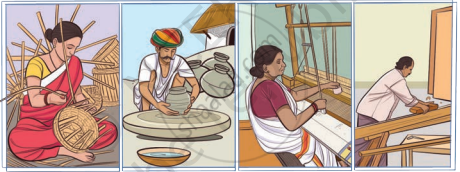
Work in pairs. Discuss the following questions and share your answers with your classmates and teacher.
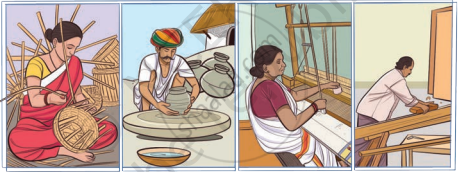
- What is common among these pictures?
- We refer to such skill-based work as
v __ __ a __ __ o __ s. - Mention a few differences between handmade and machine-made products.
NCERT solutions for इंग्लिश कावेरी कक्षा ९ 2 The Pot Maker Intex Questions [Pages 37 - 42]
Check Your Understanding:
Do you think pot making is easy? If yes, why? If no, why not?
Would Sentila be able to fulfil her dream of becoming a pot maker? Explain.
Do you think Mesoba and Arenla would support Sentila? Give a reason.
Check Your Understanding:
Do you think Onula’s support helped Sentila? If yes, why? If no, why not?
Sentila observes her mother making pots. What does this tell us about her?
Arrange the following events of the story in the correct sequence. Share your answer with your classmates and teacher.
| 1. The village council called Mesoba to know about Arenla’s unwillingness to teach pottery to Sentila. | |
| 2. Arenla made a new batch of pots and asked Sentila to continue the work as she was unwell. | |
| 3. Sentila observed how other expert potters crafted beautiful pots. | |
| 4. Sentila was passionate about pottery but did not share it with her mother | |
| 5. Onula guided Sentila in the art of pot making. | |
| 6. Sentila overheard her mother saying that pot making was a tiring job and that she earned very little from it. | |
| 7. Onula observed two rows of pots inside the work shed, which she felt was the work of two people. | |
| 8. Sentila learnt the art of pot making for a year from her mother, but was unsuccessful. | |
| 9. Sentila was able to make pots quickly and skillfully, just one less than her mother’s. |
NCERT solutions for इंग्लिश कावेरी कक्षा ९ 2 The Pot Maker Exercise [Pages 42 - 52]
Critical Reflection:
Read the extract given below and answer the questions that follow.
| Pounding the stubborn clay inside bamboo cylinders to soften it, is also tedious. So many times I’ve dropped the mould out of sheer exhaustion and have had to start all over again. It takes months to bring out a batch of pots after so much labour. And the reward? A few rupees. But if Sentila learns weaving, she can make much more money besides providing enough cloth for the family. Weaving is not messy like pot making and can be done indoors in all seasons. Also, the time spent on weaving one shawl is much less and the return is handsome. |
(i) Choose the correct reason for the given assertion.
(A): The effort in making pots is far greater than the returns.
- The process of pot making is quite tiresome and long, and one hardly earns much.
- The process of pot making is exhausting, takes a long time, yet gives a sense of satisfaction.
(ii) Why does Arenla want Sentila to learn weaving?
(iii) State one advantage that weaving has over pot making, as per the extract.
(iv) Choose the sentence that uses the word ‘handsome’ in the same way as in the extract.
- My father is a handsome man.
- They will make a handsome profit selling this property.
(v) ‘And the reward?’ What is the author’s purpose of using a question mark here?
Read the extract given below and answer the questions that follow.
| Onula saw her taking out some clay and the implements from her basket quietly. She watched Sentila’s clumsy efforts to make a pot and noticed that Sentila was too tense. As a result, the clay seemed unable or unwilling to yield the right shape. When Sentila wearily let the misshapen lump fall flat on the ground, Onula went to her and said, “Don’t worry, little one, I shall teach you how to make a perfect pot.” Sentila watched in amazement as Onula fashioned a beautiful pot and asked her to try again. |
(i) Complete the sentence with an appropriate reason.
Onula feels Sentila’s effort at making a pot is clumsy because ______.
(ii) Choose the correct option to complete the following sentence.
‘Don’t worry, little one, I shall teach you how to make a perfect pot.’
This shows that Onula was ______.
- sincere and generous
- forgiving and thoughtful
- thoughtful and generous
- forgiving and sincere
(iii) Which among the following is the effect of a cause?
- As a result, the clay seemed unable or unwilling to yield the right shape.
- Onula saw her taking out some clay and the implements from her basket quietly.
(iv) ‘Onula fashioned a beautiful pot.’ Here, the word ‘fashioned’ means ______. (created/styled)
(v) How might Sentila have felt when she saw ‘the misshapen lump fall flat on the ground’?
Answer the following questions.
Describe the process of pot making followed by expert pot makers, as observed by Sentila.
What warning was given to Mesoba by the village council?
How did Sentila feel when she failed at pot making even after a year of training with her mother?
‘Onula stood there for a long time as if trying to absorb a new phenomenon’. Explain.
‘The tradition and history of the people did not belong to any individual,’ what does this symbolise?
What is the significance of the concluding line of the story, ‘A new pot maker was born’?
What is the role of perseverance in pursuing one’s dreams? Elaborate with reference to Sentila.
Vocabulary and Structures in Context:
Classify the words/phrases given in the box as shown in the table below. One example for each category has been done for you.
| dao | dough | pounding | bamboo |
| clay | kiln | spatula | basket |
| cylinders | rotating | bed of hay | shaping |
| Tools/Implements | Raw Materials | Process |
| dao | dough | pounding |
Notice the use of the following words in the text.
| pittance | rupees | reward | return |
These words relate to livelihood and economic aspects that are crucial for any enterprise/business/vocation. Work in pairs and find the meanings of the following words related to economy. You may refer to a dictionary.
| bankrupt | credit | currency | debt |
| fiscal | inflation | investment | interest |
Now, frame sentences using each word.
Complete the following sentence with a suitable noun clause.
The elders emphasised that ______.
Complete the following sentence with a suitable noun clause.
Mesoba explained why ______.
Complete the following sentence with a suitable noun clause.
Onula’s promise was that ______.
Complete the following sentence with a suitable noun clause.
Sentila observed her mother carefully when she was shaping the mouth of the pot, which ______.
Complete the following sentence with a suitable noun clause.
The kiln, where ______, required careful attention to prevent over-or-under firing.
Read the following sentence from the text. Underline the main clause and circle the subordinate clause.
Arenla took Sentila to the riverbank where the grey and red clay was found.
Read the following sentence from the text. Underline the main clause and circle the subordinate clause.
She started on the next one, and like a sprinter who had suddenly found momentum...
Read the following sentence from the text. Underline the main clause and circle the subordinate clause.
... skills such as pot making, which not only catered to the needs of the people...
Complete the following sentence with a suitable relative clause.
Sentila, whose ______, practised the craft diligently.
Complete the following sentence with a suitable relative clause.
The village council, where ______, sought an explanation for Arenla’s reluctance.
Complete the following sentence with a suitable relative clause.
The potter’s hands, which ______, shaped the clay into beautiful creations.
Complete the following sentence with a suitable relative clause.
Arenla, her mother, wanted her to learn weaving, which ______.
Complete the following sentence with a suitable relative clause.
Mesoba went home and discussed the matter with Arenla, who ______.
Find out some determiners from the text.
Fill in the banks with suitable determiners. The first two blanks have been done for you.
- The florist arranged five bouquets for her clients, that were displayed in ______ elegant floral shop.
- The carpenter crafted ______ unique tables, and ______ became the centrepiece in ______ furniture collection.
- ______ of ______ apprentices in ______ culinary class demonstrated ______ knife skills during the intense cooking session.
- ______ of ______ sculptures were displayed at ______ art exhibition, showcasing ______ diverse artistic skills.
Listen and Respond:
You will listen to a man speak about stone statues. As you listen, complete the given paragraph by filling in the blanks with the exact words you listen to.
A statue is carved to create a shape that is 1. ______. Among the many things stone is used for making stone 2. ______is one of them. India has some of the most 3. ______stone sculptures, as is obvious from its many stone monuments across the country.
You will now listen to the man speaking about some steps involved in making stone statues. As you listen, select the six correct steps out of the nine given.
- carve to remove large unwanted portions of the stone
- set up the different tools
- measure the weight and dimensions of the statue
- leave the statue in water to firm up overnight
- refine the creation within the stone
- choose the stone
- begin carving from the centre
- detach the creation from the stone as the final statue
- work to bring out the imagined shape
Speaking Activity:
- Work in pairs and choose two characters from the story-Sentila and one other character [Arenla, Mesoba, Onula, or a village elder].
- Prepare to speak from the chosen character’s perspective based on information from the story and the understanding of the intentions of the characters.
- Prepare a role-play between Sentila and the chosen character. The conversation between the characters should cover the following points.
- Sentila’s desire to learn pot making
- the challenges she faces
- the advice or perspective the other character offers
- Students can use direct quotes from the story and creatively expand on the characters’ thoughts and feelings.

You may use the following sentence prompts.
- I feel/felt ______ because...
- I wish/wished ______ because...
- When you said/did ______, it made me feel/think ______ because...
Writing Task:
Reflective writing encourages introspection and thoughtful exploration of personal experiences, skills, and aspirations. It helps individuals gain deeper insights into themselves and their goals through structured reflection.
Follow the steps given below to create a write-up about your skills and passions.
- Step 1: Introduction
Reflect on your passions and the skills you currently possess or are developing. Consider why these activities or interests are meaningful and enjoyable to you. - Step 2: Describing skills
Describe specific activities or practices you engage in to nurture your skills. This could include hobbies, classes (art, music, coding, etc.), workshops, or personal projects. - Step 3: Passion into profession
Identify which of these skills you believe have the potential to turn your passion into a profession. Explain why you think these skills are crucial or advantageous in your chosen field. - Step 4: Examples and reflection
Provide examples or anecdotes that illustrate how your skills and passions complement each other. Reflect on how these experiences have shaped your career aspirations and personal growth. - Step 5: Conclusion
Summarise your reflections. Discuss any insights gained about yourself, your skills, and your career ambitions through this exercise.
Learning Beyond the Text:
Pottery is practised in many parts of our country and each region has its unique style.
Find out about the different styles of indigenous pottery of your region and other regions of our country. Some notable styles include:
- Khurja pottery from Uttar Pradesh
- Blue pottery from Jaipur
- Terracotta from West Bengal
- Andretta pottery from Himachal Pradesh
- Karigari pottery from Tamil Nadu
- Longpi Black pottery from Manipur
Match the pictures with the pottery it represents.
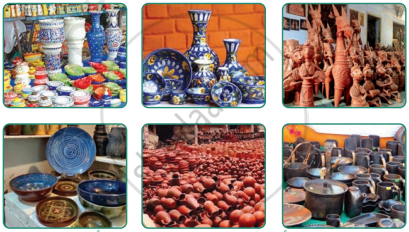
You must have read stories in English and in your own language about the value of handicrafts and art. Read the story ‘Quality’ by John Galsworthy. Write its review and make a presentation highlighting the decline of traditional crafts and skills vs. industrialisation and mass-produced goods.
Solutions for 2: The Pot Maker
NCERT solutions for इंग्लिश कावेरी कक्षा ९ chapter 2 - The Pot Maker
Shaalaa.com has the CBSE Mathematics इंग्लिश कावेरी कक्षा ९ CBSE solutions in a manner that help students grasp basic concepts better and faster. The detailed, step-by-step solutions will help you understand the concepts better and clarify any confusion. NCERT solutions for Mathematics इंग्लिश कावेरी कक्षा ९ CBSE 2 (The Pot Maker) include all questions with answers and detailed explanations. This will clear students' doubts about questions and improve their application skills while preparing for board exams.
Further, we at Shaalaa.com provide such solutions so students can prepare for written exams. NCERT textbook solutions can be a core help for self-study and provide excellent self-help guidance for students.
Concepts covered in इंग्लिश कावेरी कक्षा ९ chapter 2 The Pot Maker are .
Using NCERT इंग्लिश कावेरी कक्षा ९ solutions The Pot Maker exercise by students is an easy way to prepare for the exams, as they involve solutions arranged chapter-wise and also page-wise. The questions involved in NCERT Solutions are essential questions that can be asked in the final exam. Maximum CBSE इंग्लिश कावेरी कक्षा ९ students prefer NCERT Textbook Solutions to score more in exams.
Get the free view of Chapter 2, The Pot Maker इंग्लिश कावेरी कक्षा ९ additional questions for Mathematics इंग्लिश कावेरी कक्षा ९ CBSE, and you can use Shaalaa.com to keep it handy for your exam preparation.
