Advertisements
Chapters
*: Bharat Our Land
2: The Pot Maker
*: Gifts of Grace: Honouring Our Vocations
3: Winds of Change
*: Canvas of Soil
4: Vitamin-M
*: I Cannot Remember My Mother
5: The World of Limitless Possibilities
*: Nine Gold Medals
6: Twin Melodies
*: A Friend Found in Music
7: Carrier of Words
*: Words
8: Follow That Dream
▶ *: Believe in Yourself
Advertisements
Solutions for Chapter *: Believe in Yourself
Below listed, you can find solutions for Chapter * of CBSE NCERT for इंग्लिश कावेरी कक्षा ९.
NCERT solutions for इंग्लिश कावेरी कक्षा ९ * Believe in Yourself Reflect and Respond [Page 245]
Imagine that you are the person in the image.
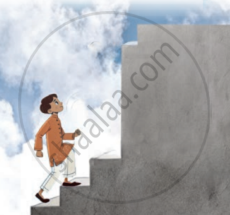
- What emotions do you feel standing at the base of a difficult task?
- What might make you take the first step?
Think about a time when you had to face a challenge.
- What was it, and how did you feel at the start of the journey?
- How did you feel once you made the decision to move forward?
What does the phrase ‘believe in yourself’ mean to you? Write some words or phrases you associate with believing in yourself.
Select the correct meaning of ‘status quo’ based on the given sentence.
Even though some kids wanted to try new activities, most of them were happy with the status quo and didn’t want any changes.
A plan to make things more exciting.
A situation to keep things the same.
A decision where everything is completely different.
A choice to change things quickly without thinking.
NCERT solutions for इंग्लिश कावेरी कक्षा ९ * Believe in Yourself Exercise [Pages 247 - 256]
Based on your understanding of the poem, select the correct central idea for the stanza from the options given.
Stanza 1
Facing challenges requires personal responsibility and a clear focus on one’s future.
Facing challenges is a journey best taken with support and guidance from others.
Based on your understanding of the poem, select the correct central idea for the stanza from the options given.
Stanza 2
Fear and uncertainty make it difficult to make choices as the future approaches.
Facing the future with confidence makes choices easier and more straightforward.
Based on your understanding of the poem, select the correct central idea for the stanza from the options given.
Stanza 3
Personal growth involves finding balance between comfort and change.
Personal growth requires leaving behind comfort and embracing change.
Based on your understanding of the poem, select the correct central idea for the stanza from the options given.
Stanza 4
The first step towards change may feel easy if you place your trust in others to guide you and provide support.
The first step towards change is difficult, but having self-belief and confidence helps you stay on track.
Fill in the blank to complete the following sentence.
Rhyme Scheme:
The poem follows a simple, yet effective rhyme scheme ______ that flows steadily through each stanza.
Tone:
State whether the following statement is true or false.
The overall tone of the poem is motivational and encouraging.
State whether the following statement is true or false.
The tone shifts from thoughtful in the beginning to one of determination by the end of the poem.
Speaker:
Fill in the blanks with the correct options from those given in the brackets.
The speaker in this poem is not distant; rather, he/she comes across as a ______ (stranger/guide) who understands the struggle and is encouraging the reader to take ______ (interest in/control of) his/her own future.
The use of direct address ‘You’ creates a close connection, as though the speaker is ______. (talking directly to the reader/addressing the reader from a distance)
Imagery:
Match the phrases from the poem in Column 1 with the imagery they represent in Column 2. An extra representation is given.
| Column 1 | Column 2 |
| 1. There is no crowd to see... | (i) Represents the difficulty of beginning a new challenge or change. |
| 2. push you back in fear? | (ii) Suggests a solitary journey, stressing individual effort. |
| (iii) Evokes the mental barrier that prevents growth. |
Symbolism:
Select the words/phrases from the box below to complete the given sentences.
| unknown | self-improvement | courage |
| leap of faith | stagnation |
- Comfort and the status quo represent ______ and fear of change, symbolising the comfort zone that holds one back.
- The future symbolises the ______, the potential for change and success that lies ahead but requires ______ to step into.
- The first step symbolises the initial ______ required to begin the journey of ______ or personal development.
Metaphor:
The poet uses a metaphor in the line, ‘The first step is the hardest’. Explain why this is metaphorical.
Identify the lines from the poem that show antithesis and explain why it is so.
Critical Reflection:
Read the extract given below and answer the questions that follow.
| Step up to the challenge There is no crowd to see, It’s just you and the future And where you want to be. |
(i) What does the line, ‘There is no crowd to see’ suggest about facing challenges?
(ii) Complete the following suitably.
The line ‘It’s just you and the future’ suggests that ______.
(iii) Fill in the blank with the appropriate word/phrase from the extract.
Latha will ______ her efforts to improve her vocal performance by practicing harder each day.
(iv) Select the most suitable title for the extract.
- The Struggles of Change
- Facing the Future Alone
- A Journey of Growth
- The Power of Fear
(v) Complete the analogy by using a word from the extract.
achieve : goal : : face : ______
Answer the following questions.
What is the significance of the metaphor, ‘The first step is the hardest’ in the context of personal growth?
What message does the antithesis in the poem convey about the nature of personal development?
Do you think the poet’s message is realistic in the context of real-world struggles?
(Clue: Evaluate whether simply ‘believing in yourself’ is enough to overcome obstacles or other factors are also necessary.)
Consider a situation where you or someone you know had to take a difficult first step towards a goal. How does the poem’s message about the importance of self-belief apply to this situation?
Vocabulary in Context:
Fill in the blank in the given sentence with the Latin expressions used in English from the table.
I enjoy reading fantasy books, ______ Harry Potter and Magical Paint Brush.
Fill in the blank in the given sentence with the Latin expressions used in English from the table.
After helping Tanya with the homework, Ritu asked for a ______ to borrow her notes next time.
Fill in the blank in the given sentence with the Latin expressions used in English from the table.
I love all kinds of outdoor activities, such as trekking, hiking, biking, ______.
Fill in the blank in the given sentence with the Latin expressions used in English from the table.
The park is not very special ______; it becomes more fun when you visit with friends.
Fill in the blank in the given sentence with the Latin expressions used in English from the table.
We created an ______ team to organise the school festival.
Fill in the blank in the given sentence with the Latin expressions used in English from the table.
The movie started ______, with the hero already fighting the villain in a huge battle.
Read the following rhetorical question and state what they intend to achieve.
Isn’t it obvious that we must act now? Don’t we all have a responsibility to make a change?
Read the following rhetorical question and state what they intend to achieve.
Will we let fear control us, or will we rise above it?
Match the situations in Column 1 to the rhetorical questions in Column 2.
| Column 1 | Column 2 |
| (i) Deciding whether to stand up for what is right | A. How can we ever grow if we never try anything new? |
| (ii) Owning up to a mistake made in a group project | B. Isn’t it better to admit our mistakes than to let them define us? |
| (iii) Deciding whether to try something challenging, like public speaking | C. If I don’t take responsibility now, when will I? |
| (iv) Choosing between two career paths | D. Can I really move forward without knowing which path to take? |
| (v) Deciding whether to apologise for a mistake | E. What’s the point of playing it safe if it means staying stuck? |
| (vi) Trying something new and stepping out of your comfort zone | F. How can we stay silent when we know what is right? |
Listen and Respond:
You will listen to a conversation between two friends. As you listen, answer the following questions in one to three exact words that you hear.
How did the boy feel before the play?
You will listen to a conversation between two friends. As you listen, answer the following questions in one to three exact words that you hear.
According to the girl, where does confidence come from?
You will listen to a conversation between two friends. As you listen, answer the following questions in one to three exact words that you hear.
What was the girl finally sure about regarding the boy?
You will once again listen to the conversation. As you listen, select the four true statements from 1-7 given below.
- The boy feels confident but is worried about freezing on stage.
- The girl encourages the boy to push through his doubts by trusting in his preparation.
- The boy thinks that the audience will be supportive regardless of his performance.
- The girl believes that self-doubt is a normal part of preparing for a big performance.
- The boy feels that his preparation is not enough and doubts his abilities, even though he has practiced.
- The girl suggests that the boy should avoid feeling nervous and perform perfectly.
- The girl believes that pushing through nervousness will help the boy grow and build confidence.
Speaking Activity:
Work in pairs. Read the three Sayings/Proverbs given below. For the following, think of a real-life situation where it could apply. Do the suggested role play and use the Saying/Proverb.
Sayings/Proverbs:
Don’t judge a book by its cover.
- Situation to consider: Have you ever misjudged someone based on their appearance or first impression? What happened?
- Role-play: One student acts as someone who judges others based on their looks or first impressions. The other student plays someone who shows the true personality after a deeper conversation, proving that appearances can be deceptive.
Work in pairs. Read the three Sayings/Proverbs given below. For the following, think of a real-life situation where it could apply. Do the suggested role play and use the Saying/Proverb.
Sayings/Proverbs:
Actions speak louder than words.
- Situation to consider: Think of a time when someone’s actions proved more valuable than their words.
- Role-play: One student talks about how they will improve their grades, and the other shows how they actually put in the effort. Compare the impact of talking versus doing.
Work in pairs. Read the three Sayings/Proverbs given below. For the following, think of a real-life situation where it could apply. Do the suggested role play and use the Saying/Proverb.
Sayings/Proverbs:
When the going gets tough, the tough get going.
- Situation to consider: Can you think of a time when you faced a difficult challenge but didn’t give up?
- Role-play: One student plays someone who is giving up on a tough school project, while the other encourages that student to keep going. Show how perseverance leads to success despite difficulties.
Writing Task:
Your class is conducting the morning assembly. You have been asked to deliver a speech on the topic, ‘Turning Challenges into Opportunities’. Draft this speech by following the guidelines given below.
- Opening paragraph: Greet the audience and introduce yourself. Begin with a quotation, a question or a surprising fact. State the purpose of your speech and provide an overview of what you will be talking about.
- Paragraphs 2 and 3-Body of the speech: Divide the body of your speech into two paragraphs, each focusing on a different main point or idea. Use transition words, anecdotes, statistics, and other supporting evidence to strengthen your points.
- Concluding paragraph: Summarise the main points of your speech. End with a statement that leaves a lasting impression on the audience and convey your thanks.
- Use formal language to present ideas clearly
- Use persuasive tone-don’t you agree.../..., isn’t it?
|
Refer to the guidelines given below.
|
Learning Beyond the Text:
Explore the stories of Indian leaders who faced significant challenges and turned them into opportunities for success.
For example:
- Dr. B. R. Ambedkar:
At school, Ambedkar suffered untold humiliations and discrimination but he never gave up.
It was for sheer grit, hardwork, and perseverence that he went on to study Politics and Economics. His self-motivation proved to be a life-changing event not only for him but also for the nation. He is known as a great jurist, economist, and social reformer.
He rose to become the Chairperson of the Drafting Committee of the Constitution of India. - Lal Bahadur Shastri:
He endured many hardships throughout his life. His father passed away when he was just a year and a half old, leaving the family in financial distress. Despite the challenges, he remained committed to his education, often walking several miles barefoot to attend school, even in extreme weather. After graduating from Kashi Vidyapeeth in Varanasi, he was honoured with the title “Shastri,” meaning scholar.
Deeply involved in India’s freedom movement, Shastri was imprisoned multiple times alongside other freedom fighters for his active participation. Following India’s independence, he dedicated himself to the progress and unity of the nation. Through unwavering determination and sincere efforts, Lal Bahadur Shastri rose to become the Prime Minister of India, leaving a legacy of humility, service, and patriotism. - Dr. APJ Abdul Kalam:
Kalam’s family faced financial difficulties, which made it hard for them to support his education fully. To help with his school expenses, Kalam took on a job delivering newspapers early in the morning. He would wake up before dawn, distribute newspapers across the town, and then head to school.
This job was more than just a way to earn money; it was a valuable learning experience for Kalam. Through this work, he learnt the importance of hard work, perseverance, and managing responsibilities. It also gave him a sense of independence and taught him the value of hard work.
He was a renowned scientist, also known as the ‘Missile Man of India’. He rose to become the 11th President of India.
Now, find out about such personalities from your village, town, city, or state and present their success stories in class.
Solutions for *: Believe in Yourself
NCERT solutions for इंग्लिश कावेरी कक्षा ९ chapter * - Believe in Yourself
Shaalaa.com has the CBSE Mathematics इंग्लिश कावेरी कक्षा ९ CBSE solutions in a manner that help students grasp basic concepts better and faster. The detailed, step-by-step solutions will help you understand the concepts better and clarify any confusion. NCERT solutions for Mathematics इंग्लिश कावेरी कक्षा ९ CBSE * (Believe in Yourself) include all questions with answers and detailed explanations. This will clear students' doubts about questions and improve their application skills while preparing for board exams.
Further, we at Shaalaa.com provide such solutions so students can prepare for written exams. NCERT textbook solutions can be a core help for self-study and provide excellent self-help guidance for students.
Concepts covered in इंग्लिश कावेरी कक्षा ९ chapter * Believe in Yourself are .
Using NCERT इंग्लिश कावेरी कक्षा ९ solutions Believe in Yourself exercise by students is an easy way to prepare for the exams, as they involve solutions arranged chapter-wise and also page-wise. The questions involved in NCERT Solutions are essential questions that can be asked in the final exam. Maximum CBSE इंग्लिश कावेरी कक्षा ९ students prefer NCERT Textbook Solutions to score more in exams.
Get the free view of Chapter *, Believe in Yourself इंग्लिश कावेरी कक्षा ९ additional questions for Mathematics इंग्लिश कावेरी कक्षा ९ CBSE, and you can use Shaalaa.com to keep it handy for your exam preparation.
