Advertisements
Chapters
2: Is Matter Around Us Pure
3: Atoms and Molecules
4: Structure of the Atom
5: The Fundamental Unit of Life
6: Tissues
▶ 7: Diversity In Living Organisms
8: Motion
9: Force and Laws of Motion
10: Gravitation
11: Work and Energy
12: Sound
13: Why Do We Fall Ill
14: Natural Resources
15: Improvement In Food Resources

Advertisements
Solutions for Chapter 7: Diversity In Living Organisms
Below listed, you can find solutions for Chapter 7 of CBSE NCERT Exemplar for साइंस इग्ज़ेम्प्लार [अंग्रेजी} कक्षा ९.
NCERT Exemplar solutions for साइंस इग्ज़ेम्प्लार [अंग्रेजी} कक्षा ९ 7 Diversity In Living Organisms Multiple Choice Questions [Pages 48 - 53]
Find out incorrect sentence
Protista includes unicellular eukaryotic organisms
Whittaker considered cell structure, mode, and source of nutrition for classifying the organisms in five kingdoms (c)
Both Monera and Protista may be autotrophic and heterotrophic
Monerans have well-defined nucleus
Which among the following has specialised tissue for conduction of water?
- Thallophyta
- Bryophyta
- Pteridophyta
- Gymnosperms
(i) and (ii)
(ii) and (iii)
(iii) and (iv)
(i) and (iv)
Which among the following produce seeds?
Thallophyta
Bryophyta
Pteridophyta
Gymnosperms
Which one is a true fish?
Jellyfish
Starfish
Dogfish
Silverfish
Which among the following is exclusively marine?
Porifera
Echinodermata
Mollusca
Pisces
Which among the following have an open circulatory system?
- Arthropoda
- Mollusca
- Annelida
- Coelenterata
(i) and (ii)
(iii) and (iv)
(i) and (iii)
(ii) and (iv)
In which group of animals, coelom is filled with blood?
Arthropoda
Annelida
Nematoda
Echinodermata
Elephantiasis is caused by
Wuchereria
Pinworm
Planarians
Liver flukes
Which one is the most striking or (common) character of the vertebrates?
Presence of notochord
Presence of triploblastic condition
Presence of gill pouches
Presence of coelom
Which among the following have scales?
- Amphibians
- Pisces
- Reptiles
- Mammals
(i) and (iii)
(iii) and (iv)
(ii) and (iii)
(i) and (ii)
Find out the false statement
Aves are warm blooded, egg-laying, and have a four-chambered heart
Aves have feather covered body, fore limbs are modified as wing and breathe through lungs
Most of the mammals are viviparous
Fishes, amphibians and reptiles are oviparous
Pteridophyta do not have
root
stem
flowers
leaves
Identify a member of porifera
Spongilla
Euglena
Penicillium
Hydra
Which is not an aquatic animal?
Hydra
Jellyfish
Corals
Filaria
Amphibians do not have the following
Three chambered heart
Gills or lungs
Scales
Mucus glands
Organisms without nucleus and cell organelles belong to
- fungi
- protista
- cyano bacteria
- archae bacteria
(i) and (ii)
(iii) and (iv)
(i) and (iv)
(ii) and (iii)
Which of the following is not a criterion for classification of living organisms?
Body design of the organism
Ability to produce one’s own food
Membrane bound nucleus and cell organelles
Height of the plant
The feature that is not a characteristic of protochordata?
Presence of notochord
Bilateral symmetry and coelom
Jointed legs
Presence of circulatory system
The locomotory organs of Echinodermata are
tube feet
muscular feet
jointed legs
parapodia
Corals are
Poriferans attached to some solid support
Cnidarians, that are solitary living
Poriferans present at the sea bed
Cnidarians that live in colonies
Who introduced the system of scientific nomenclature of organisms
Robert Whittaker
Carolus Linnaeus
Robert Hooke
Ernst Haeckel
Two chambered heart occurs in
crocodiles
fish
aves
amphibians
Skeleton is made entirely of cartilage in
Sharks
Tuna
Rohu
None of these
One of the following is not an Annelid
Nereis
Earthworm
Leech
Urchins
The book Systema Naturae was written by
Linnaeus
Haeckel
Whittaker
Robert Brown
Karl Von Linne was involved with which branch of science?
Morphology
Taxonomy
Physiology
Medicine
Real organs are absent in
Mollusca
Coelenterata
Arthropoda
Echinodermata
Hard calcium carbonate structures are used as skeleton by
Echinodermata
Protochordata
Arthropoda
Nematoda
Differentiation in segmental fashion occurs in
Leech
Starfish
Snails
Ascaris
In taxonomic hierarchy family comes between
Class and Order
Order and Genus
Genus and Species
Division and Class
5-Kingdom classification has given by
Morgan
R. Whittaker
Linnaeus
Haeckel
Well defined nucleus is absent in
blue green algae
diatoms
algae
yeast
The ‘Origin of Species’ is written by
Linnaeus
Darwin
Hackel
Whittaker
Meena and Hari observed an animal in their garden. Hari called it an insect while Meena said it was an earthworm. Choose the character from the following which confirms that it is an insect.
Bilateral symmetrical body
Body with jointed legs
Cylindrical body
Body with little segmentation
NCERT Exemplar solutions for साइंस इग्ज़ेम्प्लार [अंग्रेजी} कक्षा ९ 7 Diversity In Living Organisms Short Answer Questions [Pages 53 - 55]
Write true (T) or false (F)
Whittaker proposed five kingdom classification.
True
False
Write true (T) or false (F)
Monera is divided into Archaebacteria and Eubacteria.
True
False
Write true (T) or false (F)
Starting from Class, Species comes before the Genus.
True
False
Write true (T) or false (F)
Anabaena belongs to the kingdom Monera.
True
False
Write true (T) or false (F)
Blue green algae belongs to the kingdom Protista.
True
False
Write true (T) or false (F)
All prokaryotes are classified under Monera.
True
False
Fill in the blanks
Fungi shows ______ mode of nutrition.
Cell wall of fungi is made up of ______.
Association between blue green algae and fungi is called as ______.
Chemical nature of chitin is ______.
______ has smallest number of organisms with maximum number of similar characters
Plants without well differentiated stem, root and leaf are kept in ______.
______ are called as amphibians of the plant kingdom.
You are provided with the seeds of gram, wheat, rice, pumpkin, maize, and pea. Classify them whether they are monocot or dicot.
Match items of column (A) with items of column (B)
| (A) | (B) | ||
| (a) | Naked seed | (A) | Angiosperms |
| (b) | Covered seed | (B) | Gymnosperms |
| (c) | Flagella | (C) | Bryophytes |
| (d) | Marchantia | (D) | Euglena |
| (e) | Marsilea | (E) | Thallophyta |
| (f) | Cladophora | (F) | Pteridophyta |
| (g) | Penicillium | (G) | Fungi |
Match items of column (A) with items of column (B)
| (A) | (B) | ||
| (a) | Pore bearing animals | (A) | Arthropoda |
| (b) | Diploblastic | (B) | Coelenterata |
| (c) | Metameric segmentation | (C) | Porifera |
| (d) | Jointed legs | (D) | Echinodermata |
| (e) | Soft bodied animals | (E) | Mollusca |
| (f) | Spiny skinned animals | (F) | Annelida |
Classify the following organisms based on the absence/presence of true coelom (i.e., acoelomate, pseudocoelomate and coelomate)
Spongilla, Sea anemone, Planaria, Liver fluke Wuchereria, Ascaris, Nereis, Earthworm, Scorpion, Birds, Fishes, Horse.
Endoskeleton of fishes are made up of cartilage and bone; classify the following fishes as cartilagenous or bony
Torpedo, Sting ray, Dogfish, Rohu, Angler fish, Exocoetus.
Classify the following based on number of chambers in their heart.
Rohu, Scoliodon, Frog, Salamander, Flying lizard, King Cobra, Crocodile, Ostrich, Pigeon, Bat, Whale
Classify Rohu, Scolidon, Flying lizard, King Kobra, Frog, Salamander, Ostrich, Pigeon, Bat, Crocodile, and Whale into the cold-blooded/warm-blooded animals.
Name two egg-laying mammals.
Fill in the blanks
Five kingdom classification of living organisms is given by ______.
Basic smallest unit of classification is ______.
Prokaryotes are grouped in Kingdom ______.
Paramecium is a protista because of its ______.
Fungi do not contain ______.
A fungus ______ can be seen without microscope.
Common fungi used in preparing the bread is ______.
Algae and fungi form symbiotic association called ______.
Give True (T) and False (F)
Gymnosperms differ from Angiosperms in having covered seed.
True
False
Give True (T) and False (F)
Non flowering plants are called Cryptogamae.
True
False
Give True (T) and False (F)
Bryophytes have conducting tissue.
True
False
Give True (T) and False (F)
Funaria is a moss.
True
False
Give True (T) and False (F)
Compound leaves are found in many ferns.
True
False
Give True (T) and False (F)
Seeds contain embryo
True
False
Give examples for the following
Bilateral, dorsiventral symmetry is found in ______.
Give examples for the following
Worms causing disease elephantiasis is______.
Give examples for the following
Open circulatory system is found in ______ where coelomic cavity is filled with blood.
Give examples for the following
______ are known to have pseudocoelom.
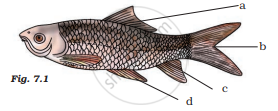
Label a,b,c and d. given in Fig. 7.1 Give the function of (b)
Fill in the boxes given in Fig. 7.2 with appropriate characteristics/plant group (s)

NCERT Exemplar solutions for साइंस इग्ज़ेम्प्लार [अंग्रेजी} कक्षा ९ 7 Diversity In Living Organisms Long Answer Questions [Page 56]
Write names of few thallophytes. Draw a labelled diagram of Spirogyra.
Thallophyta, bryophyta and pteridophyta are called as ‘Cryptogams’. Gymnosperms and Angiosperms are called as ‘phanerogams’. Discuss why? Draw one example of Gymnosperm.
Define the term:
Bilateral symmetry
Give one example of bilateral symmetry.
Define the terms and give one example
Coelom
Define the terms and give one example
Triploblastic
You are given leech, Nereis, Scolopendra, prawn and scorpion; and all have segmented body organisation. Will you classify them in one group? If no, give the important characters based on which you will separate these organisms into different groups.
Which organism is more complex and evolved among Bacteria, Mushroom, and Mango trees. Give reasons.
Differentiate between flying lizard and bird. Draw the diagram.
List out some common features in cat, rat, and bat.
Why do we keep both snake and turtle in the same class?
Solutions for 7: Diversity In Living Organisms
NCERT Exemplar solutions for साइंस इग्ज़ेम्प्लार [अंग्रेजी} कक्षा ९ chapter 7 - Diversity In Living Organisms
Shaalaa.com has the CBSE Mathematics साइंस इग्ज़ेम्प्लार [अंग्रेजी} कक्षा ९ CBSE solutions in a manner that help students grasp basic concepts better and faster. The detailed, step-by-step solutions will help you understand the concepts better and clarify any confusion. NCERT Exemplar solutions for Mathematics साइंस इग्ज़ेम्प्लार [अंग्रेजी} कक्षा ९ CBSE 7 (Diversity In Living Organisms) include all questions with answers and detailed explanations. This will clear students' doubts about questions and improve their application skills while preparing for board exams.
Further, we at Shaalaa.com provide such solutions so students can prepare for written exams. NCERT Exemplar textbook solutions can be a core help for self-study and provide excellent self-help guidance for students.
Concepts covered in साइंस इग्ज़ेम्प्लार [अंग्रेजी} कक्षा ९ chapter 7 Diversity In Living Organisms are Introduction of Biological Classification, Classification of Living Organisms, Taxonomic Hierarchy of Living Organisms: Unit of Classification, Five Kingdom Classification, Kingdom Monera, Kingdom Protista, Kingdom Fungi, Kingdom Animalia, Differences Between Plantae (Plants) and Animalia (Animals), Sub-division Algae, Kingdom Plantae: Thallophyta (Fungi), Kingdom Animalia, Phylum: Porifera, Phylum: Cnidaria/Coelenterata, Phylum: Platyhelminthes, Invertebrate: Phylum Nematoda, Phylum: Annelida, Phylum: Arthropoda, Phylum: Mollusca, Phylum: Echinodermata, Subphylum: Prochordata, Invertebrata and Vertebrata, Taxonomy and Systematics, Kingdom Plantae, Kingdom Plantae, Cryptogams > Division II- Bryophytes, Cryptogams > Division III- Pteridophytes, Phanerogams > Division I-Gymnosperms, Phanerogams > Division II- Angiosperms, Subphylum: Vertebrata/Craniata, Nomenclature.
Using NCERT Exemplar साइंस इग्ज़ेम्प्लार [अंग्रेजी} कक्षा ९ solutions Diversity In Living Organisms exercise by students is an easy way to prepare for the exams, as they involve solutions arranged chapter-wise and also page-wise. The questions involved in NCERT Exemplar Solutions are essential questions that can be asked in the final exam. Maximum CBSE साइंस इग्ज़ेम्प्लार [अंग्रेजी} कक्षा ९ students prefer NCERT Exemplar Textbook Solutions to score more in exams.
Get the free view of Chapter 7, Diversity In Living Organisms साइंस इग्ज़ेम्प्लार [अंग्रेजी} कक्षा ९ additional questions for Mathematics साइंस इग्ज़ेम्प्लार [अंग्रेजी} कक्षा ९ CBSE, and you can use Shaalaa.com to keep it handy for your exam preparation.
