Advertisements
Advertisements
Change in internal energy, when 4 kJ of work is done on the system and 1 kJ of heat is given out by the system is
Concept: undefined >> undefined
The temperature of the system, decreases in an ___________.
Concept: undefined >> undefined
Advertisements
In an isothermal reversible compression of an ideal gas the sign of q, ∆S and w are respectively
Concept: undefined >> undefined
Explain intensive properties with two examples.
Concept: undefined >> undefined
Define the following term:
Adiabatic process
Concept: undefined >> undefined
Define the following term:
Isobaric process
Concept: undefined >> undefined
Define the following term:
Isochoric process
Concept: undefined >> undefined
List the characteristics of internal energy.
Concept: undefined >> undefined
Calculate the work involved in the expansion and compression process.
Concept: undefined >> undefined
Calculate the work done when 2 moles of an ideal gas expands reversibly and isothermally from a volume of 500 ml to a volume of 2 L at 25°C and normal pressure.
Concept: undefined >> undefined
Structure of the compound whose IUPAC name is 5, 6 – dimethylhept - 2 - ene is
Concept: undefined >> undefined
How many cyclic and acyclic isomers are possible for the molecular formula C3H6O?
Concept: undefined >> undefined
Give the general characteristics of organic compounds.
Concept: undefined >> undefined
Describe the classification of organic compounds based on their structure.
Concept: undefined >> undefined
Write a note on homologous series.
Concept: undefined >> undefined
Write the molecular formula and possible structural formula of the first four members of homologous series of carboxylic acids.
Concept: undefined >> undefined
Write the molecular formula of the first six members of homologous series of nitro – alkanes.
Concept: undefined >> undefined
Give example for the following type of organic reaction.
Electrophilic substitution
Concept: undefined >> undefined
\[\ce{C2H5Br + 2Na ->[dry ether]C4H10 + 2NaBr}\]
The above reaction is an example of which of the following.
Concept: undefined >> undefined
In the following reaction,
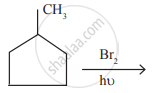
The major product obtained is
Concept: undefined >> undefined
