Advertisements
Advertisements
In the given figure, if AB || CD || FE then find x and AE.
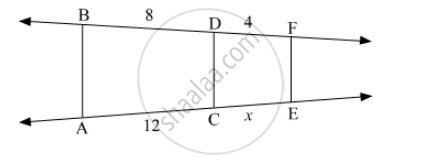
Concept: undefined >> undefined
In ∆LMN, ray MT bisects ∠LMN If LM = 6, MN = 10, TN = 8, then Find LT.
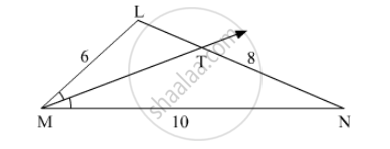
Concept: undefined >> undefined
Advertisements
In ∆ABC, seg BD bisects ∠ABC. If AB = x, BC = x + 5, AD = x – 2, DC = x + 2, then find the value of x.

Concept: undefined >> undefined
∆PQR ~ ∆LTR. In ∆PQR, PQ = 4.2 cm, QR = 5.4 cm, PR = 4.8 cm. Construct ∆PQR and ∆LTR, such that `"PQ"/"LT" = 3/4`.
Concept: undefined >> undefined
∆AMT ~ ∆AHE. In ∆AMT, AM = 6.3 cm, ∠TAM = 50°, AT = 5.6 cm, `(AM)/(AH) = 7/5`. Construct ∆AHE.
Concept: undefined >> undefined
∆ABC ~ ∆LBN. In ∆ABC, AB = 5.1 cm, ∠B = 40°, BC = 4.8 cm, \[\frac{AC}{LN} = \frac{4}{7}\]. Construct ∆ABC and ∆LBN.
Concept: undefined >> undefined
Construct ∆PYQ such that, PY = 6.3 cm, YQ = 7.2 cm, PQ = 5.8 cm. If \[\frac{YZ}{YQ} = \frac{6}{5},\] then construct ∆XYZ similar to ∆PYQ.
Concept: undefined >> undefined
Find the ratio in which point T(–1, 6)divides the line segment joining the points P(–3, 10) and Q(6, –8).
Concept: undefined >> undefined
Find the ratio in which point P(k, 7) divides the segment joining A(8, 9) and B(1, 2). Also find k.
Concept: undefined >> undefined
Find the co-ordinates of the points of trisection of the line segment AB with A(2, 7) and B(–4, –8).
Concept: undefined >> undefined
If A(–14, –10), B(6, –2) is given, find the coordinates of the points which divide segment AB into four equal parts.
Concept: undefined >> undefined
If A (20, 10), B(0, 20) are given, find the coordinates of the points which divide segment AB into five congruent parts.
Concept: undefined >> undefined
In ∆PQR seg PM is a median. Angle bisectors of ∠PMQ and ∠PMR intersect side PQ and side PR in points X and Y respectively. Prove that XY || QR.
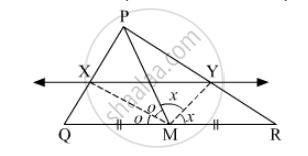
Complete the proof by filling in the boxes.
In △PMQ, ray MX is bisector of ∠PMQ.
∴ `square/square = square/square` .......... (I) theorem of angle bisector.
In △PMR, ray MY is bisector of ∠PMQ.
∴ `square/square = square/square` .......... (II) theorem of angle bisector.
But `(MP)/(MQ) = (MP)/(MR)` .......... M is the midpoint QR, hence MQ = MR.
∴ `(PX)/(XQ) = (PY)/(YR)`
∴ XY || QR .......... converse of basic proportionality theorem.
Concept: undefined >> undefined
In the given fig, bisectors of ∠B and ∠C of ∆ABC intersect each other in point X. Line AX intersects side BC in point Y. AB = 5, AC = 4, BC = 6 then find `"AX"/"XY"`.
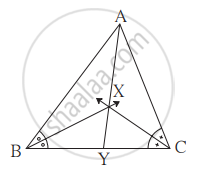
Concept: undefined >> undefined
In ▢ABCD, seg AD || seg BC. Diagonal AC and diagonal BD intersect each other in point P. Then show that `"AP"/"PD" = "PC"/"BP"`.

Concept: undefined >> undefined
Prove that:
`(sin^2θ)/(cosθ) + cosθ = secθ`
Concept: undefined >> undefined
Prove that:
Sin4θ - cos4θ = 1 - 2cos2θ
Concept: undefined >> undefined
Prove that:
`"tan A"/(1 + "tan"^2 "A")^2 + "Cot A"/(1 + "Cot"^2 "A")^2 = "sin A cos A"`.
Concept: undefined >> undefined
Prove that:
`"tanθ"/("secθ" – 1) = (tanθ + secθ + 1)/(tanθ + secθ - 1)`
Concept: undefined >> undefined
Given A(4, –3), B(8, 5). Find the coordinates of the point that divides segment AB in the ratio 3 : 1.
Concept: undefined >> undefined
