Advertisements
Advertisements
प्रश्न
What is the distance of the point (– 5, 4) from the origin?
विकल्प
3 units
`sqrt(14)` units
`sqrt(31)` units
`sqrt(41)` units
Advertisements
उत्तर
`sqrt(41)` units
Explanation:
Given points are (– 5, 4) and (0, 0).
Distance = `sqrt((x_2 - x_1)^2 + (y_2 - y_1)^2`
Here, x1 = – 5, y1 = 4, x2 = 0, y2 = 0
∴ Distance = `sqrt((0 - (- 5))^2 + (0 - 4)^2`
= `sqrt(5^2 + 4^2)`
= `sqrt(25 + 16)`
= `sqrt(41)`
Thus, the distance is `sqrt(41)` units.
APPEARS IN
संबंधित प्रश्न
Find the coordinates of the centre of the circle passing through the points (0, 0), (–2, 1) and (–3, 2). Also, find its radius.
Find a relation between x and y such that the point (x, y) is equidistant from the point (3, 6) and (–3, 4).
ABC is a triangle and G(4, 3) is the centroid of the triangle. If A = (1, 3), B = (4, b) and C = (a, 1), find ‘a’ and ‘b’. Find the length of side BC.
Find the distance of the following points from the origin:
C(–4, –6)
Find the values of x for which the distance between the points P(x, 4) and Q(9, 10) is 10 units.
Find the distance between the following pairs of point.
W `((- 7)/2 , 4)`, X (11, 4)
Determine whether the point is collinear.
R(0, 3), D(2, 1), S(3, –1)
Find the distance between the following pairs of point in the coordinate plane :
(7 , -7) and (2 , 5)
Find the distance between the following point :
(Sin θ - cosec θ , cos θ - cot θ) and (cos θ - cosec θ , -sin θ - cot θ)
Find the value of a if the distance between the points (5 , a) and (1 , 5) is 5 units .
Prove that the points (6 , -1) , (5 , 8) and (1 , 3) are the vertices of an isosceles triangle.
Prove that the points (0,3) , (4,3) and `(2, 3+2sqrt 3)` are the vertices of an equilateral triangle.
Find the distance between the following pairs of points:
`(3/5,2) and (-(1)/(5),1(2)/(5))`
Given A = (3, 1) and B = (0, y - 1). Find y if AB = 5.
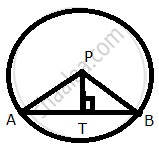
Point P (2, -7) is the center of a circle with radius 13 unit, PT is perpendicular to chord AB and T = (-2, -4); calculate the length of: AT
Calculate the distance between A (5, -3) and B on the y-axis whose ordinate is 9.
Find distance between point Q(3, –7) and point R(3, 3)
Solution: Suppose Q(x1, y1) and point R(x2, y2)
x1 = 3, y1 = –7 and x2 = 3, y2 = 3
Using distance formula,
d(Q, R) = `sqrt(square)`
∴ d(Q, R) = `sqrt(square - 100)`
∴ d(Q, R) = `sqrt(square)`
∴ d(Q, R) = `square`
Show that the points (0, –1), (8, 3), (6, 7) and (–2, 3) are vertices of a rectangle.
AOBC is a rectangle whose three vertices are A(0, 3), O(0, 0) and B(5, 0). The length of its diagonal is ______.
