Advertisements
Advertisements
प्रश्न
Draw a line segment AB of length 10 cm and divide it internally in the ratio of 2:5 Justify the division of line segment AB.
Advertisements
उत्तर

Steps of construction:
- Draw a line segment AB of length 10 cm.
- Draw a line AX making an acute angle with AB.
- Mark 7 points A1, A2, A3, ...... A7 along AX such that AA1 = A1A2 = A1A3 = ...... = A6A7.
- Join point B with point A7.
- Through the point A2, draw a line parallel to A7B by making an angle equal to ∠AA7B at A2. This line meets AB at a point P.
As a result, point P is necessary to divide line AB internally in the ratio of 2 : 5.
Justification: In ΔAA7B, A2P || A7B.
As a result of the basic proportionality theorem,
`(A A_2)/(A_2A_7) = (AP)/(PB)` .......(i)
By the above construction,
`(A A_2)/(A_2A_7) = 2/5` ......(ii)
By equations (i) and (ii),
`(AP)/(PB) = 2/5`
Thus, AP : PB = 2 : 5
As a result, P splits the line AB in the ratio 2 : 5.
APPEARS IN
संबंधित प्रश्न
Construct a triangle ABC in which AB = 5 cm, BC = 6 cm and ∠ABC = 60˚. Now construct another triangle whose sides are 5/7 times the corresponding sides of ΔABC.
Construct a triangle ABC with BC = 7 cm, ∠B = 60° and AB = 6 cm. Construct another triangle whose sides are `3/4` times the corresponding sides of ∆ABC.
Construct a triangle with sides 5 cm, 6 cm and 7 cm and then another triangle whose sides are `7/5` of the corresponding sides of the first triangle. Give the justification of the construction.
Construct an isosceles triangle whose base is 8 cm and altitude 4 cm and then another triangle whose side are `1 1/2` times the corresponding sides of the isosceles triangle.
Give the justification of the construction
Draw a ΔABC in which BC = 6 cm, AB = 4 cm and AC = 5 cm. Draw a triangle similar to ΔABC with its sides equal to (3/4)th of the corresponding sides of ΔABC.
Draw a triangle ABC with side BC = 6 cm, ∠C = 30° and ∠A = 105°. Then construct another triangle whose sides are `2/3` times the corresponding sides of ΔABC.
Construct ∆PYQ such that, PY = 6.3 cm, YQ = 7.2 cm, PQ = 5.8 cm. If \[\frac{YZ}{YQ} = \frac{6}{5},\] then construct ∆XYZ similar to ∆PYQ.
Find the co-ordinates of the points of trisection of the line segment AB with A(2, 7) and B(–4, –8).
Draw a line segment AB of length 7 cm. Using ruler and compasses, find a point P on AB such that `(AP)/(AB)=3/5`.
Δ SHR ∼ Δ SVU. In Δ SHR, SH = 4.5 cm, HR = 5.2 cm, SR = 5.8 cm and
SHSV = 53 then draw Δ SVU.
Draw seg AB of length 9.7 cm. Take a point P on it such that A-P-B, AP = 3.5 cm. Construct a line MN ⊥ sag AB through point P.
Find the ratio in which the segment joining the points (1, –3) and (4, 5) is divided by the x-axis? Also, find the coordinates of this point on the x-axis.
Points P and Q trisect the line segment joining the points A(−2, 0) and B(0, 8) such that P is near to A. Find the coordinates of points P and Q.
If the point P(6, 7) divides the segment joining A(8, 9) and B(1, 2) in some ratio, find that ratio.
Solution:
Point P divides segment AB in the ratio m : n.
A(8, 9) = (x1, y1), B(1, 2) = (x2, y2) and P(6, 7) = (x, y)
Using Section formula of internal division,
∴ `7 = (m(square) - n(9))/(m + n)`
∴ 7m + 7n = `square` + 9n
∴ 7m – `square` = 9n – `square`
∴ `square` = 2n
∴ `m/n = square`
Point P divides the line segment joining R(-1, 3) and S(9,8) in ratio k:1. If P lies on the line x - y + 2 = 0, then value of k is ______.
To construct a triangle similar to a given ΔABC with its sides `3/7` of the corresponding sides of ΔABC, first draw a ray BX such that ∠CBX is an acute angle and X lies on the opposite side of A with respect to BC. Then locate points B1, B2, B3, ... on BX at equal distances and next step is to join ______.
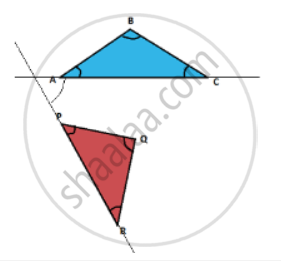
If the perpendicular distance between AP is given, which vertices of the similar triangle would you find first?

If you need to construct a triangle with point P as one of its vertices, which is the angle that you need to construct a side of the triangle?
Two line segments AB and AC include an angle of 60° where AB = 5 cm and AC = 7 cm. Locate points P and Q on AB and AC, respectively such that AP = `3/4` AB and AQ = `1/4` AC. Join P and Q and measure the length PQ.
