Advertisements
Advertisements
A solid is completely immersed in a liquid. The force exerted by the liquid on the solid will
(a) increase if it is pushed deeper inside the liquid
(b) change if its orientation is changed
(c) decrease if it is taken partially out of the liquid
(d) be in the vertically upward direction.
Concept: undefined >> undefined
An ornament weighing 36 g in air, weighs only 34 g in water. Assuming that some copper is mixed with gold to prepare the ornament, find the amount of copper in it. Specific gravity of gold is 19.3 and that of copper is 8.9.
Concept: undefined >> undefined
Advertisements
Refer to the previous problem. Suppose, the goldsmith argues that he has not mixed copper or any other material with gold, rather some cavities might have been left inside the ornament. Calculate the volume of the cavities left that will allow the weights given in that problem.
Concept: undefined >> undefined
A cylindrical object of outer diameter 20 cm and mass 2 kg floats in water with its axis vertical. If it is slightly depressed and then released, find the time period of the resulting simple harmonic motion of the object.
Concept: undefined >> undefined
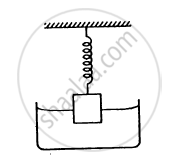
A cylindrical object of outer diameter 10 cm, height 20 cm and density 8000 kg/m3 is supported by a vertical spring and is half dipped in water as shown in figure. (a) Find the elongation of the spring in equilibrium condition. (b) If the object is slightly depressed and released, find the time period of resulting oscillations of the object. The spring constant = 500 N/m.
Concept: undefined >> undefined
A cube of ice of edge 4 cm is placed in an empty cylindrical glass of inner diameter 6 cm. Assume that the ice melts uniformly from each side so that it always retains its cubical shape. Remembering that ice is lighter than water, find the length of the edge of the ice cube at the instant it just leaves contact with the bottom of the glass.
Concept: undefined >> undefined
If a particle is accelerating, it is either speeding up or speeding down. Do you agree with this statement?
Concept: undefined >> undefined
Give example where the velocity of a particle is zero but its acceleration is not zero.
Concept: undefined >> undefined
Give example where the velocity is opposite in direction to the acceleration.
Concept: undefined >> undefined
Give example where the velocity is perpendicular to the acceleration.
Concept: undefined >> undefined
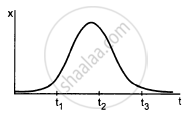
In figure shows the x coordinate of a particle as a function of time. Find the sings of vx and ax at t = t1, t = t2 and t = t3.
Concept: undefined >> undefined
A stone is released from an elevator going up with an acceleration a. The acceleration of the stone after the release is
Concept: undefined >> undefined
The accelerations of a particle as seen from two frames S1 and S2 have equal magnitude 4 m/s2.
Concept: undefined >> undefined
An object having a velocity 4.0 m/s is accelerated at the rate of 1.2 m/s2 for 5.0 s. Find the distance travelled during the period of acceleration.
Concept: undefined >> undefined
What can be said about the centre of mass of a uniform hemisphere without making any calculation? Will its distance from the centre be more than r/2 or less than r/2?
Concept: undefined >> undefined
A uniform sphere is placed on a smooth horizontal surface and a horizontal force F is applied on it at a distance h above the surface. The acceleration of the centre
Concept: undefined >> undefined
A heavy ring of mass m is clamped on the periphery of al light circular disc. A small particle having equal mass is clamped at the centre of the disc. The system is rotated in such a way that the centre moves in a circle of radius r with a uniform speed v. We conclude that an external force
Concept: undefined >> undefined
A uniform disc of radius R is put over another uniform disc of radius 2R of the same thickness and density. The peripheries of the two discs touch each other. Locate the centre of mass of the system.
Concept: undefined >> undefined
A disc of radius R is cut out from a larger disc of radius 2R in such a way that the edge of the hole touches the edge of the disc. Locate the centre of mass of the residual disc.
Concept: undefined >> undefined
One end of a uniform rod of mass m and length l is clamped. The rod lies on a smooth horizontal surface and rotates on it about the clamped end at a uniform angular velocity \[\omega\] The force exerted by the clamp on the rod has a horizontal component
Concept: undefined >> undefined
