Advertisements
Advertisements
प्रश्न
A stone is released from an elevator going up with an acceleration a. The acceleration of the stone after the release is
विकल्प
a upward
(g − a) upward
(g − a) downward
g downward
Advertisements
उत्तर
g downward
Gravity is the only force acting on the stone when it is released. And, we know that gravity is always in the downward direction.
APPEARS IN
संबंधित प्रश्न
Read the statement below carefully and state, with reason and example, if it is true or false:
A particle in one-dimensional motion with constant speed must have zero acceleration.
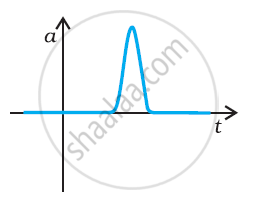
Suggest a suitable physical situation for the following graph:
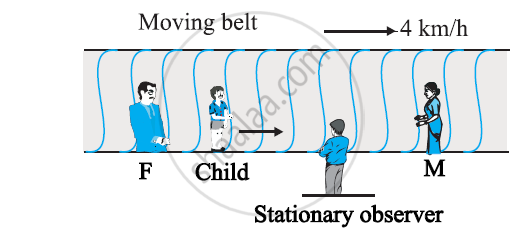
On a long horizontally moving belt (Fig. 3.26), a child runs to and fro with a speed 9 km h–1 (with respect to the belt) between his father and mother located 50 m apart on the moving belt. The belt moves with a speed of 4 km h–1. For an observer on a stationary platform outside, what is the
(a) speed of the child running in the direction of motion of the belt ?.
(b) speed of the child running opposite to the direction of motion of the belt ?
(c) time taken by the child in (a) and (b) ?
Which of the answers alter if motion is viewed by one of the parents?
If a particle is accelerating, it is either speeding up or speeding down. Do you agree with this statement?
Give example where the velocity is opposite in direction to the acceleration.
Give example where the velocity is perpendicular to the acceleration.
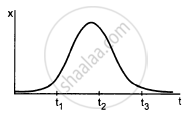
In figure shows the x coordinate of a particle as a function of time. Find the sings of vx and ax at t = t1, t = t2 and t = t3.
The accelerations of a particle as seen from two frames S1 and S2 have equal magnitude 4 m/s2.
An object having a velocity 4.0 m/s is accelerated at the rate of 1.2 m/s2 for 5.0 s. Find the distance travelled during the period of acceleration.
If the velocity of a car is given by V = (150 − 10x)½ m/s. If a car retards their motion by applying brakes then what will be the acceleration?
A lift is coming from 8th floor and is just about to reach 4th floor. Taking ground floor as origin and positive direction upwards for all quantities, which one of the following is correct?
A graph of x versus t is shown in figure. Choose correct alternatives from below.
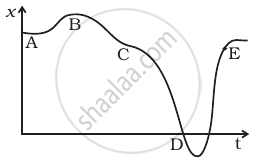
- The particle was released from rest at t = 0.
- At B, the acceleration a > 0.
- At C, the velocity and the acceleration vanish.
- Average velocity for the motion between A and D is positive.
- The speed at D exceeds that at E.
Give example of a motion where x > 0, v < 0, a > 0 at a particular instant.
An object falling through a fluid is observed to have acceleration given by a = g – bv where g = gravitational acceleration and b is constant. After a long time of release, it is observed to fall with constant speed. What must be the value of constant speed?
The dimensional formula for acceleration is ______.
What does the area under a velocity-time curve represent?
A car's velocity changes from 10 m/s to 25 m/s in 3 seconds. What is its average acceleration?
A vehicle applies its brakes and slows down uniformly. This is an example of ______.
Acceleration is defined as ______.
A velocity–time graph is a straight line with zero slope. What does this indicate about the motion?
For a body starting from rest and moving with uniform positive acceleration, the distances covered in successive equal time intervals are in the ratio ______.
A ball is thrown straight up from the ground at 15 m/s. At the same time, another ball is dropped from rest from a height of 30 m. If g = 10 m/s2, at what height above the ground do they meet?
Instantaneous acceleration of a particle is correctly expressed as ______.
