Please select a subject first
Advertisements
Advertisements
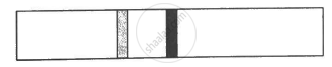
Figure shows a cylindrical tube with adiabatic walls and fitted with an adiabatic separator. The separator can be slid into the tube by an external mechanism. An ideal gas (γ = 1.5) is injected in the two sides at equal pressures and temperatures. The separator remains in equilibrium at the middle. It is now slid to a position where it divides the tube in the ratio 1 : 3. Find the ratio of the temperatures in the two parts of the vessel.
Concept: undefined >> undefined
Two vessels A and B of equal volume V0 are connected by a narrow tube that can be closed by a valve. The vessels are fitted with pistons that can be moved to change the volumes. Initially, the valve is open and the vessels contain an ideal gas (Cp/Cv = γ) at atmospheric pressure p0 and atmospheric temperature T0. The walls of vessel A are diathermic and those of B are adiabatic. The valve is now closed and the pistons are slowly pulled out to increase the volumes of the vessels to double the original value. (a) Find the temperatures and pressures in the two vessels. (b) The valve is now opened for sufficient time so that the gases acquire a common temperature and pressure. Find the new values of the temperature and pressure.
Concept: undefined >> undefined
Advertisements
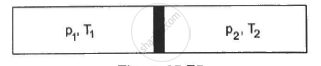
The figure shows an adiabatic cylindrical tube of volume V0 divided in two parts by a frictionless adiabatic separator. Initially, the separator is kept in the middle, an ideal gas at pressure p1 and temperature T1 is injected into the left part and another ideal gas at pressure p2 and temperature T2 is injected into the right part. Cp/Cv = γ is the same for both the gases. The separator is slid slowly and is released at a position where it can stay in equilibrium. Find (a) the volumes of the two parts (b) the heat given to the gas in the left part and (c) the final common pressure of the gases.
Concept: undefined >> undefined
An ideal gas of density 1.7 × 10⁻³ g cm−3 at a pressure of 1.5 × 10⁵ Pa is filled in a Kundt's tube. When the gas is resonated at a frequency of 3.0 kHz, nodes are formed at a separation of 6.0 cm. Calculate the molar heat capacities Cp and Cv of the gas.
Concept: undefined >> undefined
The normal duration of I.Sc. Physics practical period in Indian colleges is 100 minutes. Express this period in microcenturies. 1 microcentury = 10−6 × 100 years. How many microcenturies did you sleep yesterday?
Concept: undefined >> undefined
The frequency of vibration of a string depends on the length L between the nodes, the tension F in the string and its mass per unit length m. Guess the expression for its frequency from dimensional analysis.
Concept: undefined >> undefined
Can we have physical quantities having magnitude and direction which are not vectors?
Concept: undefined >> undefined
If a particle is accelerating, it is either speeding up or speeding down. Do you agree with this statement?
Concept: undefined >> undefined
Give example where the velocity of a particle is zero but its acceleration is not zero.
Concept: undefined >> undefined
Give example where the velocity is opposite in direction to the acceleration.
Concept: undefined >> undefined
Give example where the velocity is perpendicular to the acceleration.
Concept: undefined >> undefined
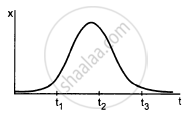
In figure shows the x coordinate of a particle as a function of time. Find the sings of vx and ax at t = t1, t = t2 and t = t3.
Concept: undefined >> undefined
A stone is released from an elevator going up with an acceleration a. The acceleration of the stone after the release is
Concept: undefined >> undefined
The length and the radius of a cylinder measured with a slide callipers are found to be 4.54 cm and 1.75 cm respectively. Calculate the volume of the cylinder.
Concept: undefined >> undefined
The length of the string of a simple pendulum is measured with a metre scale to be 90.0 cm. The radius of the bod plus the length of the hook is calculated to be 2.13 cm using measurements with a slide callipers. What is the effective length of the pendulum? (The effective length is defined as the distance between the point of suspension and the centre of the bob.)
Concept: undefined >> undefined
The accelerations of a particle as seen from two frames S1 and S2 have equal magnitude 4 m/s2.
Concept: undefined >> undefined
An object having a velocity 4.0 m/s is accelerated at the rate of 1.2 m/s2 for 5.0 s. Find the distance travelled during the period of acceleration.
Concept: undefined >> undefined
If the radius of the earth decreases by 1% without changing its mass, will the acceleration due to gravity at the surface of the earth increase or decrease? If so, by what per cent?
Concept: undefined >> undefined
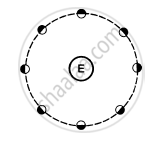
The moon rotates about the earth in such a way that only one hemisphere of the moon faces the earth (see the following figure). Can we ever see the "other face" of the moon from the earth? Can a person on the moon ever see all the faces of the earth?
Concept: undefined >> undefined
A sphere rolls on a horizontal surface. If there any point of the sphere which has a vertical velocity?
Concept: undefined >> undefined
