Advertisements
Advertisements
Which of the following (referred to a spherical mirror) do (does) not depend on whether the rays are paraxial or not?
(a) Pole
(b) Focus
(c) Radius of curvature
(d) Principal axis
Concept: undefined >> undefined
A light ray falling at an angle of 45° with the surface of a clean slab of ice of thickness 1.00 m is refracted into it at an angle of 30°. Calculate the time taken by the light rays to cross the slab. Speed of light in vacuum = 3 × 10⁸ m s−1.
Concept: undefined >> undefined
Advertisements
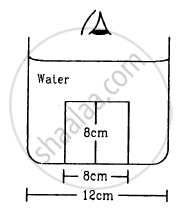
A cylindrical vessel of diameter 12 cm contains 800π cm3 of water. A cylindrical glass piece of diameter 8.0 cm and height 8.0 cm is placed in the vessel. If the bottom of the vessel under the glass piece is seen by the paraxial rays (see figure), locate its image. The index of refraction of glass is 1.50 and that of water is 1.33.
Concept: undefined >> undefined
A small object is placed at the centre of the bottom of a cylindrical vessel of radius 3 cm and height 4 cm filled completely with water. Consider the ray leaving the vessel through a corner. Suppose this ray and the ray along the axis of the vessel are used to trace the image. Find the apparent depth of the image and the ratio of real depth to the apparent depth under the assumptions taken. Refractive index of water = 1.33.
Concept: undefined >> undefined
A light ray is incident at an angle of 45° with the normal to a √2 cm thick plate (μ = 2.0). Find the shift in the path of the light as it emerges out from the plate.
Concept: undefined >> undefined
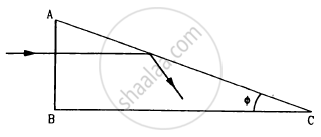
A light ray is incident normally on the face AB of a right-angled prism ABC (μ = 1.50) as shown in figure. What is the largest angle ϕ for which the light ray is totally reflected at the surface AC?
Concept: undefined >> undefined
Find the maximum angle of refraction when a light ray is refracted from glass (μ = 1.50) to air.
Concept: undefined >> undefined
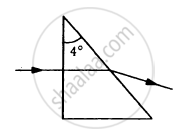
Find the angle of deviation suffered by the light ray shown in figure. The refractive index μ = 1.5 for the prism material.
Concept: undefined >> undefined
A light ray, going through a prism with the angle of prism 60°, is found to deviate by 30°. What limit on the refractive index can be put from these data?
Concept: undefined >> undefined
Can we conclude from the interference phenomenon whether light is a transverse wave or a longitudinal wave?
Concept: undefined >> undefined
Why don't we have interference when two candles are placed close to each other and the intensity is seen on a distant screen? What happens if the candles are replaced by laser sources?
Concept: undefined >> undefined
What is the luminous flux of a source emitting radio waves?
Concept: undefined >> undefined
The luminous flux of a 1 W sodium vapour lamp is more than that of a 10 kW source of ultraviolet radiation. Comment.
Concept: undefined >> undefined
Light is incident normally on a small plane surface. If the surface is rotated by an angle of 30° about the incident light, does the illuminance of the surface increase, decreases or remain same? Does your answer change if the light did not fall normally on the surface?
Concept: undefined >> undefined
A bulb is hanging over a table. At which portion of the table is the illuminance maximum? If a plane mirror is placed above the bulb facing the table, will the illuminance on the table increase?
Concept: undefined >> undefined
The sun is less bright at morning and evening as compared to at noon although its distance from the observer is almost the same Why?
Concept: undefined >> undefined
Why is the luminous efficiency small for a filament bulb as compared to a mercury vapour lamp?
Concept: undefined >> undefined
The yellow colour has a greater luminous efficiency as compared to the other colours. Can we increase the illuminating power of a white light source by putting a yellow plastic paper around this source?
Concept: undefined >> undefined
The one parameter that determines the brightness of a light source sensed by an eye is ____________ .
Concept: undefined >> undefined
Three light sources A, B and C emit equal amount of radiant energy per unit time. The wavelengths emitted by the three source are 450 nm, 555 nm and 700 nm respectively. The brightness sensed by an eye for the sources are XA, XB and XC respectively. Then, ________ .
Concept: undefined >> undefined
