हिंदी
कर्नाटक बोर्ड पी.यू.सी.पीयूसी विज्ञान कक्षा ११

A Small Object is Placed at the Centre of the Bottom of a Cylindrical Vessel of Radius 3 Cm and Height 4 Cm Filled Completely with Water. - Physics

Advertisements
Advertisements

प्रश्न

A small object is placed at the centre of the bottom of a cylindrical vessel of radius 3 cm and height 4 cm filled completely with water. Consider the ray leaving the vessel through a corner. Suppose this ray and the ray along the axis of the vessel are used to trace the image. Find the apparent depth of the image and the ratio of real depth to the apparent depth under the assumptions taken. Refractive index of water = 1.33.

योग
Advertisements

उत्तर

Given,
Refractive index of water μ = 1.33
Radius of the cylindrical vessel = 3 cm
Height of the cylindrical vessel = 4 cm

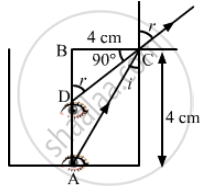
Let x be the length of BD
According to the diagram,
\[\frac{x}{3} = cot r . . . . (i)\]
Using Snell's law,

\[\frac{\sin  i}{\sin  r} = \frac{1}{1 . 33} = \frac{3}{4}\] 

\[ \Rightarrow \sin  r = \frac{4}{3}\sin  i = \frac{4}{3} \times \frac{3}{5} = \frac{4}{5}\] 

\[As  \sin  i   = \frac{BC}{AC} = \frac{3}{5}\] 

\[ \Rightarrow \cot  r = \frac{3}{4}           .  .  .  .  . (ii)\] 

From (i) and (ii), 

\[\frac{x}{3} = \frac{3}{4}\] 

\[ \Rightarrow x = \frac{9}{4} = 2 . 25  \text{ cm }\] 
Hence, the ratio of real and apparent depth of the image will be \[4: 2 . 25 = 1 . 78\] 
shaalaa.com
  क्या इस प्रश्न या उत्तर में कोई त्रुटि है?
अध्याय 18: Geometrical Optics - Exercise [पृष्ठ ४१३]

APPEARS IN

एचसी वर्मा Concepts of Physics Vol. 1 [English] Class 11 and 12
अध्याय 18 Geometrical Optics
Exercise | Q 23 | पृष्ठ ४१३

संबंधित प्रश्न

a) Give two reasons to explain why reflecting telescopes are preferred over refracting type.


Use the mirror equation to show that a convex mirror always produces a virtual image independent of the location of the object.


An object is kept on the principal axis of a concave mirror of focal length 10 cm. at a distance of 15
cm from its pole. The image formed by the mirror is:

(a) Virtual and magnified

(b) Virtual and diminished

(c) Real and magnified

(d) Real and diminished


A point object O is placed at a distance of 15cm from a convex lens L of focal length 1 Ocm as shown in Figure 5 below. On the other side of the lens, a convex mirror M is placed such that its distance from the lens is equal to the focal length of the lens. The final image formed by this combination is observed to coincide with the object O. Find the focal length of the convex mirror


Use the mirror equation to show that an object placed between f and 2f of a concave mirror forms an image beyond 2f.


 Define the term 'limit of resolution'?


following Figure shows two rays A and B being reflected by a mirror and going as A' and B'. The mirror


Mark the correct options.


A light ray falling at an angle of 45° with the surface of a clean slab of ice of thickness 1.00 m is refracted into it at an angle of 30°. Calculate the time taken by the light rays to cross the slab. Speed of light in vacuum = 3 × 10⁸ m s−1.


A cylindrical vessel of diameter 12 cm contains 800π cm3 of water. A cylindrical glass piece of diameter 8.0 cm and height 8.0 cm is placed in the vessel. If the bottom of the vessel under the glass piece is seen by the paraxial rays (see figure), locate its image. The index of refraction of glass is 1.50 and that of water is 1.33.


A light ray is incident at an angle of 45° with the normal to a √2 cm thick plate (μ = 2.0). Find the shift in the path of the light as it emerges out from the plate.


A light ray, going through a prism with the angle of prism 60°, is found to deviate by 30°. What limit on the refractive index can be put from these data?


The figure below shows the positions of a point object O, two lenses, a plane mirror and the final image I which coincides with the object. The focal length of the convex lens is 20 cm. Calculate the focal length of the concave lens.


A parallel beam of light is allowed to fall on a transparent spherical globe of diameter 30cm and refractive index 1.5. The distance from the centre of the globe at which the beam of light can converge is ______ mm.


Two plane mirrors are inclined at an angle of 40°. The possible number of images of an object placed at point P would be?


A point object is placed at a distance of 30 cm from a convex mirror of a focal length of 30 cm. What is the separation between the image and the object?


Share
Notifications

Englishहिंदीमराठी


      Forgot password?
Use app×