Please select a subject first
Advertisements
Advertisements
Given log2 x = m. Express 2m - 3 in terms of x.
Concept: undefined >> undefined
Given log5 y = n. Express 53n + 2 in terms of y.
Concept: undefined >> undefined
Advertisements
If log2x = a and log3 y = a, write 72a in terms of x and y.
Concept: undefined >> undefined
Solve for x:
log(x - 1) + log (x + 1) = log21
Concept: undefined >> undefined
If log (x2 - 21) = 2, show that x = ± 11.
Concept: undefined >> undefined
In triangle ABC, D is a point in AB such that AC = CD = DB. If ∠B = 28°, find the angle ACD.
Concept: undefined >> undefined
ABC is an equilateral triangle. Its side BC is produced up to point E such that C is mid-point of BE. Calculate the measure of angles ACE and AEC.
Concept: undefined >> undefined
In triangle ABC; angle ABC = 90o and P is a point on AC such that ∠PBC = ∠PCB.
Show that: PA = PB.
Concept: undefined >> undefined
In triangle ABC; ∠A = 60o, ∠C = 40o, and the bisector of angle ABC meets side AC at point P. Show that BP = CP.
Concept: undefined >> undefined
Using the information given of the following figure, find the values of a and b. [Given: CE = AC]
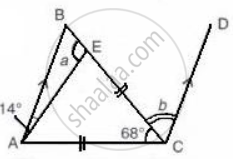
Concept: undefined >> undefined
In triangle ABC, AB = AC; BE ⊥ AC and CF ⊥ AB.
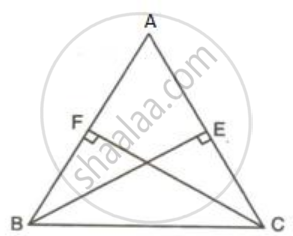
Prove that:
- BE = CF
- AF = AE
Concept: undefined >> undefined
Through any point in the bisector of an angle, a straight line is drawn parallel to either arm of the angle. Prove that the triangle so formed is isosceles.
Concept: undefined >> undefined
The sides AB and AC of a triangle ABC are produced; and the bisectors of the external angles at B and C meet at P. Prove that if AB > AC, then PC > PB.
Concept: undefined >> undefined
Prove that the straight line joining the vertex of an isosceles triangle to any point in the base is smaller than either of the equal sides of the triangle.
Concept: undefined >> undefined
In the following figure, ABC is an equilateral triangle and P is any point in AC;
prove that: BP > PA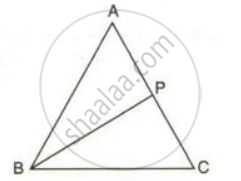
Concept: undefined >> undefined
From the following figure; 
prove that:
(i) AB > BD
(ii) AC > CD
(iii) AB + AC > BC.
Concept: undefined >> undefined
Adjacent sides of a parallelogram are equal and one of the diagonals is equal to any one of the sides of this parallelogram. Show that its diagonals are in ratio √3:1.
Concept: undefined >> undefined
A ladder 13 m long rests against a vertical wall. If the foot of the ladder is 5 m from the foot of the wall, find the distance of the other end of the ladder from the ground.
Concept: undefined >> undefined
A man goes 40 m due north and then 50 m due west. Find his distance from the starting point.
Concept: undefined >> undefined
In ΔABC, Find the sides of the triangle, if:
- AB = ( x - 3 ) cm, BC = ( x + 4 ) cm and AC = ( x + 6 ) cm
- AB = x cm, BC = ( 4x + 4 ) cm and AC = ( 4x + 5) cm
Concept: undefined >> undefined
