Please select a subject first
Advertisements
Advertisements
Write an expression for the electrical energy spent in flow of current through an electrical appliance in terms of current, resistance and time.
Concept: undefined >> undefined
Write an expression for the electrical energy spent in flow of current through an electrical appliance in terms of current, resistance and time.
Concept: undefined >> undefined
Advertisements
Name the S.I. unit of electrical energy. How is it related to Wh?
Concept: undefined >> undefined
Name the S.I. unit of electrical energy. How is it related to Wh?
Concept: undefined >> undefined
What is consumed while using different electrical appliances, for which electricity bills are paid?
Concept: undefined >> undefined
What is consumed while using different electrical appliances, for which electricity bills are paid?
Concept: undefined >> undefined
How do kilowatt and kilowatt-hour differ?
Concept: undefined >> undefined
How do kilowatt and kilowatt-hour differ?
Concept: undefined >> undefined
List the names of three electrical gadgets used in your house. Write their power, voltage rating and approximate time for which each one is used in a day. Hence find the electrical energy consumed by each in a month of 30 days.
Concept: undefined >> undefined
List the names of three electrical gadgets used in your house. Write their power, voltage rating and approximate time for which each one is used in a day. Hence find the electrical energy consumed by each in a month of 30 days.
Concept: undefined >> undefined
When a current I flows through a resistance R for time t, the electrical energy spent is given by ______.
Concept: undefined >> undefined
When a current I flows through a resistance R for time t, the electrical energy spent is given by ______.
Concept: undefined >> undefined
An electric toaster draws current 8 A in a circuit with source of voltage 220 V. It is used for 2 h. Find the cost of operating the toaster if the cost of electrical energy is ₹ 4.50 per kWh.
Concept: undefined >> undefined
An electric toaster draws current 8 A in a circuit with source of voltage 220 V. It is used for 2 h. Find the cost of operating the toaster if the cost of electrical energy is ₹ 4.50 per kWh.
Concept: undefined >> undefined
State three actions that a total reflecting prism can produce.
Concept: undefined >> undefined
Give any two important sources of background radiation.
Concept: undefined >> undefined
What is mean by background radiation?
Concept: undefined >> undefined
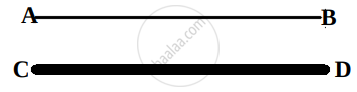
- Define pitch.
- Two wires AB and CD of same length are stretched by same amount. Which wire will produce a sound of greater pitch on plucking?
- Give a reason for your answer.
Concept: undefined >> undefined
Name one internal source of background radiations.
Concept: undefined >> undefined
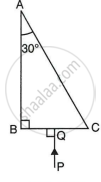
Complete the path of ray PQ through the glass prism ABC shown in Fig. till it emerges out of the prism. Given the critical angle of the glass is 42°.
Concept: undefined >> undefined
