Advertisements
Advertisements
Where is the oval window located? Briefly mention its function.
Concept: undefined >> undefined
Where is the Cochlea located? Briefly mention its function.
Concept: undefined >> undefined
Advertisements
Where is the Semicircular canals located? Briefly mention its function.
Concept: undefined >> undefined
Where is the Utriculus located? Briefly mention its function.
Concept: undefined >> undefined
Name the three ear ossicles.
Concept: undefined >> undefined
With reference to the human ear, answer the question that follow:
Give the technical term for the structure found in the inner ear.
Concept: undefined >> undefined
With reference to the human ear, answer the question that follow:
Name the three small bones present in the middle ear. What is the biological term for them collectively ?
Concept: undefined >> undefined
What is the biological term for the three small bones present in the middle ear collectively?
Concept: undefined >> undefined
With reference to the human ear, answer the question that follow:
Name the part of the ear associated with
(1) static balance
(2) hearing
(3) dynamic balance.
Concept: undefined >> undefined
Name the part of the ear associated with hearing.
Concept: undefined >> undefined
Name the part of the ear associated with dynamic balance.
Concept: undefined >> undefined
With reference to the human ear, answer the question that follow:
Name the nerve, which transmits messages from the ear to the brain.
Concept: undefined >> undefined
The figure below is the sectional view of a part of the skull showing s sense organ:
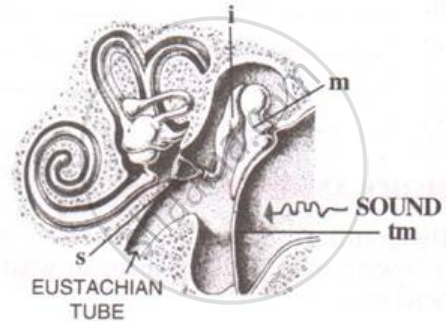
Name the sense organ.
Concept: undefined >> undefined
Given below is the diagram of a part of the human ear. Study the same and answer the questions that follow:
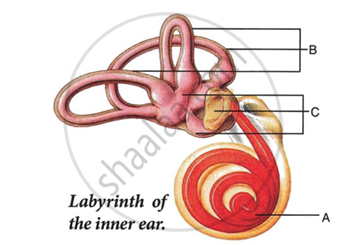 |
Give the collective biological term for Malleus, locus and Stapes.
Concept: undefined >> undefined
Draw a labelled diagram of the inner ear.
Concept: undefined >> undefined
Mention the exact location of the following :
Incus
Concept: undefined >> undefined
Name the following:
Part of internal ear related to balance.
Concept: undefined >> undefined
Give the main function of the following:
Cochlea
Concept: undefined >> undefined
The diagram alongside represents the structure found in the inner ear. Study the same and then answer the questions that follow:
(i) Name the parts labelled A, B, C and D.
(ii) Name the parts of the ear responsible for transmitting impulses to the brain.
(iii) Name the part labelled above which is responsible for:
1. Static equilibrium. 2. Dynamic equilibrium. 3. Hearing
(iv) Name the audio receptor cells which pick up vibrations.
(v) Name the fluid present in the inner ear.

Concept: undefined >> undefined
The diagram alongside represents the structure of the human ear.
(i) Write the names of the parts labelled a to g.
(ii) State briefly the functions of the parts b, d, and g.
(iii) Name the main division of the ear.
(iv) Which is the smallest bone in the human body?
(v) What is labyrinth?

Concept: undefined >> undefined
