Advertisements
Advertisements
If x – 2 is a factor of each of the following three polynomials. Find the value of ‘a’ in each case:
x5 - 3x4 - ax3 + 3ax2 + 2ax + 4.
Concept: undefined >> undefined
In the given figure, O is the centre of the circle and ∠PBA = 45°. Calculate the value of ∠PQB.
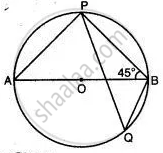
Concept: undefined >> undefined
Advertisements
Show that x2 - 9 is factor of x3 + 5x2 - 9x - 45.
Concept: undefined >> undefined
In the given figure, BAD = 65°, ABD = 70°, BDC = 45°.
(i) Prove that AC is a diameter of the circle.
(ii) Find ACB.

Concept: undefined >> undefined
In Fig, Chord ED is parallel to the diameter AC of the circle. Given ∠CBE = 65°, Calculate ∠ DEC.

Concept: undefined >> undefined
In the figure, ∠DBC = 58°. BD is diameter of the circle.
Calculate:
- ∠BDC
- ∠BEC
- ∠BAC
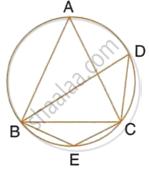
Concept: undefined >> undefined
In the figure given alongside, AD is the diameter of the circle. If ∠ BCD = 130°, Calculate: (i) ∠ DAB (ii) ∠ ADB.

Concept: undefined >> undefined
Construct the rhombus ABCD whose diagonals AC and BD are of lengths 8 cm and 6 cm respectively. Construct the inscribed circle of the rhombus. Measure its radius.
Concept: undefined >> undefined
Using ruler and compass construct a cyclic quadrilateral ABCD in which AC = 4 cm, ∠ ABC = 60°, AB 1.5 cm and AD = 2 cm. Also, write the steps of construction.
Concept: undefined >> undefined
(a) Only the ruler and compass may be used in this question. All contraction lines and arcs must be clearly shown and be of sufficient length and clarity to permit assessment.
(i) Construct a ABC, such that AB = AC = 7 cm and BC = 5 cm.
(ii) Construct AD, the perpendicular bisector of BC.
(iii) Draw a circle with center A and radius 3 cm. Let this circle cut AD at P.
(iv) Construct another circle, to touch the circle with center A, externally at P, and pass through B and C.
Concept: undefined >> undefined
Solve: 2cos2θ + sin θ - 2 = 0.
Concept: undefined >> undefined
In each of the following, determine whether the given numbers are roots of the given equations or not; x2 – x + 1 = 0; 1, – 1
Concept: undefined >> undefined
In each of the following, determine whether the given numbers are roots of the given equations or not; x2 – 5x + 6 = 0; 2, – 3
Concept: undefined >> undefined
In each of the following, determine whether the given numbers are roots of the given equations or not; 3x2 – 13x – 10 = 0; 5, `(-2)/(3)`
Concept: undefined >> undefined
In each of the following, determine whether the given numbers are roots of the given equations or not; 6x2 – x – 2 = 0; `(-1)/(2), (2)/(3)`
Concept: undefined >> undefined
If `sqrt(2)` is a root of the equation `"k"x^2 + sqrt(2x) - 4` = 0, find the value of k.
Concept: undefined >> undefined
If a is a root of the equation x2 – (a + b)x + k = 0, find the value of k.
Concept: undefined >> undefined
If `(2)/(3)` and – 3 are the roots of the equation px2+ 7x + q = 0, find the values of p and q.
Concept: undefined >> undefined
Find the discriminant of the following equations and hence find the nature of roots: 3x2 – 5x – 2 = 0
Concept: undefined >> undefined
Find the discriminant of the following equations and hence find the nature of roots: 2x2– 3x + 5 = 0
Concept: undefined >> undefined
