Advertisements
Advertisements
In the given figure, the value of y is
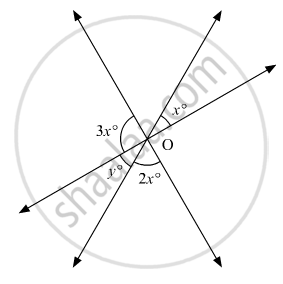
Concept: undefined >> undefined
In the given figure, the value of x is ______.
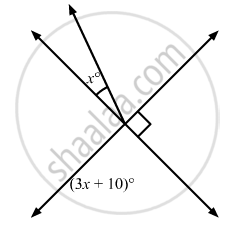
Concept: undefined >> undefined
Advertisements
In the given figure, which of the following statements must be true?
(i) a + b = d + c
(ii) a + c + e = 180°
(iii) b + f = c + e
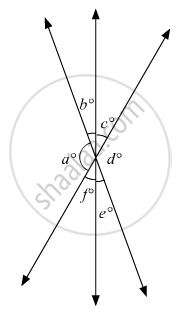
Concept: undefined >> undefined
Two lines AB and CD intersect at O. If ∠AOC + ∠COB + ∠BOD = 270°, then ∠AOC =
Concept: undefined >> undefined
Find the area of an equilateral triangle having each side 4 cm.
Concept: undefined >> undefined
Find the area of an equilateral triangle having each side x cm.
Concept: undefined >> undefined
The perimeter of a triangullar field is 144 m and the ratio of the sides is 3 : 4 : 5. Find the area of the field.
Concept: undefined >> undefined
Find the area of an equilateral triangle having altitude h cm.
Concept: undefined >> undefined
Let Δ be the area of a triangle. Find the area of a triangle whose each side is twice the side of the given triangle.
Concept: undefined >> undefined
If each side of a triangle is doubled, the find percentage increase in its area.
Concept: undefined >> undefined
If each side of a equilateral triangle is tripled then what is the percentage increase in the area of the triangle?
Concept: undefined >> undefined
Mark the correct alternative in each of the following:
The sides of a triangle are 16 cm, 30 cm, 34 cm. Its area is
Concept: undefined >> undefined
The base of an isosceles right triangle is 30 cm. Its area is
Concept: undefined >> undefined
The sides of a triangle are 7 cm, 9 cm and 14 cm. Its area is
Concept: undefined >> undefined
The sides of a triangular field are 325 m, 300 m and 125 m. Its area is
Concept: undefined >> undefined
The sides of a triangle are 50 cm, 78 cm and 112 cm. The smallest altitude is
Concept: undefined >> undefined
The sides of a triangle are 11 m, 60 m and 61 m. The altitude to the smallest side is
Concept: undefined >> undefined
The sides of a triangle are 11 cm, 15 cm and 16 cm. The altitude to the largest side is
Concept: undefined >> undefined
The base and hypotenuse of a right triangle are respectively 5 cm and 13 cm long. Its area is ______.
Concept: undefined >> undefined
Concept: undefined >> undefined
