Advertisements
Advertisements
Although Zr belongs to 4d and Hf belongs to 5d transition series but it is quite difficult to separate them. Why?
Concept: undefined >> undefined
Although +3 oxidation states is the characteristic oxidation state of lanthanoids but cerium shows +4 oxidation state also. Why?
Concept: undefined >> undefined
Advertisements
Match the compounds/elements given in Column I with uses given in Column II.
| Column I (Compound/element) | Column II (Use) | |
| (i) | Lanthanoid oxide | (a) Production of iron alloy |
| (ii) | Lanthanoid | (b) Television screen |
| (iii) | Misch metal | (c) Petroleum cracking |
| (iv) | Magnesium based alloy is constituent of | (d) Lanthanoid metal + iron |
| (v) | Mixed oxides of lanthanoids are employed | (e) Bullets |
| (f) In X-ray screen |
Concept: undefined >> undefined
Match the statements given in Column I with the oxidation states given in Column II.
| Column I | Column II | |
| (i) | Oxidation state of Mn in MnO2 is | (a) + 2 |
| (ii) | Most stable oxidation state of Mn is | (b) + 3 |
| (iii) | Most stable oxidation state of | (c) + 4 |
| Mn in oxides is | (d) + 5 | |
| (iv) | Characteristic oxidation state of lanthanoids is | (e) + 7 |
Concept: undefined >> undefined
Match the property given in Column I with the element given in Column II.
| Column I (Property) | Column II (Element) | |
| (i) | Lanthanoid which shows +4 oxidation state |
(a) Pm |
| (ii) | Lanthanoid which can show +2 oxidation state |
(b) Ce |
| (iii) | Radioactive lanthanoid | (c) Lu |
| (iv) | Lanthanoid which has 4f7 electronic configuration in +3 oxidation state |
(d) Eu |
| (v) | Lanthanoid which has 4f14 electronic configuration in +3 oxidation state |
(e) Gd |
| (f) Dy |
Concept: undefined >> undefined
On the basis of Lanthanoid contraction, explain the following:
Nature of bonding in \[\ce{La2O3}\] and \[\ce{Lu2O3}\] .
Concept: undefined >> undefined
On the basis of Lanthanoid contraction, explain the following:
Trends in the stability of oxo salts of lanthanoids from \[\ce{La}\] to \[\ce{Lu}\].
Concept: undefined >> undefined
On the basis of Lanthanoid contraction, explain the following:
Stability of the complexes of lanthanoids.
Concept: undefined >> undefined
On the basis of Lanthanoid contraction, explain the following:
Radii of 4d and 5d block elements.
Concept: undefined >> undefined
On the basis of Lanthanoid contraction, explain the following:
Trends in acidic character of lanthanoid oxides.
Concept: undefined >> undefined
Match the reactions given in Column I with the names given in Column II.
| Column I | Column II | |
| (i) |  |
(a) Fittig reaction |
| (ii) |  |
(b) Wurtz Fittig reaction |
| (iii) |  |
(c) Finkelstein reaction |
| (iv) | \[\ce{C2H5Cl + Nal ->[dry acetone] C2H5l + NaCl}\] | (d) Sandmeyer reaction |
Concept: undefined >> undefined
Assertion: tert-Butyl bromide undergoes Wurtz reaction to give 2, 2, 3, 3-tetramethylbutane.
Reason: In Wurtz reaction, alkyl halides react with sodium in dry ether to give hydrocarbon containing double the number of carbon atoms present in the halide.
Concept: undefined >> undefined
Preparation of alcohols from alkenes involves the electrophilic attack on alkene carbon atom. Explain its mechanism.
Concept: undefined >> undefined
Explain why low molecular mass alcohols are soluble in water.
Concept: undefined >> undefined
\[\begin{array}{cc}
\ce{CH3 - C ≡ CH ->[40{%} H2SO4][1{%} HgSO4] A ->[Isomerisation] CH3 - C - CH3}\\
\phantom{........................................}||\\
\phantom{........................................}\ce{O}\\
\end{array}\]
Structure of ‘A’ and type of isomerism in the above reaction are respectively.
Concept: undefined >> undefined
Amino acids are classified as acidic, basic or neutral depending upon the relative number of amino and carboxyl groups in their molecule. Which of the following are acidic?
(i)
\[\begin{array}{cc}
\ce{(CH3)2CH - CH - COOH}\\
\phantom{..}|\\
\phantom{.....}\ce{NH2}
\end{array}\]
(ii)
\[\begin{array}{cc}
\ce{HOOC - CH2 - CH2 - CH - COOH}\\
\phantom{............}|\\
\phantom{...............}\ce{NH2}
\end{array}\]
(iii)
\[\ce{H2N - CH2 - CH2 - CH2 - COOH}\]
(iv)
\[\begin{array}{cc}
\ce{HOOC - CH2 - CH - COOH}\\
\phantom{.....}|\\
\phantom{........}\ce{NH2}
\end{array}\]
Concept: undefined >> undefined
Assertion: Glycine must be taken through diet.
Reason: It is an essential amino acid.
Concept: undefined >> undefined
Which of the following polymers have vinylic monomer units?
(i) Acrilan
(ii) Polystyrene
(iii) Nylon
(iv) Teflon
Concept: undefined >> undefined
How is the following resin intermediate prepared and which polymer is formed by this monomer unit?
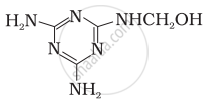
(Resin intermediate)
Concept: undefined >> undefined
Match the polymers given in Column I with their commercial names given in Column II.
| Column I | Column II |
| (i) Polyester of glycol and phthalic acid | (a) Novolac |
| (ii) Copolymer of 1, 3-butadiene and styrene | (b) Glyptal |
| (iii) Phenol and formaldehyde resin | (c) Buna-S |
| (iv) Polyester of glycol and terephthalic acid | (d) Buna-N |
| (v) Copolymer of 1, 3-butadiene and acrylonitrile | (e) Dacron |
Concept: undefined >> undefined
