Advertisements
Advertisements
You are given four sources of light each one providing a light of a single colour – red, blue, green and yellow. Suppose the angle of refraction for a beam of yellow light corresponding to a particular angle of incidence at the interface of two media is 90°. Which of the following statements is correct if the source of yellow light is replaced with that of other lights without changing the angle of incidence?
Concept: undefined >> undefined
The radius of curvature of the curved surface of a plano-convex lens is 20 cm. If the refractive index of the material of the lens be 1.5, it will ______.
Concept: undefined >> undefined
Advertisements
The direction of ray of light incident on a concave mirror is shown by PQ while directions in which the ray would travel after reflection is shown by four rays marked 1, 2, 3 and 4 (figure). Which of the four rays correctly shows the direction of reflected ray?

Concept: undefined >> undefined
A car is moving with at a constant speed of 60 km h–1 on a straight road. Looking at the rear view mirror, the driver finds that the car following him is at a distance of 100 m and is approaching with a speed of 5 km h–1. In order to keep track of the car in the rear, the driver begins to glance alternatively at the rear and side mirror of his car after every 2 s till the other car overtakes. If the two cars were maintaining their speeds, which of the following statement (s) is/are correct?
Concept: undefined >> undefined
An astronomical refractive telescope has an objective of focal length 20 m and an eyepiece of focal length 2 cm.
- The length of the telescope tube is 20.02 m.
- The magnification is 1000.
- The image formed is inverted.
- An objective of a larger aperture will increase the brightness and reduce chromatic aberration of the image.
Concept: undefined >> undefined
A short object of length L is placed along the principal axis of a concave mirror away from focus. The object distance is u. If the mirror has a focal length f, what will be the length of the image? You may take L << |v – f|.
Concept: undefined >> undefined
A thin convex lens of focal length 25 cm is cut into two pieces 0.5 cm above the principal axis. The top part is placed at (0, 0) and an object placed at (– 50 cm, 0). Find the coordinates of the image.
Concept: undefined >> undefined
(i) Consider a thin lens placed between a source (S) and an observer (O) (Figure). Let the thickness of the lens vary as `w(b) = w_0 - b^2/α`, where b is the verticle distance from the pole. `w_0` is a constant. Using Fermat’s principle i.e. the time of transit for a ray between the source and observer is an extremum, find the condition that all paraxial rays starting from the source will converge at a point O on the axis. Find the focal length.

(ii) A gravitational lens may be assumed to have a varying width of the form
`w(b) = k_1ln(k_2/b) b_("min") < b < b_("max")`
= `k_1ln (K_2/b_("min")) b < b_("min")`
Show that an observer will see an image of a point object as a ring about the center of the lens with an angular radius
`β = sqrt((n - 1)k_1 u/v)/(u + v)`
Concept: undefined >> undefined
Figure shows a standard two slit arrangement with slits S1, S2, P1, P2 are the two minima points on either side of P (Figure). At P2 on the screen, there is a hole and behind P2 is a second 2-slit arrangement with slits S3, S4 and a second screen behind them.

Concept: undefined >> undefined
For light diverging from a point source ______.
- the wavefront is spherical.
- the intensity decreases in proportion to the distance squared.
- the wavefront is parabolic.
- the intensity at the wavefront does not depend on the distance.
Concept: undefined >> undefined
Is Huygen’s principle valid for longitudinal sound waves?
Concept: undefined >> undefined
Consider a point at the focal point of a convergent lens. Another convergent lens of short focal length is placed on the other side. What is the nature of the wavefronts emerging from the final image?
Concept: undefined >> undefined
What is the shape of the wavefront on earth for sunlight?
Concept: undefined >> undefined
Consider Figure for photoemission.

How would you reconcile with momentum conservation? Note light (photons) have momentum in a different direction than the emitted electrons.
Concept: undefined >> undefined
O2 molecule consists of two oxygen atoms. In the molecule, nuclear force between the nuclei of the two atoms ______.
Concept: undefined >> undefined
Would the Bohr formula for the H-atom remain unchanged if proton had a charge (+4/3)e and electron a charge (−3/4)e, where e = 1.6 × 10⁻¹⁹C. Give reasons for your answer.
Concept: undefined >> undefined
Assume that there is no repulsive force between the electrons in an atom but the force between positive and negative charges is given by Coulomb’s law as usual. Under such circumstances, calculate the ground state energy of a He-atom.
Concept: undefined >> undefined
The Bohr model for the H-atom relies on the Coulomb’s law of electrostatics. Coulomb’s law has not directly been verified for very short distances of the order of angstroms. Supposing Coulomb’s law between two opposite charge + q1, –q2 is modified to |F| = `(q_1q_2)/((4πε_0)) 1/r^2, r ≥ R_0 = (q_1q_2)/(4πε_0) 1/R_0^2 (R_0/r)^ε, r ≤ R_0` Calculate in such a case, the ground state energy of a H-atom, if ε = 0.1, R0 = 1Å.
Concept: undefined >> undefined
Explain why elemental semiconductor cannot be used to make visible LEDs.
Concept: undefined >> undefined
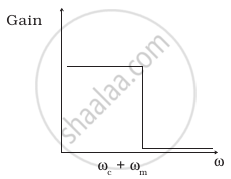
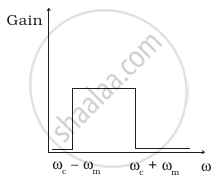
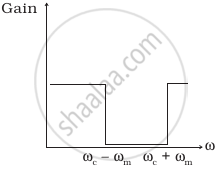
The frequency response curve (Figure) for the filter circuit used for production of AM wave should be ______.
 (i) |
 (ii) |
 (iii) |
 (iv) |
- (i) followed by (ii).
- (ii) followed by (i).
- (iii).
- (iv).
Concept: undefined >> undefined
