हिंदी

Science (English Medium) कक्षा १२ - CBSE Question Bank Solutions for Physics

Advertisements
विषयों
अध्याय
विषयों
मुख्य विषय
अध्याय
Advertisements
Advertisements
Physics
< prev  2321 to 2340 of 2764  next > 

Differentiate between Analog and Digital communication. 

[15] Communication Systems
Chapter: [15] Communication Systems
Concept: undefined >> undefined

State how a moving coil galvanometer can be converted into an ammeter.

[4] Moving Charges and Magnetism
Chapter: [4] Moving Charges and Magnetism
Concept: undefined >> undefined

Advertisements

Explain the significance of a radial magnetic field when a current-carrying coil is kept in it. 

[4] Moving Charges and Magnetism
Chapter: [4] Moving Charges and Magnetism
Concept: undefined >> undefined

Answer the following question.
Derive an expression for the electric field at any point on the equatorial line of an electric dipole. 

[1] Electric Charges and Fields
Chapter: [1] Electric Charges and Fields
Concept: undefined >> undefined

Define the term ‘current sensitivity’ of a moving coil galvanometer.

[4] Moving Charges and Magnetism
Chapter: [4] Moving Charges and Magnetism
Concept: undefined >> undefined

An electric dipole is placed at an angle of 30° with an electric field intensity of 2 × 10⁵ N/C. It experiences a torque equal to 4 Nm. The charge on the dipole, if the dipole length is 2 cm, is ______.

[1] Electric Charges and Fields
Chapter: [1] Electric Charges and Fields
Concept: undefined >> undefined

A galvanometer coil has a resistance of 12 Ω and the metre shows full scale deflection for a current of 3 mA. How will you convert the metre into a voltmeter of range 0 to 18 V?

[4] Moving Charges and Magnetism
Chapter: [4] Moving Charges and Magnetism
Concept: undefined >> undefined

A galvanometer coil has a resistance of 15 Ω and the metre shows full scale deflection for a current of 4 mA. How will you convert the metre into an ammeter of range 0 to 6 A?

[4] Moving Charges and Magnetism
Chapter: [4] Moving Charges and Magnetism
Concept: undefined >> undefined

Work done by a uniform electric field 'E' in moving a charge 'q' at a distance 'd' from a to b is ______.

[2] Electrostatic Potential and Capacitance
Chapter: [2] Electrostatic Potential and Capacitance
Concept: undefined >> undefined
A region surrounding a stationary electric dipoles has ______.
[1] Electric Charges and Fields
Chapter: [1] Electric Charges and Fields
Concept: undefined >> undefined
The electric field at a point on equatorial line of a dipole and direction of the dipole moment ______.
[1] Electric Charges and Fields
Chapter: [1] Electric Charges and Fields
Concept: undefined >> undefined
Debye is the unit of ______.
[1] Electric Charges and Fields
Chapter: [1] Electric Charges and Fields
Concept: undefined >> undefined
An electric dipole will experience a net force when it is placed in ______.
[1] Electric Charges and Fields
Chapter: [1] Electric Charges and Fields
Concept: undefined >> undefined
An electric dipole is kept in a non-uniform electric field. It experiences ______.
[1] Electric Charges and Fields
Chapter: [1] Electric Charges and Fields
Concept: undefined >> undefined
The formation of a dipole is due to two equal and dissimilar point charges placed at a ______.
[1] Electric Charges and Fields
Chapter: [1] Electric Charges and Fields
Concept: undefined >> undefined

An electric dipole is placed at an angle of 30° to a non-uniform electric field. The dipole will experience ________.

[1] Electric Charges and Fields
Chapter: [1] Electric Charges and Fields
Concept: undefined >> undefined
An electric dipole is placed at the centre of a sphere then ______.
[1] Electric Charges and Fields
Chapter: [1] Electric Charges and Fields
Concept: undefined >> undefined
An electric dipole has a pair of equal and opposite point charges q and –q separated by a distance 2x. The axis of the dipole is ______.
[1] Electric Charges and Fields
Chapter: [1] Electric Charges and Fields
Concept: undefined >> undefined

A conic surface is placed in a uniform electric field E as shown in the figure such that the field is perpendicular to the surface on the side AB. The base of the cone is of radius R, and the height of the cone is h. The angle of the cone is θ.
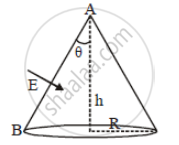
Find the magnitude of the flux that enters the cone's curved surface from the left side. Do not count the outgoing flux (θ < 45°)

[1] Electric Charges and Fields
Chapter: [1] Electric Charges and Fields
Concept: undefined >> undefined

The AC voltage across a resistance can be measured using a ______.

[4] Moving Charges and Magnetism
Chapter: [4] Moving Charges and Magnetism
Concept: undefined >> undefined
< prev  2321 to 2340 of 2764  next > 
Advertisements
Advertisements
CBSE Science (English Medium) कक्षा १२ Question Bank Solutions
Question Bank Solutions for CBSE Science (English Medium) कक्षा १२ Biology
Question Bank Solutions for CBSE Science (English Medium) कक्षा १२ Chemistry
Question Bank Solutions for CBSE Science (English Medium) कक्षा १२ Computer Science (C++)
Question Bank Solutions for CBSE Science (English Medium) कक्षा १२ Computer Science (Python)
Question Bank Solutions for CBSE Science (English Medium) कक्षा १२ English Core
Question Bank Solutions for CBSE Science (English Medium) कक्षा १२ English Elective - NCERT
Question Bank Solutions for CBSE Science (English Medium) कक्षा १२ Entrepreneurship
Question Bank Solutions for CBSE Science (English Medium) कक्षा १२ Geography
Question Bank Solutions for CBSE Science (English Medium) कक्षा १२ Hindi (Core)
Question Bank Solutions for CBSE Science (English Medium) कक्षा १२ Hindi (Elective)
Question Bank Solutions for CBSE Science (English Medium) कक्षा १२ History
Question Bank Solutions for CBSE Science (English Medium) कक्षा १२ Informatics Practices
Question Bank Solutions for CBSE Science (English Medium) कक्षा १२ Mathematics
Question Bank Solutions for CBSE Science (English Medium) कक्षा १२ Physical Education
Question Bank Solutions for CBSE Science (English Medium) कक्षा १२ Physics
Question Bank Solutions for CBSE Science (English Medium) कक्षा १२ Political Science
Question Bank Solutions for CBSE Science (English Medium) कक्षा १२ Psychology
Question Bank Solutions for CBSE Science (English Medium) कक्षा १२ Sanskrit (Core)
Question Bank Solutions for CBSE Science (English Medium) कक्षा १२ Sanskrit (Elective)
Question Bank Solutions for CBSE Science (English Medium) कक्षा १२ Sociology
Share
Notifications

Englishहिंदीमराठी


      Forgot password?
Use app×