Please select a subject first
Advertisements
Advertisements
A spherical ball of surface area 20 cm2 absorbs any radiation that falls on it. It is suspended in a closed box maintained at 57°C. (a) Find the amount of radiation falling on the ball per second. (b) Find the net rate of heat flow to or from the ball at an instant when its temperature is 200°C. Stefan constant = 6.0 × 10⁻⁸ W m−2 K−4.
Concept: undefined >> undefined
A lift is coming from 8th floor and is just about to reach 4th floor. Taking ground floor as origin and positive direction upwards for all quantities, which one of the following is correct?
Concept: undefined >> undefined
Advertisements
A graph of x versus t is shown in figure. Choose correct alternatives from below.
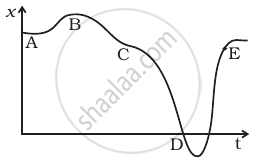
- The particle was released from rest at t = 0.
- At B, the acceleration a > 0.
- At C, the velocity and the acceleration vanish.
- Average velocity for the motion between A and D is positive.
- The speed at D exceeds that at E.
Concept: undefined >> undefined
Give example of a motion where x > 0, v < 0, a > 0 at a particular instant.
Concept: undefined >> undefined
An object falling through a fluid is observed to have acceleration given by a = g – bv where g = gravitational acceleration and b is constant. After a long time of release, it is observed to fall with constant speed. What must be the value of constant speed?
Concept: undefined >> undefined
Can you accelerate a car on a frictionless horizontal road by putting more petrol in the engine? Can you stop a car going on a frictionless horizontal road by applying brakes?
Concept: undefined >> undefined
A scooter starting from rest moves with a constant acceleration for a time ∆t1, then with a constant velocity for the next ∆t2 and finally with a constant deceleration for the next ∆t3 to come to rest. A 500 N man sitting on the scooter behind the driver manages to stay at rest with respect to the scooter without touching any other part. The force exerted by the seat on the man is
Concept: undefined >> undefined
Two cars of unequal masses use similar tyres. If they are moving at the same initial speed, the minimum stopping distance
Concept: undefined >> undefined
In order to stop a car in shortest distance on a horizontal road, one should
Concept: undefined >> undefined
Consider a vehicle going on a horizontal road towards east. Neglect any force by the air. The frictional force on the vehicle by the road
(a) is towards east if the vehicle is accelerating
(b) is zero if the vehicle is moving with a uniform velocity
(c) must be towards east
(d) must be towards west.
Concept: undefined >> undefined
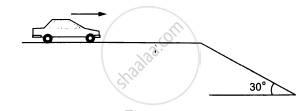
A care is going at a speed of 21.6 km/hr when it encounters at 12.8 m long slope of angle 30° (in the following figure). The friction coefficient between the road and the tyre is `1/2sqrt3`. Show that no matter how hard the driver applies the brakes, the car will reach the bottom with a speed greater than 36 km/hr. Take g = 10 m/s2.
Concept: undefined >> undefined
A car starts from rest on a half kilometre long bridge. The coefficient of friction between the tyre and the road is 1.0. Show that one cannot drive through the bridge in less than 10 s.
Concept: undefined >> undefined
In a rotating body, \[\alpha = \alpha r\text{ and }\nu = \omega r.\] Thus \[\frac{\alpha}{\alpha} = \frac{\nu}{\omega}.\] Can you use the theorems of ration and proportion studied in algebra so as to write \[\frac{\alpha + \alpha}{\alpha - \alpha} = \frac{\nu + \omega}{\nu - \omega}\]
Concept: undefined >> undefined
Consider the following two equations
(A) \[L = I \omega\]
(B) \[\frac{dL}{dt} = \Gamma\]
In noninertial frames _______________ .
Concept: undefined >> undefined
A wheel is making revolutions about its axis with uniform angular acceleration. Starting from rest, it reaches 100 rev/sec in 4 seconds. Find the angular acceleration. Find the angle rotated during these four seconds.
Concept: undefined >> undefined
A wheel starting from rest is uniformly accelerated at 4 rad/s2 for 10 seconds. It is allowed to rotate uniformly for the next 10 seconds and is finally brought to rest in the next 10 seconds. Find the total angle rotated by the wheel.
Concept: undefined >> undefined
A body rotates about a fixed axis with an angular acceleration of one radian/second. Through what angle does it rotate during the time in which its angular velocity increases from 5 rad/s to 15 rad/s.
Concept: undefined >> undefined
Water and mercury are filled in two cylindrical vessels up to same height. Both vessels have a hole in the wall near the bottom. The velocity of water and mercury coming out of the holes are v1 and v2 respectively.
Concept: undefined >> undefined
A hollow sphere of radius R lies on a smooth horizontal surface. It is pulled by a horizontal force acting tangentially from the highest point. Find the distance travelled by the sphere during the time it makes one full rotation.
Concept: undefined >> undefined
At a metro station, a girl walks up a stationary escalator in time t1. If she remains stationary on the escalator, then the escalator take her up in time t2. The time taken by her to walk up on the moving escalator will be ______.
Concept: undefined >> undefined
