हिंदी

Science (English Medium) कक्षा ११ - CBSE Question Bank Solutions

Advertisements
विषयों
अध्याय
विषयों
मुख्य विषय
अध्याय

Please select a subject first

Advertisements
Advertisements
< prev  11241 to 11260 of 13919  next > 

Answer the following question based on the P-T phase diagram of carbon dioxide:

At what temperature and pressure can the solid, liquid and vapour phases of CO2 co-exist in equilibrium?

[10] Thermal Properties of Matter
Chapter: [10] Thermal Properties of Matter
Concept: undefined >> undefined

Answer the following question based on the P-T phase diagram of carbon dioxide:

What is the effect of decrease of pressure on the fusion and boiling point of CO2?

[10] Thermal Properties of Matter
Chapter: [10] Thermal Properties of Matter
Concept: undefined >> undefined

Advertisements

Answer the following question based on the P-T phase diagram of carbon dioxide:

What are the critical temperature and pressure for CO2? What is their significance?

[10] Thermal Properties of Matter
Chapter: [10] Thermal Properties of Matter
Concept: undefined >> undefined

Which of the following ratios express pressure?

  1. Force/Area
  2. Energy/Volume
  3. Energy/Area
  4. Force/ Volume
[1] Units and Measurements
Chapter: [1] Units and Measurements
Concept: undefined >> undefined

There are three forces F1, F2 and F3 acting on a body, all acting on a point P on the body. The body is found to move with uniform speed.

  1. Show that the forces are coplanar.
  2. Show that the torque acting on the body about any point due to these three forces is zero.
[4] Laws of Motion
Chapter: [4] Laws of Motion
Concept: undefined >> undefined

Figure shows (vx, t) and (vy, t) diagrams for a body of unit mass. Find the force as a function of time.


(a)

(b)
[4] Laws of Motion
Chapter: [4] Laws of Motion
Concept: undefined >> undefined

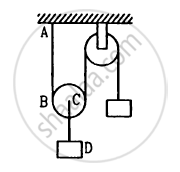
There are four forces acting at a point P produced by strings as shown in the figure, which is at rest. Find the forces F1 and F2.

[4] Laws of Motion
Chapter: [4] Laws of Motion
Concept: undefined >> undefined

A body is falling freely under the action of gravity alone in vacuum. Which of the following quantities remain constant during the fall?

[5] Work, Energy and Power
Chapter: [5] Work, Energy and Power
Concept: undefined >> undefined

Two inclined frictionless tracks, one gradual and the other steep meet at A from where two stones are allowed to slide down from rest, one on each track as shown in figure.


Which of the following statement is correct?

[5] Work, Energy and Power
Chapter: [5] Work, Energy and Power
Concept: undefined >> undefined

Which of the diagrams shown in figure represents variation of total mechanical energy of a pendulum oscillating in air as function of time?

[5] Work, Energy and Power
Chapter: [5] Work, Energy and Power
Concept: undefined >> undefined

A mass of 5 kg is moving along a circular path of radius 1 m. If the mass moves with 300 revolutions per minute, its kinetic energy would be ______.

[5] Work, Energy and Power
Chapter: [5] Work, Energy and Power
Concept: undefined >> undefined

In a shotput event an athlete throws the shotput of mass 10 kg with an initial speed of 1 ms–1 at 45° from a height 1.5 m above ground. Assuming air resistance to be negligible and acceleration due to gravity to be 10 ms–2, the kinetic energy of the shotput when it just reaches the ground will be ______.

[5] Work, Energy and Power
Chapter: [5] Work, Energy and Power
Concept: undefined >> undefined

Why is electrical power required at all when the elevator is descending? Why should there be a limit on the number of passengers in this case?

[5] Work, Energy and Power
Chapter: [5] Work, Energy and Power
Concept: undefined >> undefined

A body falls towards earth in air. Will its total mechanical energy be conserved during the fall? Justify.

[5] Work, Energy and Power
Chapter: [5] Work, Energy and Power
Concept: undefined >> undefined

A bob of mass m suspended by a light string of length L is whirled into a vertical circle as shown in figure. What will be the trajectory of the particle if the string is cut at

  1. Point B?
  2. Point C? 
  3. Point X?

[5] Work, Energy and Power
Chapter: [5] Work, Energy and Power
Concept: undefined >> undefined

A baloon filled with helium rises against gravity increasing its potential energy. The speed of the baloon also increases as it rises. How do you reconcile this with the law of conservation of mechanical energy? You can neglect viscous drag of air and assume that density of air is constant.

[5] Work, Energy and Power
Chapter: [5] Work, Energy and Power
Concept: undefined >> undefined

A particle of mass m is moving in yz-plane with a uniform velocity v with its trajectory running parallel to + ve y-axis and intersecting z-axis at z = a (Figure). The change in its angular momentum about the origin as it bounces elastically from a wall at y = constant is ______.

[6] System of Particles and Rotational Motion
Chapter: [6] System of Particles and Rotational Motion
Concept: undefined >> undefined

A Merry-go-round, made of a ring-like platform of radius R and mass M, is revolving with angular speed ω. A person of mass M is standing on it. At one instant, the person jumps off the round, radially away from the centre of the round (as seen from the round). The speed of the round afterwards is ______.

[6] System of Particles and Rotational Motion
Chapter: [6] System of Particles and Rotational Motion
Concept: undefined >> undefined

Choose the correct alternatives:

  1. For a general rotational motion, angular momentum L and angular velocity ω need not be parallel.
  2. For a rotational motion about a fixed axis, angular momentum L and angular velocity ω are always parallel.
  3. For a general translational motion , momentum p and velocity v are always parallel.
  4. For a general translational motion, acceleration a and velocity v are always parallel.
[6] System of Particles and Rotational Motion
Chapter: [6] System of Particles and Rotational Motion
Concept: undefined >> undefined

Figure shows two identical particles 1 and 2, each of mass m, moving in opposite directions with same speed v along parallel lines. At a particular instant, r1 and r2 are their respective position vectors drawn from point A which is in the plane of the parallel lines. Choose the correct options:

  1. Angular momentum l1 of particle 1 about A is l1 = mvd1
  2. Angular momentum l2 of particle 2 about A is l2 = mvr2
  3. Total angular momentum of the system about A is l = mv(r1 + r2)
  4. Total angular momentum of the system about A is l = mv (d2 − d1)

⊗ represents a unit vector coming out of the page.

⊗ represents a unit vector going into the page.

[6] System of Particles and Rotational Motion
Chapter: [6] System of Particles and Rotational Motion
Concept: undefined >> undefined
< prev  11241 to 11260 of 13919  next > 
Advertisements
Advertisements
CBSE Science (English Medium) कक्षा ११ Question Bank Solutions
Question Bank Solutions for CBSE Science (English Medium) कक्षा ११ Biology
Question Bank Solutions for CBSE Science (English Medium) कक्षा ११ Chemistry
Question Bank Solutions for CBSE Science (English Medium) कक्षा ११ Computer Science (C++)
Question Bank Solutions for CBSE Science (English Medium) कक्षा ११ Computer Science (Python)
Question Bank Solutions for CBSE Science (English Medium) कक्षा ११ English Core
Question Bank Solutions for CBSE Science (English Medium) कक्षा ११ English Elective - NCERT
Question Bank Solutions for CBSE Science (English Medium) कक्षा ११ Entrepreneurship
Question Bank Solutions for CBSE Science (English Medium) कक्षा ११ Geography
Question Bank Solutions for CBSE Science (English Medium) कक्षा ११ Hindi (Core)
Question Bank Solutions for CBSE Science (English Medium) कक्षा ११ Hindi (Elective)
Question Bank Solutions for CBSE Science (English Medium) कक्षा ११ History
Question Bank Solutions for CBSE Science (English Medium) कक्षा ११ Mathematics
Question Bank Solutions for CBSE Science (English Medium) कक्षा ११ Physics
Question Bank Solutions for CBSE Science (English Medium) कक्षा ११ Political Science
Question Bank Solutions for CBSE Science (English Medium) कक्षा ११ Psychology
Question Bank Solutions for CBSE Science (English Medium) कक्षा ११ Sanskrit (Core)
Question Bank Solutions for CBSE Science (English Medium) कक्षा ११ Sanskrit (Elective)
Question Bank Solutions for CBSE Science (English Medium) कक्षा ११ Sociology
Share
Notifications

Englishहिंदीमराठी


      Forgot password?
Use app×