Please select a subject first
Advertisements
Advertisements
The number of significant figures in 0.06900 is ______.
Concept: undefined >> undefined
The sum of the numbers 436.32, 227.2 and 0.301 in appropriate significant figures is ______.
Concept: undefined >> undefined
Advertisements
The mass and volume of a body are 4.237 g and 2.5 cm3, respectively. The density of the material of the body in correct significant figures is ______.
Concept: undefined >> undefined
The numbers 2.745 and 2.735 on rounding off to 3 significant figures will give ______.
Concept: undefined >> undefined
The length and breadth of a rectangular sheet are 16.2 cm and 10.1cm, respectively. The area of the sheet in appropriate significant figures and error is ______.
Concept: undefined >> undefined
Why do we have different units for the same physical quantity?
Concept: undefined >> undefined
Calculate the length of the arc of a circle of radius 31.0 cm which subtends an angle of `pi/6` at the centre.
Concept: undefined >> undefined
A lift is coming from 8th floor and is just about to reach 4th floor. Taking ground floor as origin and positive direction upwards for all quantities, which one of the following is correct?
Concept: undefined >> undefined
A graph of x versus t is shown in figure. Choose correct alternatives from below.
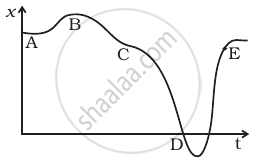
- The particle was released from rest at t = 0.
- At B, the acceleration a > 0.
- At C, the velocity and the acceleration vanish.
- Average velocity for the motion between A and D is positive.
- The speed at D exceeds that at E.
Concept: undefined >> undefined
Give example of a motion where x > 0, v < 0, a > 0 at a particular instant.
Concept: undefined >> undefined
An object falling through a fluid is observed to have acceleration given by a = g – bv where g = gravitational acceleration and b is constant. After a long time of release, it is observed to fall with constant speed. What must be the value of constant speed?
Concept: undefined >> undefined
In a two dimensional motion, instantaneous speed v0 is a positive constant. Then which of the following are necessarily true?
Concept: undefined >> undefined
In a two dimensional motion, instantaneous speed v0 is a positive constant. Then which of the following are necessarily true?
Concept: undefined >> undefined
Motion in two dimensions, in a plane can be studied by expressing position, velocity and acceleration as vectors in cartesian co-ordinates A = `A_xhati + A_yhatj` where `hati` and `hatj` are unit vector along x and y directions, respectively and Ax and Ay are corresponding components of (Figure). Motion can also be studied by expressing vectors in circular polar co-ordinates as A = `A_rhatr + A_θhatθ` where `hatr = r/r = cos θhati + sin θj` and `hatθ = - sin θhati + cos θ hatj` are unit vectors along direction in which `r` and `θ` are increasing.
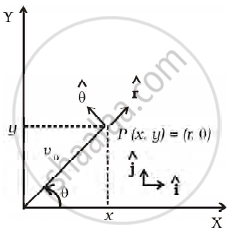
- Express `hati` and `hatj` in terms of `hatr` and `hatθ`
- Show that both `hatr` and `hatθ` are unit vectors and are perpendicular to each other.
- Show that `d/(dt) (hatr) = ωhatθ` where `θ = (dθ)/(dt)` and `d/(dt) (hatθ) = - ωhatr`
- For a particle moving along a spiral given by `t = aθhatr`, where a = 1 (unit), find dimensions of ‘a’.
- Find velocity and acceleration in polar vector representation for particle moving along spiral described in (d) above.
Concept: undefined >> undefined
Two billiard balls A and B, each of mass 50 g and moving in opposite directions with speed of 5 ms–1 each, collide and rebound with the same speed. If the collision lasts for 10–3 s, which of the following statements are true?
- The impulse imparted to each ball is 0.25 kg ms–1 and the force on each ball is 250 N.
- The impulse imparted to each ball is 0.25 kg ms–1 and the force exerted on each ball is 25 × 10–5 N.
- The impulse imparted to each ball is 0.5 Ns.
- The impulse and the force on each ball are equal in magnitude and opposite in direction.
Concept: undefined >> undefined
A girl riding a bicycle along a straight road with a speed of 5 ms–1 throws a stone of mass 0.5 kg which has a speed of 15 ms–1 with respect to the ground along her direction of motion. The mass of the girl and bicycle is 50 kg. Does the speed of the bicycle change after the stone is thrown? What is the change in speed, if so?
Concept: undefined >> undefined
A 100 kg gun fires a ball of 1 kg horizontally from a cliff of height 500 m. It falls on the ground at a distance of 400 m from the bottom of the cliff. Find the recoil velocity of the gun. (acceleration due to gravity = 10 ms–2)
Concept: undefined >> undefined
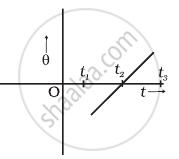
The variation of angular position θ, of a point on a rotating rigid body, with time t is shown in figure. Is the body rotating clock-wise or anti-clockwise?
Concept: undefined >> undefined
Two cylindrical hollow drums of radii R and 2R, and of a common height h, are rotating with angular velocities ω(anti-clockwise) and ω(clockwise), respectively. Their axes, fixed are parallel and in a horizontal plane separated by (3R + δ). They are now brought in contact (δ → 0).
- Show the frictional forces just after contact.
- Identify forces and torques external to the system just after contact.
- What would be the ratio of final angular velocities when friction ceases?
Concept: undefined >> undefined
The temperature of a wire is doubled. The Young’s modulus of elasticity ______.
Concept: undefined >> undefined
