Advertisements
Advertisements
प्रश्न
Motion in two dimensions, in a plane can be studied by expressing position, velocity and acceleration as vectors in cartesian co-ordinates A = `A_xhati + A_yhatj` where `hati` and `hatj` are unit vector along x and y directions, respectively and Ax and Ay are corresponding components of (Figure). Motion can also be studied by expressing vectors in circular polar co-ordinates as A = `A_rhatr + A_θhatθ` where `hatr = r/r = cos θhati + sin θj` and `hatθ = - sin θhati + cos θ hatj` are unit vectors along direction in which `r` and `θ` are increasing.
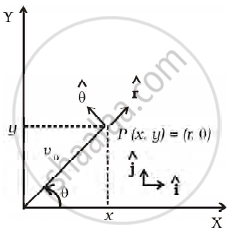
- Express `hati` and `hatj` in terms of `hatr` and `hatθ`
- Show that both `hatr` and `hatθ` are unit vectors and are perpendicular to each other.
- Show that `d/(dt) (hatr) = ωhatθ` where `θ = (dθ)/(dt)` and `d/(dt) (hatθ) = - ωhatr`
- For a particle moving along a spiral given by `t = aθhatr`, where a = 1 (unit), find dimensions of ‘a’.
- Find velocity and acceleration in polar vector representation for particle moving along spiral described in (d) above.
Advertisements
उत्तर
a. Given, unit vetor `hatr = cos θhati + sinθhatj` ......(i)
`hatθ = - sin θ hati + cos θhatj` ......(ii)
Multiplying equation (i) by sin θ and equation (ii) with cos θ and adding
`hatr sin θ + hatθ cos θ = sin θ. cos θhati + sin^2 θhatj + cos^2 θhatj - sinθ. cos θhati`
= `hatj (cos^2 θ + sin^2 θ) = hatj`
⇒ `hatr sin θ + θ cos θ = hatj`
By equation (i) `xx cos θ` - equation (ii) `xx sin θ`
`n(hatr cos θ - hatθ sin θ) = hati`
b. `hatr.hatθ = (cos θhati + sinθhatj) . (- sin θhati + cosθhatj)`
= `- cos θ . sin θ + sin θ . cos θ`
= 0
⇒ θ = 90° Angle between `hatr` and `hatθ`
c. Given, `hatr = cos θhati + sinθhatj`
`(dhatr)/(dt) = d/(dt) (cos θhati + sinθhatj)`
= `- sin θ . (dθ)/(dt) hati + cos θ . (dθ)/(dt) hatj`
= `ω [- sin θhati + cos θhatj]` ......`[∵ θ = (dθ)/(dt)]`
d. Given, `r = aθhatr`, here, writing dimensions `[r] = [a][θ][hatr]`
⇒ L = [a] % 1
⇒ L = [M0L1T0]
e. Given, a = 1 unit `r = θhatr = θ[cos θhati + sin θhatj]`
Velocity, v = `(dr)/(dt) = (dθ)/(dt) hatr + θ d/(dt) hatr = (dθ)/(dt) hatr + θ d/(dt) [(cos θhati + sinθhatj)]`
= `(dθ)/(dt) hatr + θ [(- sin hati + cos θ hatj) (dθ)/(dt)]`
= `(dθ)/(dt) hatr + θ hatθ ω`
= `ωhatr + ω θhatθ`
Acceleration, a = `d/(dt) [ωhatr + ωθhatθ]`
= `d/(dt) [(dθ)/(dt) hatr + (dθ)/(dt) (θhatθ)]`
= `(d^2θ)/(dt^2) hatr + (dθ)/(dt) * (dhatr)/(dt) + (d^2θ)/(dt^2) θhatθ + (dθ)/(dt) d/(dt) (θhatθ)`
= `(d^2θ)/(dt^2) hatr + ω[-sin θhati + sinθhatj] + (d^2θ)/(dt^2) θhatθ + (ωd)/(dt) (θhatθ)`
= `(d^2θ)/(dt^2) hatr + ω^2hatθ + (d^2θ)/(dt^2) xx θhatθ + ω^2hatθ + w^2θ (-hatr) ((d^2θ)/(dtv^2) - ω^2)hatr + (2ω^2 + (d^2θ)/(dt^2) θ)θ`
APPEARS IN
संबंधित प्रश्न
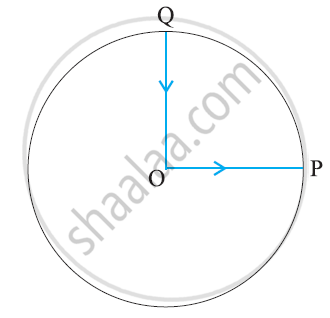
A cyclist starts from the centre O of a circular park of radius 1 km, reaches the edge P of the park, then cycles along the circumference, and returns to the centre along QO as shown in figure. If the round trip takes 10 min, what is the (a) net displacement, (b) average velocity, and (c) average speed of the cyclist?
For any arbitrary motion in space, state whether the following statement is true:
`"a"_"average"=["v"("t"_2) - "v"("t"_1)]/("t"_2 - "t"_1)`
(The ‘average’ stands for average of the quantity over the time interval t1 to t2)
For any arbitrary motion in space, state whether the following statement is true:
`"V"_"average"` = `(1/2)("v"("t"_1) + "v"("t"_2))`
(The ‘average’ stands for average of the quantity over the time interval t1 to t2)
For any arbitrary motion in space, state whether the following statement is true:
`"V"_"average"` = [r(t2) - r(t1) ] /(t2 – t1)
For any arbitrary motion in space, state whether the following statement is true:
`"r"("t") = "r"(0) + "v"(0)"t" + 1/2 "a" "t"^2 `
(The ‘average’ stands for average of the quantity over the time interval t1 to t2)
In a two dimensional motion, instantaneous speed v0 is a positive constant. Then, which of the following are necessarily true?
In a two dimensional motion, instantaneous speed v0 is a positive constant. Then which of the following are necessarily true?
In a two dimensional motion, instantaneous speed v0 is a positive constant. Then which of the following are necessarily true?
Two balls A and B are placed at the top of 180 m tall tower. Ball A is released from the top at t = 0 s. Ball B is thrown vertically down with an initial velocity 'u' at t = 2 s. After a certain time, both balls meet 100 m above the ground. Find the value of 'u' in ms-1. [use g = 10 ms -2]:
A small toy starts moving from the position of rest under constant acceleration. If it travels a distance of 10 minutes, the distance travelled by the toy in the next will be ______.
Two vectors `vec"A"` and `vec"B"` have equal magnitudes. If magnitude of `vec"A"` + `vec"B"` is equal to two times the magnitude of `vec"A"` - `vec"B"`, then the angle between `vec"A"` and `vec"B"` will be :
The position of a particle is x - y plane is described by the variables x = at3 and y = 2at. Then the acceleration of the particle ______.
A displacement vector, at an angle of 30° with y-axis has an x-component of 10 units. Then the magnitude of the vector is ______.
A stone is dropped from the top of the tower and travels 24.5 m in the last second of its journey. The height of the tower is ______.
(g = 9.8 m/s2)
The displacement s of a particle depends on time t according to the following relation `s = 1/3t^3 - t^2 + t`. The velocity and displacement of the particle at the instant when its acceleration is zero, are respectively ______.
