Please select a subject first
Advertisements
Advertisements
Read the given source and answer the questions that follow:
|
Language Diversity of India How many languages do we have in India? The answer depends on how one counts it. The latest information that we have is from the Census of India held in 2011. This census recorded more than 1300 distinct languages which people mentioned as their mother tongues. These languages were grouped together under some major languages. For example languages like Bhojpuri, Magadhi, Bundelkhandi, Chhattisgarhi, Rajasthani and many others were grouped together under 'Hindi'. Even after this grouping, the Census found 121 major languages. Of these 22 languages are now included in the Eighth Schedule of the Indian Constitution and are therefore called 'Scheduled Languages'. Others are called 'Non-Scheduled Languages'. In terms of languages, India is perhaps the most diverse country in the world. |
- Explain the importance of language diversity in India.
- Differentiate between Scheduled and Non-Scheduled Languages.
- The fusion of languages has united the country into one cultural entity.' Explain the statement with an example.
Concept: undefined >> undefined
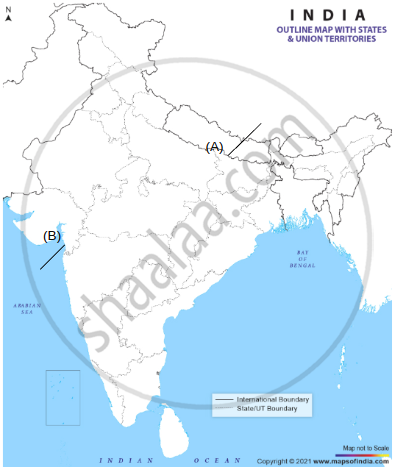
- Two places A and B have been market on the given political outline map of India. Identify them with the help of given information and write their correct names on the lines drawn near them.
- The place where Mahatma Gandhi started Satyagraha for Indigo peasants.
- The place where session of Indian National Congress held in December, 1920.
- On the same outline map of India locate and label any three of the following with suitable symbols.
- Tehri Dam
- Naraura Atomic Power Station
- Pune Software Technology Park
- Haldia Sea Port

Concept: undefined >> undefined
Advertisements
Analyse the characteristics of India's National Water Policy 2002.
Concept: undefined >> undefined
Analyse the main aims of 'Jal Kranti Abhiyan (2015-16) in India.
Concept: undefined >> undefined
When many countries of Europe came together to form the European Union, ______ was chosen as its headquarters.
Concept: undefined >> undefined
Evaluate the impacts of opening foreign trade on the global economy by identifying the appropriate statements among the following options:
- The choice of goods in the markets increase.
- Producers from two countries closely compete against each other despite the distance between their locations.
- Foreign trade thus results in connecting the markets or integration of markets in different countries.
- The quality of the product is always good.
Concept: undefined >> undefined
Provide evidence to support the claim that print culture had a significant impact on the social lives of women in India?
Concept: undefined >> undefined
Mr Pawan, a village head wanted to create more job opportunities to increase the income of the people of his village under MNREGA act, Suggest any three activities, so that Mr Pawan could initiate in his village.
Concept: undefined >> undefined
Compare Tables “A” & “B” and answer the question given below.
| Table- A | |||
| Share of Sectors in GDP in % | |||
| Year | Tertiary | Secondary | Primary |
| 1973-74 | 50 | 10 | 40 |
| 2013-14 | 68 | 21 | 11 |
| Table- B | |||
| Share of Sectors in employment in % | |||
| Year | Tertiary | Secondary | Primary |
| 1977-78 | 18 | 11 | 71 |
| 2017-18 | 31 | 25 | 44 |
A remarkable fact about India is that while there has been a change in the share of the three sectors in GDP, a similar shift has not taken place in employment. Why didn’t a similar shift out of primary sector happen in case of employment? Substantiate your answer.
Concept: undefined >> undefined
Read the source given below and answer the questions that follow:
|
It is said of “passive resistance” that it is the weapon of the weak, but the power which is the subject of this article can be used only by the strong. This power is not passive resistance; indeed, it calls for intense activity. The movement in South Africa was not passive but active… 'Satyagraha is not physical force. A satyagrahi does not inflict pain on the adversary; he does not seek his destruction … In the use of satyagraha, there is no ill will whatever. 'Satyagraha is pure soul force. Truth is the very substance of the soul. That is why this force is called satyagraha. The soul is informed with knowledge. In it burns the flame of love.… Nonviolence is the supreme dharma …' It is certain that India cannot rival Britain or Europe in force of arms. The British worship the war god and they can all of them become, as they are becoming, bearers of arms. The hundreds of millions in India can never carry arms. They have made the religion of non-violence their own … In his famous book Hind Swaraj (1909) Mahatma Gandhi declared that British rule was established in India, with the cooperation of Indians, and had survived only because of this cooperation. If Indians refused to cooperate, British rule will collapse within a year. |
- Why did Gandhiji say that passive resistance is not the weapon of the weak?
- “Satyagraha is pure soul-force.” Substantiate this statement in 20 words.
- What according to Mahatma Gandhi is the best weapon to use to collapse British rule in India?
Concept: undefined >> undefined
Read the source given below and answer the questions that follow:
|
For comparing countries, their income is considered to be one of the most important attributes. Countries with higher incomes are more developed than others with less income. This is based on the understanding that more income means more of all things that human beings need. Whatever people like, and should have, they will be able to get with greater income. So, greater income itself is considered to be one important goal. Now, what is the income of a country? Intuitively, the income of the country is the income of all the residents of the country. This gives us the total income of the country. However, for comparison between countries, total income is not such a useful measure. Since, countries have different populations, comparing total income will not tell us what an average person is likely to earn. Are people in one country better off than others in a different country? Hence, we compare the average income which is the total income of the country divided by its total population. The average income is also called per capita income. In World Development Reports, brought out by the World Bank, this criterion is used in classifying countries. Countries with per capita income of US \[\ce{$}\]49,300 per annum and above in 2019, are called high-income or rich countries and those with per capita income of US \[\ce{$}\]2500 or less are called low-income countries. The rich countries, excluding countries of the Middle East and certain other small countries are generally called developed countries.
|
Concept: undefined >> undefined
Read the given case and answer the questions that follow:
|
Mahatma Gandhi's thoughts on Satyagraha 'It is said of "passive resistance" that it is the weapon of the weak, but the power which is the subject of this article can be used only by the strong. This power is not passive resistance; indeed it calls for intense activity. The movement in South Africa was not passive but active ....' 'Satyagraha is not a physical force. A satyagrahi does not inflict pain on the adversary, he does not seek his destrudion ... In the use of satyagraha, there is no ill-will whatever.' 'Satyagraha is pure soul-force. Truth is the very substance of the soul. That's why this force is called satyagraha. The soul is informed with knowledge. In it burns the flame of love ... Non-violence is the supreme dharma.' 'It is certain that India cannot rival Britain or Europe in force of arms. The British worship the war god and they can all become, bearers of arms. The hundreds of millions in India can never carry arms. They have made the religion of non-violence their own....' |
- What type of movement Gandhiji organised in South Africa?
- Why is satyagraha considered as pure soul- force?
- How has Gandhiji described passive resistance?
Concept: undefined >> undefined
In which one of the following institutions in India was a system of reservation for women made by amending the Constitution In 1992?
Concept: undefined >> undefined
Read the arguments given the favour of power sharing and choose the correct option.
- Reduce the likelihood of bias.
- Barricades the decision-making process
- Accommodates diversities
- Increases the participation of people in power
Concept: undefined >> undefined
Which one of the following statements best describes the meaning of 'Globalisation'?
Concept: undefined >> undefined
“Foreign trade results in connecting the markets in different countries.” Support the statement in the context of globalisation.
Concept: undefined >> undefined
(a) Two places, 'A' and 'B', have been marked on the given political outline map of India. Identify them with the help of the following information and write their correct names on the lines drawn near them:
- The place where Gandhiji started Satyagraha for indigo peasants. (1)
- The place where Gandhiji broke the Salt Law. (1)
(b) On the same political outline map of India, locate and label any three of the following with suitable symbols: (3)
- Naharkatiya - Oil field
- Talcher - Major Coal Mines
- Narora - Atomic Power Plant
- Tuticorin - Major Sea Port
Concept: undefined >> undefined
Read the given text and answer the following questions:
| ‘It is said of “passive resistance” that it is the weapon of the weak, but the power which is the subject of this article can be used only by the strong. This power is not passive resistance; indeed, it calls for intense activity. The movement in South Africa was not passive but active … ‘Satyagraha is not physical force. A satyagrahi does not inflict pain on the adversary; he does not seek his destruction … In the use of satyagraha, there is no ill-will whatever. ‘Satyagraha is pure soul-force. Truth is the very substance of the soul. That is why this force is called satyagraha. The soul is informed with knowledge. In it burns the flame of love. … Nonviolence is the supreme dharma …‘It is certain that India cannot rival Britain or Europe in force of arms. The British worship the war-god and they can all of them become, as they are becoming, bearers of arms. The hundreds of millions in India can never carry arms. They have made the religion of non-violence their own ...’ |
- Why did Gandhiji consider nonviolence as supreme dharma?
- How was Gandhian satyagraha taken by the people who believed in his philosophy?
- Why was Gandhian satyagraha considered as a novel way to resist injustice?
Concept: undefined >> undefined
Suppose your parents want to purchase gold jewellery along with you, then which logo will you look for on the jewellery?
Concept: undefined >> undefined
Why has the ‘National Manufacturing Competitiveness Council’ been set up?
Concept: undefined >> undefined
