Please select a subject first
Advertisements
Advertisements
‘There is a hole in the ozone layer’. What do you understand by this?
Concept: Ozone Layer Depletion
Agricultural water pollution and Shipping water pollution.
Concept: Environmental Issues >> Water Pollution
The depletion of the ozone layer is due to ______.
Concept: Ozone Layer Depletion
Suggest measures to conserve the forests.
Concept: Deforestation and Its Causes
Observe the graph and select the correct option:
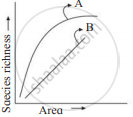
Concept: Patterns of Biodiversity
Enlist any six categories into which a given species is placed once it has been thoroughly evaluated by IUCN.
Concept: Loss of Biodiversity
Write a short note on the greenhouse effect.
Concept: Environmental Issues
How many Biodiversity hotspots have been identified around the world?
Concept: Loss of Biodiversity
______ was signed in 1987 to control emission of ozone depleting substances.
Concept: Ozone Layer Depletion
Lesser variation in biomass production over a period of time is called ______.
Concept: Patterns of Biodiversity
Rivet Popper Hypothesis is an analogy to explain the significance of ______.
Concept: Patterns of Biodiversity
Which device is used to clean both dust and gases from polluted air?
Concept: Prevention and Control of Air Pollution
What is ex-situ conservation?
Concept: Loss of Biodiversity
Mention any two places where the ex-situ conservation is undertaken.
Concept: Loss of Biodiversity
Iron (z=26) is highly ferromagnetic. Explain.
Concept: Properties of Solids: Magnetic Properties
Silver crystallises in FCC structure. If density of silver is 10.51 gcm-3, calculate the volume of unit cell. [Atomic mass of slive (Ag) = 108 gm-1]
Concept: Calculations Involving Unit Cell Dimensions
p - type semi-conductors are made by mixing silicon with impurities of ______.
Concept: Properties of Solids: Electrical Properties >> Applications of n-type and p-type Semiconductors
Explain impurity defect in stainless steel with diagram
Concept: Imperfections in Solids - Introduction
Niobium crystallises as body centred cube (BCC) and has density of 8.55 Kg / dm-3 . Calculate the attomic radius of niobium.
(Given : Atomic mass of niobium = 93).
Concept: Calculations Involving Unit Cell Dimensions
In a semiconductor, acceptor impurity is.................................
- antimony
- indium
- phosphorous
- arsenic
Concept: Properties of Solids: Electrical Properties >> Applications of n-type and p-type Semiconductors
