Advertisements
Advertisements
Given below is a diagram representing a stage during the mitotic cell division. Study thediagram and answer the following questions: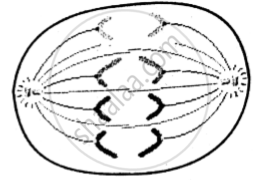
Is it a plant or an animal cell? Give a reason to support your answer.
Concept: Significance of Mitosis
Given below is a diagram representing a stage during the mitotic cell division. Study thediagram and answer the following questions: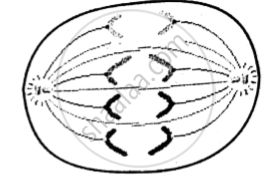
Draw a neat, labelled diagram of the stage which follows the one shown in the diagram.
Concept: Significance of Mitosis
How many chromosomes will each daughter cell have after the completion of the above division? 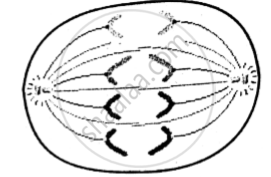
How many chromosomes will each daughter cell have after the completion of the above division?
Concept: Significance of Mitosis
Concept: Deoxyribonucleic Acid (DNA)
Differentiate between cytokinesis and karyokinesis.
Concept: Cell Division: an Essential Life Process
Differentiate between genotype and phenotype.
Concept: Genes and Genetic
Haploid number of chromosomes are found in ______.
Concept: Cell Division: an Essential Life Process
Expand the abbreviation - DNA.
Concept: Deoxyribonucleic Acid (DNA)
The diagram given below represents a stage in mitosis.

- Identify the stage given above.
- Give one reason to support your answer in (a).
- Mention the number of chromosomes given in the diagram.
Concept: Mitosis > Karyokinesis (Division of Nucleus)
The diagram given below represents a stage in mitosis.
- Identify the stage given above.
- Give one reason to support your answer in (a).
- Mention the number of chromosomes given in the diagram.
Concept: Mitosis > Karyokinesis (Division of Nucleus)
A pair of corresponding chromosomes of the same shape, size and one from each parent is called ______.
Concept: Genes and Genetic
Name the following:
The nitrogenous base that pairs with adenine.
Concept: Chromatin
Differentiate between genotype and phenotype.
Concept: Genes and Genetic
The sex chromosome in a human ovum is ______.
Concept: Sex Determination
A zygote which has Y chromosome inherited from the father will develop into a ______.
Concept: Sex Determination
Given below is a schematic representation of the inheritance of the shape of the seeds of garden peas. Answer the questions that follow:
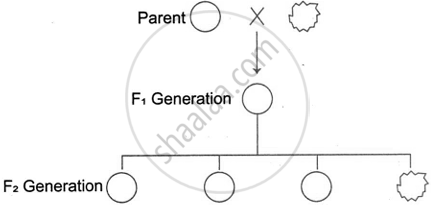
- Which is the dominant and recessive allele of the trait?
- What does the ratio 3 : 1 in the F2 generation represent?
- State Mendel's Law of Dominance.
Concept: Monohybrid Cross
A pair of corresponding chromosomes of the same shape, size and one from each parent is called ______.
Concept: Genes and Genetic
The process by which root hairs absorb water from the soil.
Concept: Concept of Absorption by the Roots
Active Transport and Diffusion [Significance in plants]
Concept: Absorption and Conduction of Water and Minerals >> Active Transport
The diagram given below represents a plant cell after being placed in a strong sugar solution. Study the diagram and answer the questions that follow:

- What is the state of the cell shown in the diagram?
- Name the structure that acts as a selectively permeable membrane.
- Label the parts numbered 1 to 4 in the diagram.
- How can the above cell be brought back to its original condition? Mention the scientific term for the recovery of the cell.
- State any two features of the above plant cell which is not present in animal cells.
Concept: Turgidity and Flaccidity (Plasmolysis)
