Advertisements
Advertisements
Expand the following biological abbreviation:
TSH
Concept: Human Endocrine Glands and Hormones >> Thyroid Gland
What are tropic hormones?
Concept: Human Endocrine Glands and Hormones >> Pituitary Gland or Hypophysis Gland
Give one example of a Tropic hormone.
Concept: Human Endocrine Glands and Hormones >> Pituitary Gland or Hypophysis Gland
Expand the abbreviation ADH.
Concept: Human Endocrine Glands and Hormones >> Pituitary Gland or Hypophysis Gland
Write the exact location of the following gland:
Thyroid
Concept: Human Endocrine Glands and Hormones >> Thyroid Gland
Name the following:
The structure which connects the placenta and the foetus.
Concept: Placenta (Growth) in Human
The diagram given below represents a system in the human body. Study the diagram and answer the following questions:
- Identify the system.
- Label the parts marked 5 and 6.
- Name the two hormones secreted by 1.
- Mention the number and the name of the part involved in fertilization and implantation from the above diagram.
- Mention the surgical methods of contraception in:
- Human males.
- Human females.
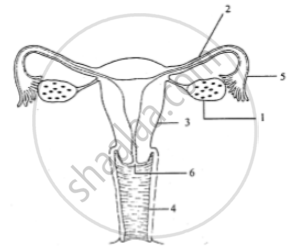
Concept: The Female Reproductive System
The onset of menstruation in a human female is called ______.
Concept: Menstrual Cycle (Ovarian Cycle)
Write any two objectives of Swachh Bharat Abhiyan.
Concept: Control of Pollution
Name the following:
The organelle that forms the aster during cell division.
Concept: Cell Organelles >> Centrosome and Centrioles
Why are RBCs efficient in their functions though they lack nucleus and mitochondria?
Concept: Cell Organelles >> Mitochondria - “Power House of the Cell”
Name the following.
The exchange of chromatid parts between the maternal and the paternal chromatids of a pair of homologous chromosomes during meiosis.
Concept: Significance of Mitosis
The diagram given below represents a certain stage of mitosis:
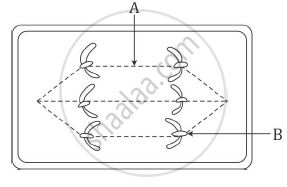
- Identify the stage of cell division.
- Name the parts labelled A and B.
- What is the unique feature observed in this stage?
- How many daughter cells are formed from this type of cell division?
Concept: Mitosis > Karyokinesis (Division of Nucleus)
The diagram given below represents a certain stage of mitosis:
- Identify the stage of cell division.
- Name the parts labelled A and B.
- What is the unique feature observed in this stage?
- How many daughter cells are formed from this type of cell division?
Concept: Mitosis > Karyokinesis (Division of Nucleus)
Correct the following statement by changing the underlined word:
Nitrogen bonds are present between the complementary nitrogenous bases of DNA.
Concept: Deoxyribonucleic Acid (DNA)
The diagram given below represents a stage during cell division.
Study the same and answer the questions that follow:

- Identify whether it is a plant cell or an animal cell. Give a reason in support of your answer.
- Name the stage depicted in the diagram. What is the unique feature observed in this stage?
- Name the type of cell division that occurs during:
- Replacement of old leaves by new ones
- Formation of gametes
- What is the stage that comes before the stage shown in the diagram?
- Draw a neat, labelled diagram of the stage mentioned in (iv) above keeping the chromosome number constant.
Concept: Mitosis > Karyokinesis (Division of Nucleus)
The diagram given below represents a stage during cell division.
Study the same and answer the questions that follow:
- Identify whether it is a plant cell or an animal cell. Give a reason in support of your answer.
- Name the stage depicted in the diagram. What is the unique feature observed in this stage?
- Name the type of cell division that occurs during:
- Replacement of old leaves by new ones
- Formation of gametes
- What is the stage that comes before the stage shown in the diagram?
- Draw a neat, labelled diagram of the stage mentioned in (iv) above keeping the chromosome number constant.
Concept: Mitosis > Karyokinesis (Division of Nucleus)
Name the three components of a nucleotide.
Concept: Chromatin
Synthesis phase in the cell cycle is called so for the synthesis of more of ______.
Concept: Cell Cycle - "Divide, Grow and Redivide"
Given below is a diagram representing a stage during the mitotic cell division. Study thediagram and answer the following questions: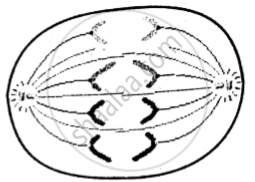
Identify the stage by giving a suitable reason.
Concept: Significance of Mitosis
