Advertisements
Advertisements
Why did Mahatma Gandhi start his historic march to Dandi?
Concept: Impact of the Civil Disobedience Movement
The period between 1920 to 1947 was marked with major events and reforms that finally led to us to our independence. In this context, answer the following questions:
State three provisions of the Gandhi Irwin pact as a result of the Civil Disobedience Movement.
Concept: Impact of the Civil Disobedience Movement
Why was the Congress session held at Lahore significant to the National Movement?
Concept: Factors Leading Upto Civil Disobedience Movement
Through various national movements, Gandhiji mobilised public support to win freedom for India. In this context, state the following:
The name was given to the uprising of 1942. Two reasons for launching this mass uprising.
Concept: Impact of the Civil Disobedience Movement
Who is regarded as the political guru of Mahatma Gandhi? Give a reason for him being considered as the Mahatma’s guru.
Concept: Impact of the Civil Disobedience Movement
With reference to the growth of National consciousness in India, explain each of the following:
The impact of the Swadeshi and the Boycott Movement.
Concept: Impact of the Civil Disobedience Movement
In 1930, Mahatma Gandhi’s demands were rejected by the British, as a result of which he launched the Civil Disobedience Movement. In this context, explain the following:

- Name the famous march undertaken by Gandhiji. Where did he begin this march? State two of its features.
- How was this Movement different from the Non-Cooperation Movement?
- Explain briefly how did Mahatma Gandhi try to promote Hindu-Muslim unity from the Rowlatt Satyagraha to the Third Round Table Conference.
Concept: Impact of the Civil Disobedience Movement
In 1930 Mahatma Gandhi's demands were rejected by the British, as a result of which he launched the Civil Disobedience Movement. In this context explain the following:
The Gandhi-Irwin Pact as a consequence of this Movement.
Concept: Impact of the Civil Disobedience Movement
In 1930 Mahatma Gandhi's demands were rejected by the British, as a result of which he launched the Civil Disobedience Movement. In this context explain the following
Significance of the Second Round Table Conference.
Concept: Impact of the Civil Disobedience Movement
Mention any one provision each of the Gandhi-Irwin Pact signed in 1931.
Concept: Impact of the Civil Disobedience Movement
In the Nagpur session, 1920, the Congress ratified the resolution to launch the Non-Cooperation movement under the leadership of Gandhiji. In this context:
What do you understand by the term Non-Cooperation?
Concept: Impact of the Civil Disobedience Movement
In the Nagpur session, 1920, the Congress ratified the resolution to launch the Non-Cooperation movement under the leadership of Gandhiji. In this context:
What were the objectives which the movement sought to achieve?
Concept: Impact of the Civil Disobedience Movement
Name the leaders of the Khilafat movement that was launched in India to champion the cause of the Caliph of Turkey.
Concept: Causes that Led to the Non-Cooperation Movement
With reference to the picture given below, answer the following questions :

State any four impacts of the movement.
Concept: Suspension of the Non-Cooperation Movement
With reference to the picture given below, answer the following questions:

- Identify the Memorial built for those who were killed in this incident.
- Where did this incident take place?
- Name the movement launched by Gandhi in 1920 as a consequence.
Concept: Causes that Led to the Non-Cooperation Movement
With reference to the picture given below, answer the following questions :

Explain briefly the reason for the suspension of this particular movement Gandhi in 1922.
Concept: Suspension of the Non-Cooperation Movement
With reference to the National Movement from 1930 to 1947, answer the following :
State any three features of the Programmed of the Civil Disobedience Movement launched in 1930.
Concept: Factors Leading Upto Civil Disobedience Movement
With reference to the National Movement from 1930 to 1947, answer the following :
What was the significance of the Second Round Table Conference held in 1931?
Concept: Impact of the Civil Disobedience Movement
People protested against the ______ because it had seven British members and no Indian representation.
Concept: Factors Leading Upto Civil Disobedience Movement
Look at the picture given below and answer the following question:
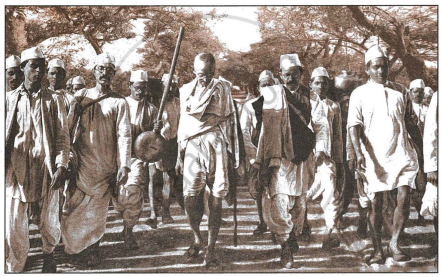
Name the march being led by Gandhiji in the above picture.
Concept: Civil Disobedience Movement (1930-1934)
