Advertisements
Advertisements
Give appropriate biological/technical terms for the following:
The mild chemical substance which when applied on the body kills germs.
Concept: First Aid and Emergency Action
Give appropriate biological/technical terms for the following:
The antiseptic substance in tears.
Concept: First Aid and Emergency Action
Rewrite the correct form of the statement: Formalin is an example of an Antiseptic
Concept: First Aid and Emergency Action
Rewrite the correct form of the statement: Sulphadiazine is an example of an Antiseptic.
Concept: First Aid and Emergency Action
The antibiotic penicillin is obtained from
A. Protozoan
B. Bacteria
C. Virus
D. Fungus
Concept: First Aid and Emergency Action
Differentiate between Disinfectant and Antiseptic (definition)
Concept: First Aid and Emergency Action
Name the disease for which the following types of vaccines are given:
Salk’s vaccine
Concept: First Aid and Emergency Action
Name the disease for which the following types of vaccines are given:
BCG
Concept: First Aid and Emergency Action
Give one example of An antibiotic
Concept: First Aid and Emergency Action
Expand the following biological abbreviations: DPT
Concept: First Aid and Emergency Action
Aqueous humour, Vitreous humour, lris, Central canal
Concept: Blood Circulatory System
Give biological reasons for the following statements:
The left ventricle of the heart has a thicker wall than the right ventricle.
Concept: Blood Circulatory System
The diagram given below represents a section of the human heart. Answer the questions that follow:
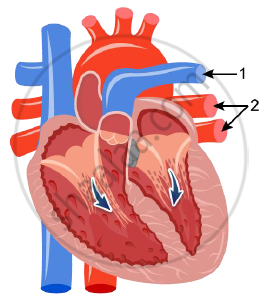
- Which parts of heart are in the diastolic phase? Give a reason to support your answer.
- Label the parts numbered 1 and 2 in the diagram. What type of blood flows through them?
- What causes the heart sounds ‘LUBB’ and ‘DUP’?
- Name the blood vessels that supply oxygenated blood to the heart muscles.
- Draw neat labelled diagrams of a cross section of an artery and a vein.
Concept: Blood Circulatory System
State the exact location of the Chordae tendinae
Concept: Blood Circulatory System
Differentiate between LUBB and DUP (names of the valves whose closure produce the sound)
Concept: Blood Circulatory System
the Biological/technical term for The vein which drains the blood from the intestine to the liver.
Concept: Blood Circulatory System
the Biological/technical term for Blood vessels carrying blood to the left atrium.
Concept: Blood Circulatory System
The vein that carries oxygenated blood.
Concept: Blood Circulatory System
fill in the blanks with suitable functions: Eustachian Tube and ______
Concept: Blood Circulatory System
The diagram given below represents the human heart in one phase of its functions. Study the diagram carefully and answer the questions that follow:
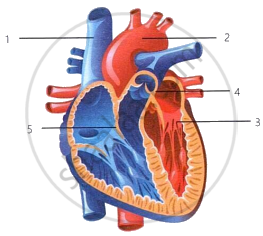
- Name the phase.
- Which part of the heart is contracting in this phase? Give a reason to support your answer.
- Name the parts labelled 1 to 4.
- What type of blood flows through 2?
- State the function of the part numbered ‘5’.
- Name the membrane that covers the heart.
Concept: Blood Circulatory System
