Please select a subject first
Advertisements
Advertisements
Figures (A), (B) and (C) given below represent different types of Demand curves.
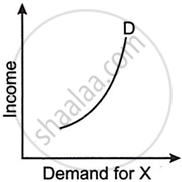 |
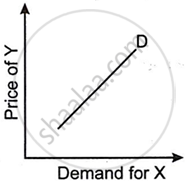 |
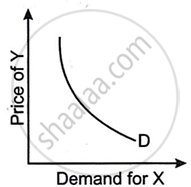 |
| (A) | (B) | (C) |
What kind of goods do each of these Demand curves represent? Give a reason for each of the curves.
Concept: Demand Curve
Draw a straight-line demand curve joining both the axes. Indicate the following on the demand curve.
Elasticity of demand is equal to zero
Concept: Demand Curve
Utility maximising consumers would like to decrease the consumption when ______.
Concept: Total Utility and Marginal Utility
Draw a diagram to show the elasticity of demand when it is greater than one.
Concept: Introduction to Elasticity of Demand
Find the value of additional investment made by the government when MPC = 0.5 and the increase in income (ΔY) = ₹ 1000.
Concept: Investment Multiplier
Explain the concept of deficient demand with the help of aggregate demand and aggregate supply curves. Discuss one physical and one monetary measure to correct it.
Concept: Concept of Aggregate Demand and Aggregate Supply
How is it determined by using Saving and Investment approach?
Concept: Concept of Aggregate Demand and Aggregate Supply
Discuss the mechanism of investment multiplier with the help of a numerical.
Concept: Investment Multiplier
Why is effective demand also known as expost demand?
Concept: Concept of Aggregate Demand and Aggregate Supply
The price of a good decreases from ₹100 to 80 per unit. If the price elasticity of demand for the good is 2 and the original quantity demanded is 30 units, calculate the new quantity demanded.
Concept: Introduction to Elasticity of Demand
Explain the concept of Investment Multiplier using a diagram.
Concept: Investment Multiplier
Mention any one difference between Induced investment and Autonomous investment.
Concept: Investment Multiplier
With reference to Simple Keynesian model, give the meaning of ex-ante demand.
Concept: Concept of Aggregate Demand and Aggregate Supply
If aggregate demand exceeds aggregate supply in a situation of full employment, what will be its impact on the economy?
Concept: Concept of Aggregate Demand and Aggregate Supply
Illustrate that the investment multiplier is inversely proportional to MPS.
Concept: Investment Multiplier
With the help of a diagram, determine the equilibrium level of output and income by using Aggregate demand and aggregate supply approach.
Concept: Concept of Aggregate Demand and Aggregate Supply
Medium of exchange and measure of value is ______.
Concept: Functions of Money
What is meant by the following function of the central bank?
Clearing house
Concept: Functions of Central Bank
The price of a mobile handset has risen in the market. But the dealers have not been able to increase the supply proportionately.
What will be the price elasticity of supply for the mobile handset? Draw the supply curve to indicate the type of elasticity.
Concept: Measurement of Elasticity of Supply > Percentage Method
Give two differences between intended supply and actual supply.
Concept: Determinants of Supply
