Advertisements
Advertisements
Mention the latitudinal and the longitudinal extent of India.
Concept: Locational Setting: Area, Latitudinal and Longitudinal Extent of India
State a difference between wet farming and dry farming. Give an example of each.
Concept: Wet and Dry Agriculture
Briefly explain any two strategies of the Second Green Revolution in India.
Concept: Wet and Dry Agriculture
State any two uses of manganese.
Concept: Power Resources
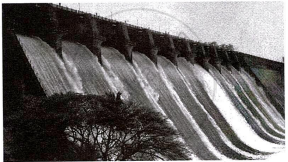
State any two conditions that are favourable for generation of power from the energy source shown above.
Concept: Power Resources
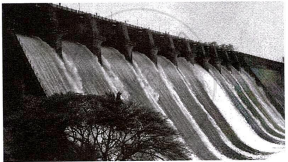
Briefly discuss the significance of this energy source in ensuring sustainable development.
Concept: Power Resources
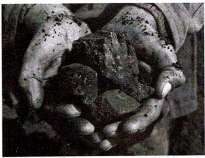
State any two disadvantages of above fossil fuel.
Concept: Power Resources
State any two advantages of tourism in India.
Concept: Concept of Tourism Industry
Why is the location of India in the Indian Ocean considered to be significant? Give two reasons.
Concept: Locational Setting: Area, Latitudinal and Longitudinal Extent of India
Give two reasons to explain why India is considered to be a subcontinent.
Concept: Locational Setting: Area, Latitudinal and Longitudinal Extent of India
Name one country which forms a frontier with India in the north.
Concept: Locational Setting: Area, Latitudinal and Longitudinal Extent of India
Mention any two differences between the Western Ghats and the Eastern Ghats.
Concept: Locational Setting: Area, Latitudinal and Longitudinal Extent of India
What is a subcontinent?
Concept: Locational Setting: Area, Latitudinal and Longitudinal Extent of India
On the outline map of India provided :
(a) Mark and name the major river which flows
(b) Mark and label the Thal Ghat gap in the Western Ghats.
(c) Shade and label the 68°7’E longitude.
(d) Mark the Khasi hills. industrial purposes.
(e) Shade and name the main area of Arid forests.
(f) Mark the capital city of Bihar.
(g) Shade and name the main state for the cultivation of jute.
(h) Mark the Kalpakkam Nuclear Power station.
(i) Mark and name the first oil refinery of India.
(j) Trade the North-South Corridor and name anyone terminal city. through Assam.
Note: All the map work, including legend (Index), should be done on the map sheet only.
Concept: Locational Setting: Area, Latitudinal and Longitudinal Extent of India
Mention the land area of India in kilometres.
Concept: Locational Setting: Area, Latitudinal and Longitudinal Extent of India
Give any three differences between Eastern Coastal lowland and Western Coastal lowland.
Concept: Locational Setting: Area, Latitudinal and Longitudinal Extent of India
Why was the state of Chhattisgarh created?
Concept: Locational Setting: Area, Latitudinal and Longitudinal Extent of India
Refer to the given outline Map of India, identify the correct option and write it in the answer booklet provided to you.

- The latitude of India marked R ______. (1)
- 68° 7'E
- 82° 30'E
- 8° 4'N
- 37° 6'N
- The riverine sea-port marked V is ______. (1)
- Mumbai
- Haldia
- Paradwip
- Kolkata
- The nuclear power station marked with ♦ is ______. (1)
- Kalpakkam
- Kaiga
- Rawatbhata
- Narora
- A centre of the sugar industry marked with a Δ is ______. (1)
- Ahmednagar
- Pune
- Mumbai
- Ahmedabad
Concept: Locational Setting: Area, Latitudinal and Longitudinal Extent of India
Indian Ocean is truly Indian. Explain this statement giving two reasons.
Concept: Locational Setting: Area, Latitudinal and Longitudinal Extent of India
What are the two negative impacts of the high percentage of the non-working population on the Indian economy?
Concept: Working Population
